Elastic Stability Coefficient θ
The elastic stability coefficient, θ, is defined as follows [1] :
|
|
Elastic stability coefficient |
|
|
Total point-in-time gravity load supported by the structure |
|
△0 |
Elastic lateral first-order story drift |
|
F0 |
Forces in a story |
|
hsx |
Story height |
|
Px |
Total unfactored vertical design load at and above level x |
|
Vx/△xe |
Story stiffness at level x, ratio of seismic shear force ( |
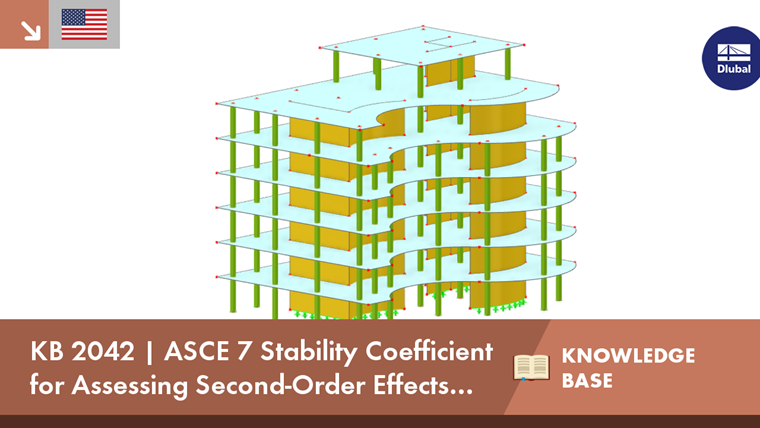
In the following, the procedure for calculating the stability coefficient is shown using the example of a reinforced concrete building with a main floor and six upper floors.
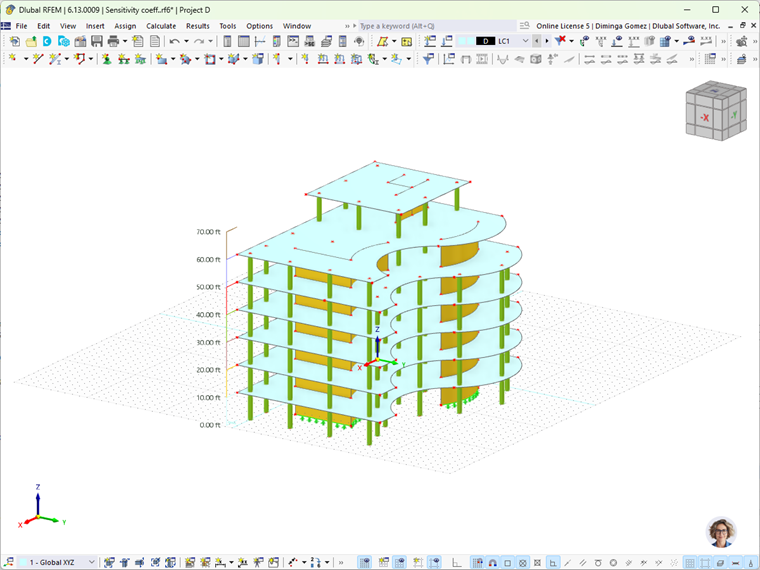
To calculate the stability coefficient, these add-ons are used:
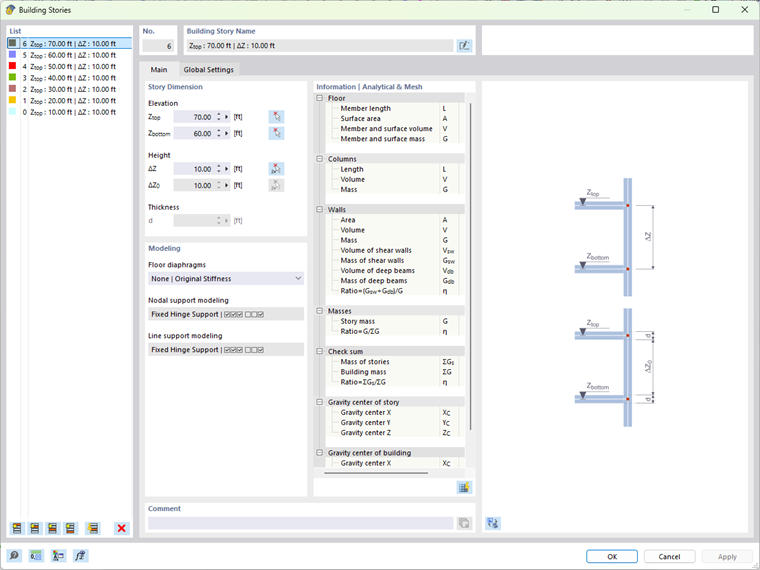
After modeling the building, it is necessary to define the stories using the Building Model add-on.
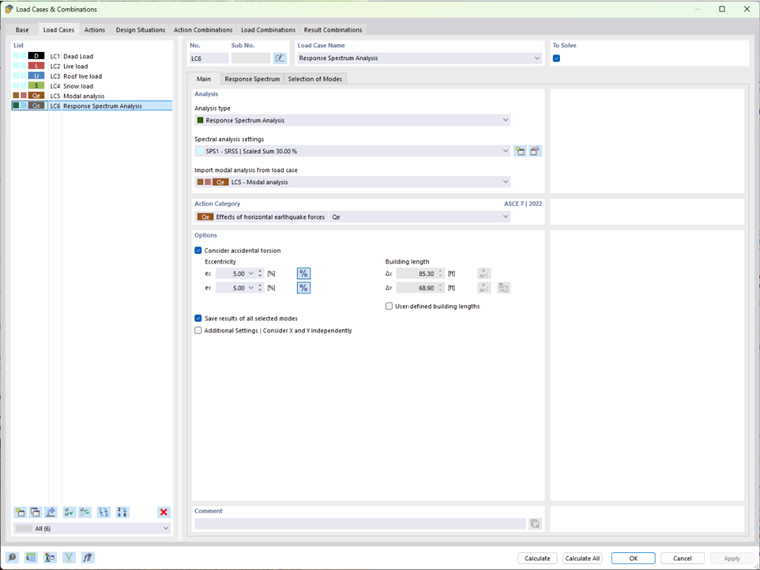
Then, a calculation according to the response spectrum analysis is required.
After the calculation, the most important parameters for the dynamic analysis can be found in the result tables of the Spectral analysis. In the Results by Story subcategory, you can also see the stability coefficient (Sensitivity Coefficient) of the individual stories.
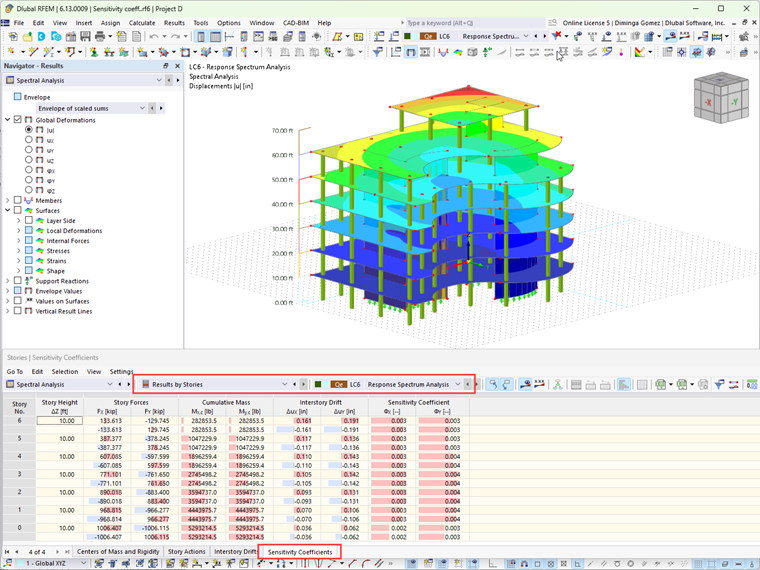
After the calculation of the stability coefficient of the interstory drift, the structure is classified for second-order analysis in accordance with ASCE 7-22, Section 12.8.7.
Second-Order Analysis Classification
1. Stability coefficient θ ≤ 0.1
The second-order (P-delta) effects are insignificant and do not need to be considered.
2. Stability coefficient 0.1 < θ ≤ θmax
The second-order analysis of the P-delta effects is to be considered for the whole structure. In this case, the first-order displacements and member forces are multiplied by 1 / (1 − θ). θmax is given by the equation below
|
Cd |
Deflection amplification factor in Table 12.2-1 |
|
β |
Ratio of shear demand to design shear capacity for the story between levels x and x-1 (taken conservatively as 1.0, but not less than 1.25/Ω0) |
3. Stability coefficient θ > θmax
The design of the structure is potentially unstable and requires revision.