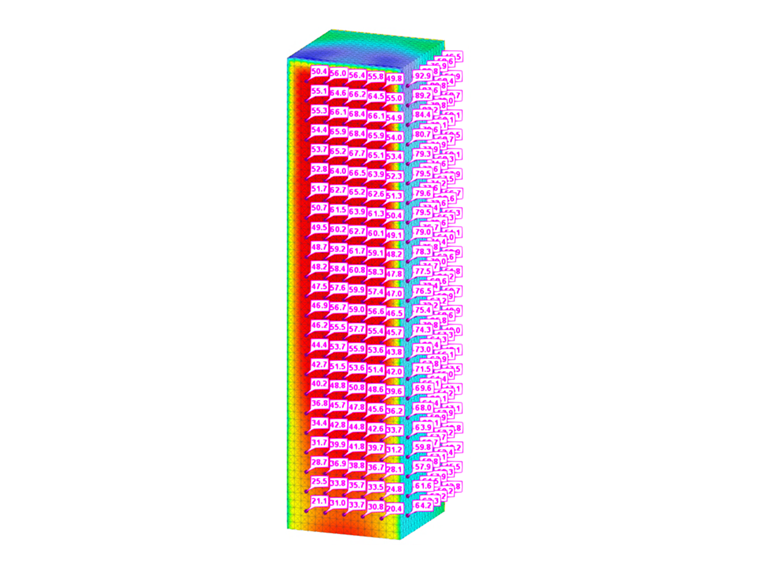
User Story
In this example, we are going to calculate the average force and moment coefficient for Tokyo Polytechnic University (TPU) as an experimental example (M0/S0), such as those applicable to the structural design process based on WTG-Merkblatt-M3.
This part of the results belongs to Group 1 according to Figure 2.2 in WTG-Merkblatt-M3:
- G2: Absolute values with medium accuracy requirements. The area of application can include parameters or preliminary studies when later investigations with higher accuracy are planned (e.g., wind tunnel examination of class G3).
- R2: Solitary, all relevant wind directions with sufficiently fine directional resolution.
- Z1: Statistical mean values, provided they concern stationary flow processes where fluctuations (e.g., due to approaching flow turbulence) can be captured sufficiently by other measures.
- S1: Static effects. It is sufficient to represent the structural model with the necessary mechanical detail, but without mass and damping properties.
Description
By investigating the aerodynamic behavior across different planes, this comparison aims to provide a more comprehensive understanding of the force distribution. Such insights are critical for evaluating the model's overall stability, aerodynamic performance, and structural response under flow conditions. The average velocity and turbulence intensity inflow profiles reproduced in the wind tunnel correspond to those of Terrain Category IV according to the standard of the Architectural Institute of Japan (AIJ). The exponent of 0.25 cited in some figures was classified as a typographical error upon inquiry. The assumed model is shown in Image 1:
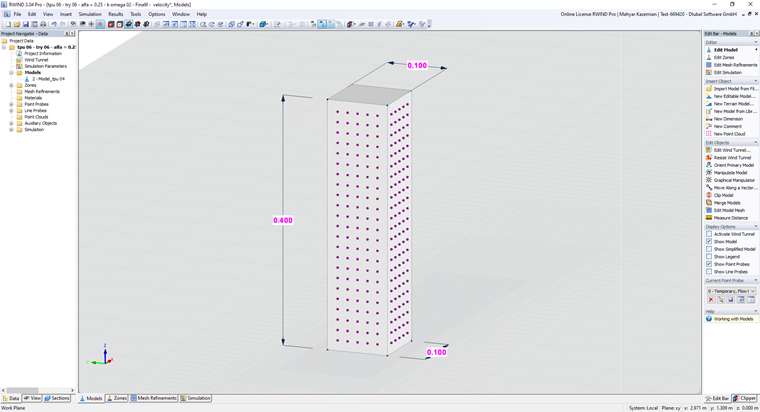
The assumptions underlying the analysis and simulations are summarized in Table 1, providing a clear overview of the parameters and conditions considered throughout the study.:
Table 1: Input data of the 3D rectangular model
| Parameter | Symbol | Value | Unit |
|---|---|---|---|
| Reference Wind Velocity | UH | 11 | m/s |
| Roof Height | Href | 0.4 | m |
| Profile Exponent | α | 0.25 | - |
| Terrain Category | - | IV | - |
| Air Density – RWIND | ρ | 1.25 | kg/m³ |
| Turbulence Model – RWIND | RANS K-Omega | - | - |
| Kinematic Viscosity – RWIND | ν | 1.5×10⁻⁵ | m²/s |
| Scheme Order – RWIND | Second | - | - |
| Residual Target Value – RWIND | 10⁻⁴ | - | - |
| Residual Type – RWIND | Pressure | - | - |
| Minimum Number of Iterations – RWIND | 800 | - | - |
| Boundary Layer – RWIND | NL | 10 | - |
| Type of Wall Function – RWIND | Enhanced / Blended | - | - |
Computational Mesh Study
Image 2 summarizes a mesh sensitivity study, showing that as the mesh density increases from 20% to 55%, the force coefficient (Cf) increases from 0.95 to 1.05 and then stabilizes. This indicates that the simulation reaches mesh independence at 55%, meaning that further refinement no longer changes the results significantly. The image highlights the importance of mesh quality in ensuring reliable wind simulation outcomes.
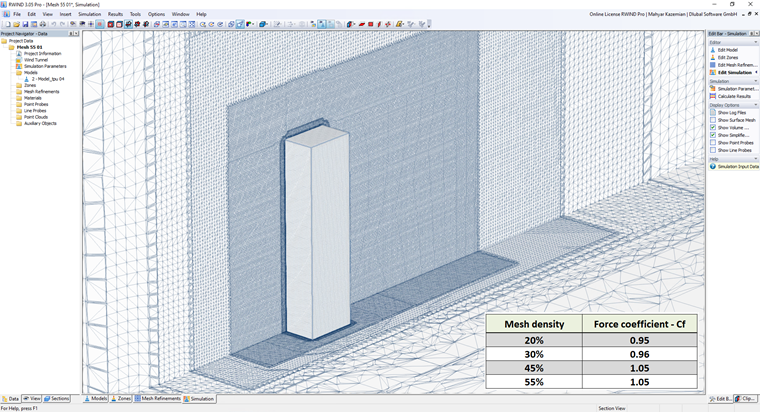
Also, the computational mesh study needs to be performed according to the following link:
Image 3 presents a diagram comparing RWIND results to experimental data, concerning the plotting of normalized wind velocity profiles according to height. The results show very good agreement.
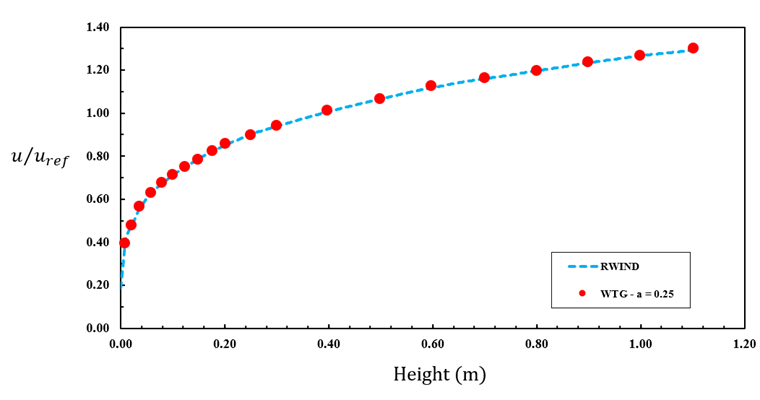
WTG-Merkblatt Accuracy Requirement
The WTG-Merkblatt M3 provides two key methods for validating simulation results. The Hit Rate Method evaluates how many of the simulated values Pi correctly match the reference values Oi within a defined tolerance, using a binary classification approach (hit or miss). This approach assesses the reliability of the simulation by calculating a hit rate q, similar to confidence functions used in reliability theory. In contrast, the Normalized Mean Squared Error (e2) method offers a more detailed accuracy assessment by quantifying the average squared deviation between simulated and reference values, normalized to account for scale differences. Together, these methods provide both qualitative and quantitative measures for simulation validation.
Results and Discussion
Table 3 shows very good agreement for the validation metric between the RWIND results and the WTG reference data for normalized velocity values. All the deviations are in an acceptable range (below 10%), so the hit rate is obtained q = 100%, and the normalized mean square error e2 = 0.00001 is extremely low. These results confirm that RWIND accurately reproduces the reference wind profile and meets strict validation criteria.
Table 3: Validation Metric for Velocity Profile
| WTG - u / uref | RWIND - u / uref | Deviation (%) | n |
|---|---|---|---|
| 0.394 | 0.390 | 1.045 | 1.00 |
| 0.478 | 0.473 | 1.093 | 1.00 |
| 0.566 | 0.564 | 0.291 | 1.00 |
| 0.629 | 0.629 | 0.081 | 1.00 |
| 0.675 | 0.674 | 0.183 | 1.00 |
| 0.713 | 0.712 | 0.072 | 1.00 |
| 0.750 | 0.753 | 0.422 | 1.00 |
| 0.784 | 0.783 | 0.098 | 1.00 |
| 0.822 | 0.819 | 0.362 | 1.00 |
| 0.869 | 0.865 | 0.463 | 1.00 |
| 0.897 | 0.901 | 0.496 | 1.00 |
| 0.939 | 0.940 | 0.113 | 1.00 |
| 1.010 | 1.005 | 0.493 | 1.00 |
| 1.065 | 1.070 | 0.540 | 1.00 |
| 1.123 | 1.124 | 0.044 | 1.00 |
| 1.161 | 1.162 | 0.121 | 1.00 |
| 1.195 | 1.195 | 0.051 | 1.00 |
| 1.237 | 1.240 | 0.263 | 1.00 |
| 1.266 | 1.270 | 0.291 | 1.00 |
| 1.299 | 1.302 | 0.223 | 1.00 |
Image 4 illustrates how surface zones are defined in RWIND to accurately calculate the force coefficients on each face of a building model exposed to wind. The 3D model, with a simple rectangular shape, has each face front, back, left, right, and top assigned a distinct color-coded zone. These zones enable RWIND to separately analyze and calculate the aerodynamic forces and pressure distribution independently for each surface. Instead of placing numerous point probes, we chose to define surface zones, as RWIND can directly determine the force coefficient for each defined zone.
In the center of Image 4, the "Edit Zone" window is open for Zone No. 2 – Front as an example. This detailed output includes key aerodynamic parameters. The projected area of this zone in the wind direction is 0.04 m². The calculated drag force on this surface is 1.7 N, and the corresponding force coefficient (Cx) is 0.56. In the following formula, the wind force coefficient (aerodynamic force coefficient) for a specific pressure zone is calculated as an example. This value can then be compared to the value displayed under the Info tab in the Edit Model Data dialog.
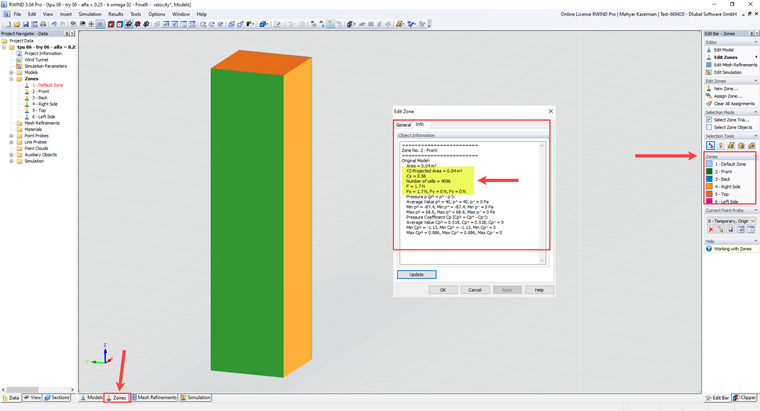
Image 5 shows the post-processing results of a wind simulation conducted for a high-rise building using the k-omega turbulence model. On the right side of the image, a comparison table displays the force coefficients obtained from the CFD simulation alongside benchmark values from the WTG guideline. The front surface has a force coefficient of 0.562, compared to the WTG reference of 0.540, which corresponds to a deviation of 4.07%. The rear surface, which is subjected to negative pressure due to wake effects, shows a slightly larger deviation of 6.09%. The side surfaces also exhibit minor differences, with deviations ranging between 3.68% and 5.38%. Notably, the total force coefficient in the wind direction representing the global drag effect shows only a 1.95% deviation, highlighting the accuracy and reliability of the CFD simulation in capturing the overall aerodynamic behavior of the structure.
The actual force values in newtons for each building face are displayed below this table. The front surface is subjected to a positive drag force of 1.7 N, while the rear, right, and left surfaces experience negative forces due to suction and side drag. The total net force in the wind direction amounts to 3.2 N, matching the global force output stated in the mesh summary. The simulation used a reference wind speed of 11 m/s and a face area of 0.04 m².
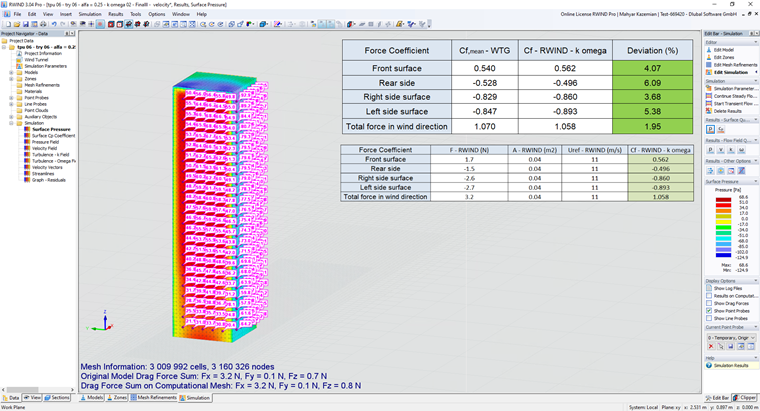
Table 4 shows that RWIND accurately replicates the reference WTG mean force coefficients on all surfaces, with deviations ranging from 1.95% to 6.09% and q=100% as hit rate. The low normalized mean square error e2=0.0015 confirms strong agreement between simulation and measurements, meeting the validation standards effectively.
Table 4: Validation Metric for Mean Force Coefficients Between WTG and RWIND
| Force Coefficient | Cf,mean – WTG | Cf – RWIND – k-omega | Deviation (%) | n |
|---|---|---|---|---|
| Front surface | 0.540 | 0.562 | 4.07 | 1.00 |
| Rear surface | –0.528 | –0.496 | 6.09 | 1.00 |
| Right side surface | –0.829 | –0.860 | 3.68 | 1.00 |
| Left side surface | –0.847 | –0.893 | 5.38 | 1.00 |
| Total force in wind direction | 1.070 | 1.058 | 1.95 | 1.00 |
| Total force in crosswind direction | 0.018 | 0.020 | 10.00 | 1.00 |
| Moment in wind direction | 0.582 | 0.520 | 10.65 | 1.00 |
| Moment in crosswind direction | 0.010 | 0.0099 | 1.00 | 1.00 |