User Story
The following example describes wind tunnel experiments conducted by Tokyo Polytechnic University (TPU) as a validation example in Part 9.3 WTG-Merkblatt M3. We are going to calculate the averaged wind pressure coefficient (Cp) for different wind zones, which belongs to Group 2, according to Figure 2.2 in WTG-Merkblatt-M3:
- G2: Absolute values with medium accuracy requirements: The area of application can include parameters or preliminary studies when later investigations with higher accuracy are planned (e.g., wind tunnel examination of class G3).
- R2: Solitary: all relevant wind directions with sufficiently fine directional resolution.
- Z2: Statistical mean values and standard deviations: provided they involve stationary flow processes, for which a statistical verification of fluctuations with a peak factor is sufficient.
- S1: Static effects: They are sufficient to represent the structural model with the necessary mechanical detail, but without mass and damping properties.
Description
This section presents experimental validation data for wind loads on low-rise building models with gable roofs. The data originates from the Tokyo Polytechnic University (TPU) aerodynamic database, which provides benchmark measurements for buildings with different roof configurations.
The verification example compares CFD predictions of wind pressure coefficients against TPU's wind tunnel experiments. The reference building geometry (dimensions ratio D:B:Ho= 160 : 160 : 40 , roof pitch angle β=45∘ ) is analyzed by decomposing the structure into individual surfaces (windward wall, side walls, leeward wall, and roof slopes) as shown in image 1. The lower part of the figure shows the inflow boundary condition profiles used in the wind tunnel and CFD model:
- Mean wind speed profile U(z)
- Turbulence intensity profile I(z)
These profiles are compared with Category III terrain conditions (AIJ 2004 standard). The agreement demonstrates that TPU's wind tunnel inflow reproduces realistic atmospheric boundary layer characteristics, providing a reliable basis for validation.
![Simulated Wind Field of Suburban Terrain [TPU Data]](/en/webimage/058502/4779281/Image.png?mw=760&hash=ec9a55cdca40d30b4481aa04757df3b01dc1fa64)
Table 1: Input data of the 3D gable roof
| Parameter | Symbol | Value | Unit |
|---|---|---|---|
| Reference Wind Velocity | UH | 22 | m/s |
| Roof Height | Href | 12 | m |
| Profile Exponent | α | 0.20 | - |
| Terrain Category | - | III | - |
| Air Density – RWIND | ρ | 1.25 | kg/m³ |
| Turbulence Model – RWIND | RANS & URANS K-Omega | - | - |
| Kinematic Viscosity – RWIND | ν | 1.5×10⁻⁵ | m²/s |
| Scheme Order – RWIND | Second | - | - |
| Residual Target Value – RWIND | 10⁻⁴ | - | - |
| Residual Type – RWIND | Pressure | - | - |
| Minimum Number of Iterations – RWIND | 800 | - | - |
| Boundary Layer – RWIND | NL | 10 | - |
| Type of Wall Function – RWIND | Enhanced / Blended | - | - |
Computational Mesh Study
The figure presents a mesh sensitivity analysis of the gable roof model in RWIND. The calculated force coefficient (Cf) remains constant at 0.83 for mesh densities of 15% and 25%, indicating stable results at lower refinement levels. At higher mesh densities of 30% and 35%, Cf slightly increases to 0.85 and 0.87, respectively. This behavior demonstrates overall convergence, with only minor variations observed as the mesh becomes finer.
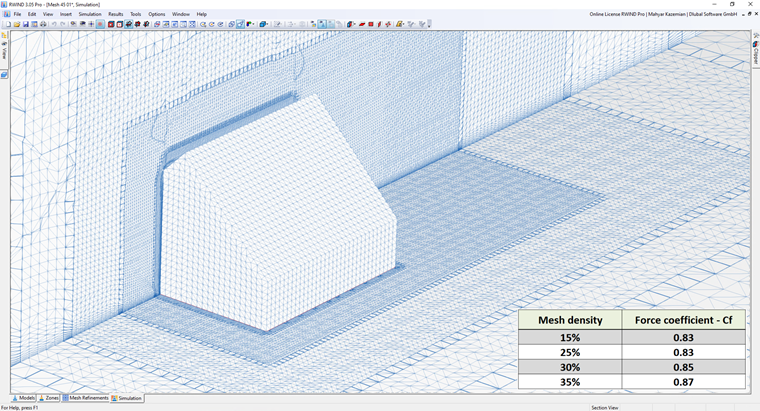
Also, the computational mesh study needs to be performed according to the following link:
WTG-Merkblatt M3 Accuracy Requirement
The WTG-Merkblatt M3 provides two key methods for validating simulation results. The Hit Rate Method evaluates how many of the simulated values Pi correctly match the reference values Oi within a defined tolerance, using a binary classification approach (hit or miss). This approach assesses the reliability of the simulation by calculating a hit rate q, similar to confidence functions used in reliability theory. In contrast, the Normalized Mean Squared Error (e2) method offers a more detailed accuracy assessment by quantifying the average squared deviation between simulated and reference values, normalized to account for scale differences. Together, these methods provide both qualitative and quantitative measures for simulation validation.
Results and Discussion
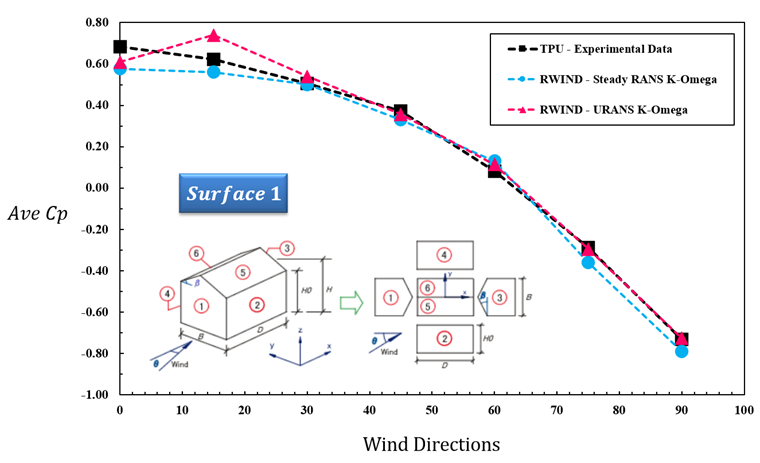
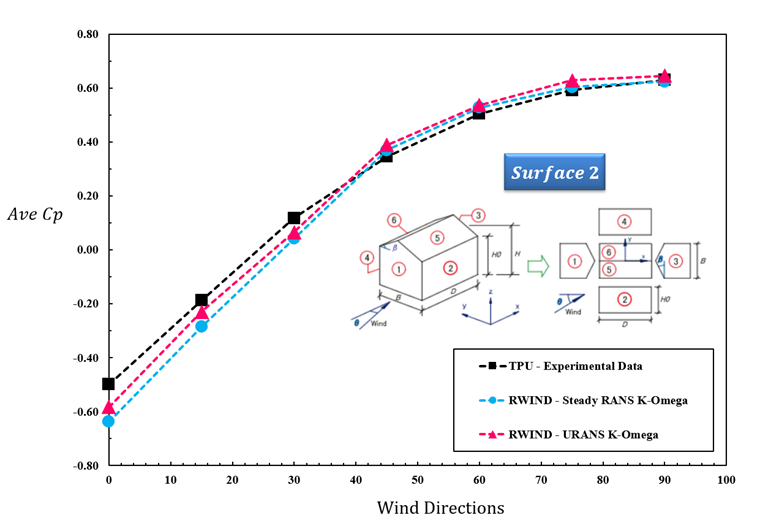
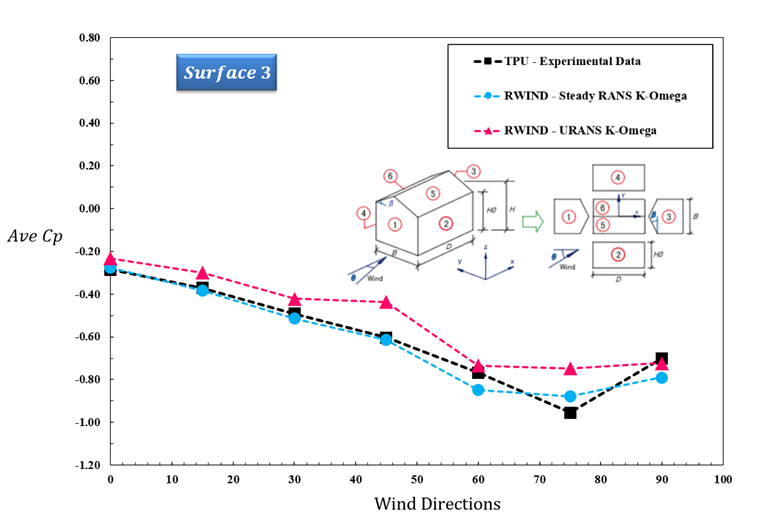
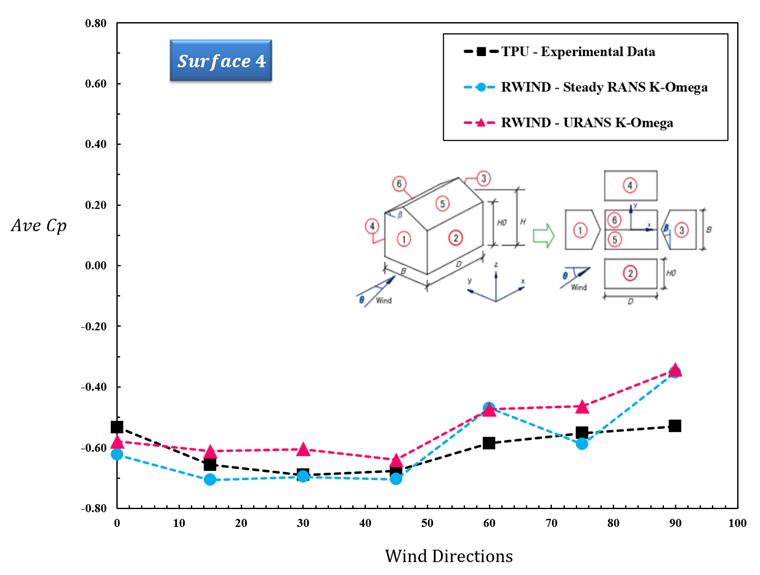
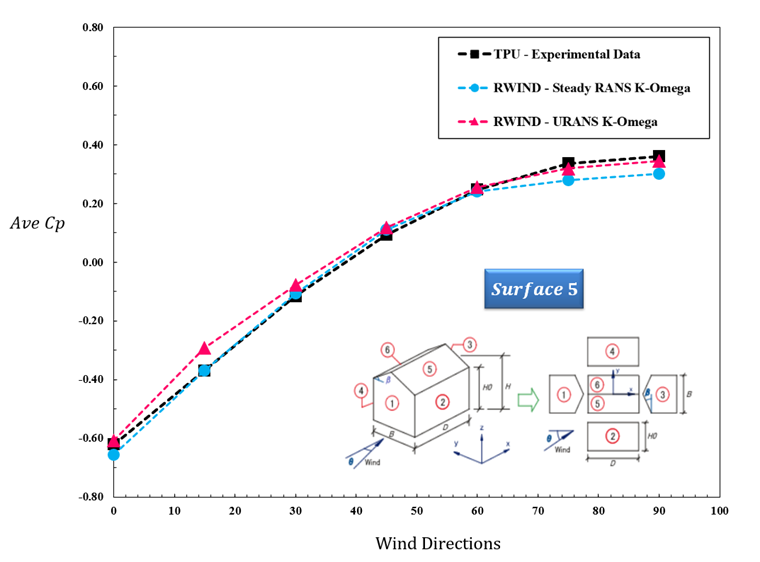
The six figures (images 3 to 8) present a comparative analysis of the average pressure coefficients (Ave Cp) on different surfaces of a gable-roof building, obtained from Tokyo Polytechnic University (TPU) wind tunnel experiments and simulated using RWIND with both Steady RANS k-ω and URANS k-ω turbulence models.
For surface 1 (windward wall), the average Cp decreases steadily from around 0.65 at 0° wind direction to about –0.9 at 90°. The experimental data start at slightly higher values, while the Steady RANS underestimates the peak positive pressures. URANS captures the pressure peaks better, particularly between 10° and 20°, and shows closer agreement with the experiments in the initial range, though all methods converge at larger angles.
For surface 2 (side wall), the average Cp increases steadily from approximately –0.6 at 0° to about +0.65 at 90°. The experimental results exhibit a smooth and consistent rise across the entire angular range. The Steady RANS simulation slightly underestimates suction at small wind angles and marginally overpredicts the positive pressures at larger angles. In contrast, the URANS results show much closer agreement with the experimental data, particularly between 30° and 80°, highlighting its improved capability in capturing the leeward flow recovery.
In the case of surface 3 (leeward wall), the pressure remains negative, beginning at around –0.3 at 0° and reaching values around –0.9 near 70°–80°. The experimental trend is well captured by Steady RANS in the most of the angles, whereas URANS consistently underpredict the pressure (less negative Cp), especially in the mid-range of wind directions. This shows that Steady RANS performs better for side-wall suction conditions.
The average pressure coefficient on surface 4 (side wall) remains negative across all wind directions, with values gradually increasing from strong suction at 0° to near neutral at 90°. Both RANS and URANS generally capture the overall trend observed in the experimental data, but noticeable deviations occur, particularly at higher wind angles where the simulations tend to overpredict the recovery. Steady RANS shows a closer agreement in the mid-range, while Steady URANS exhibits larger discrepancies at high angles.
For surface 5, all methods consistently capture the smooth transition of the average pressure coefficient from negative values (suction) at low wind angles to positive pressure at higher wind directions. The experimental data from TPU indicate a steady increase, crossing from suction to pressure around 45°, a trend that is well reflected in both numerical approaches. Steady RANS follows the experimental results with very close accuracy, showing only minimal deviations across the full angular range. URANS, on the other hand, predicts slightly different values, generally tending to underpredict the pressure at higher wind directions, but still maintains overall good agreement with both experiments and RANS.
Finally, the average pressure coefficient on surface 6 shows good agreement between experiments and CFD, while at 20°–40° the experiments indicate stronger suction. Steady RANS slightly underestimates this peak, and URANS consistently overpredicts with weaker suction. Overall, RANS captures the experimental trend more reliably, whereas URANS tends to deviate at oblique wind angles.
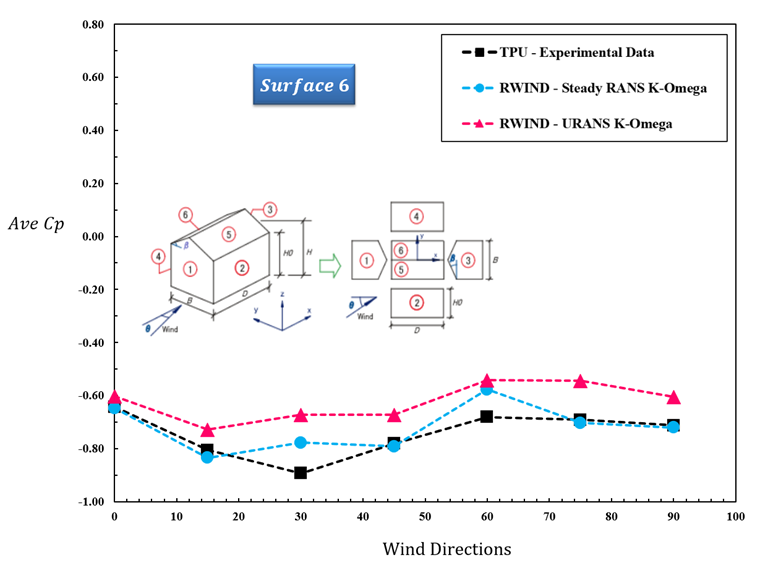
Table 3 summarizes the validation metrics for the six building surfaces, considering a deviation criterion of 10% for RANS and 20% for URANS. For Surface 1, URANS shows clear superiority with a higher hit rate (85% compared to 57% for RANS) and lower error (e² = 0.012 versus 0.015). A similar trend is observed for Surface 2, where URANS again outperforms RANS, achieving a hit rate of 71% against 57% and reducing the error from 0.025 to 0.011. In contrast, Surface 3 highlights the strength of RANS, which achieves a higher hit rate (85% versus 71%) and a significantly lower error (0.008 compared to 0.030). For Surface 4, both methods reach an identical hit rate of 85%, but RANS performs slightly better in terms of error (0.022 versus 0.026). Surfaces 5 and 6 show balanced hit rates of 71% for both methods; however, for Surface 5, the errors are equal (0.010 for both), while for Surface 6, RANS is notably superior with a much smaller error (0.006 versus 0.031). Overall, the results indicate that URANS provides better agreement with experiments on Surfaces 1 and 2, while RANS delivers more accurate predictions for Surfaces 3 and 6, with both methods showing comparable performance on Surfaces 4 and 5.
Table 3: Validation Metric for Cp value of Six Different Zones
| Surface Number | Hit rate - q 10% - RANS (%) | Hit rate - q 20% - URANS (%) | e2 - RANS | e2 - URANS |
|---|---|---|---|---|
| Surface 1 | 57 | 85 | 0.015 | 0.012 |
| Surface 2 | 57 | 71 | 0.025 | 0.011 |
| Surface 3 | 85 | 71 | 0.008 | 0.030 |
| Surface 4 | 85 | 85 | 0.022 | 0.026 |
| Surface 5 | 71 | 71 | 0.010 | 0.010 |
| Surface 6 | 71 | 71 | 0.006 | 0.031 |