User Story
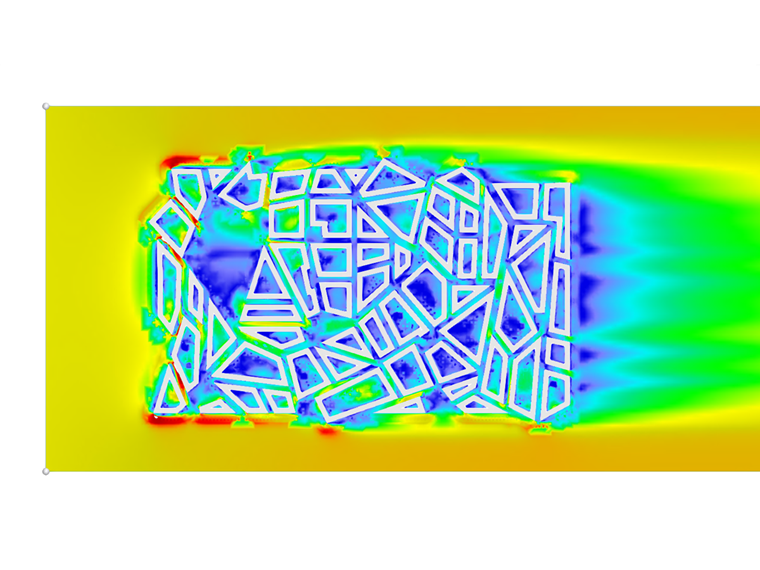
The following example describes wind tunnel experiments conducted by the Environmental Wind Tunnel Laboratory (EWTL) at the University of Hamburg [1] as a validation case in Part 9.4 of the WTG-Merkblatt M3. We are going to use the measured velocity fields of the Michel City model (Case BL3-3) to validate numerical CFD simulations in complex urban structures. The example can belong to Group 1, according to Figure 2.2 in WTG-Merkblatt-M3, based on investigating average wind velocity value:
- G2: Absolute values with medium accuracy requirements: The area of application can include parameters or preliminary studies when later investigations with higher accuracy are planned (e.g., wind tunnel examination of class G3).
- R2: Solitary: all relevant wind directions with sufficiently fine directional resolution.
- Z2: Statistical mean values and standard deviations: provided they involve stationary flow processes for which a statistical verification of fluctuations with a peak factor is sufficient.
- S1: Static effects: They are sufficient to represent the structural model with the necessary mechanical detail, but without mass and damping properties.

Description
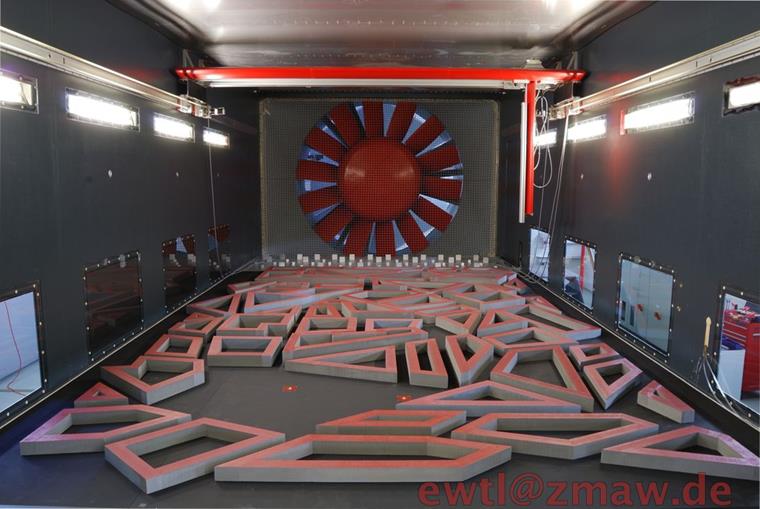
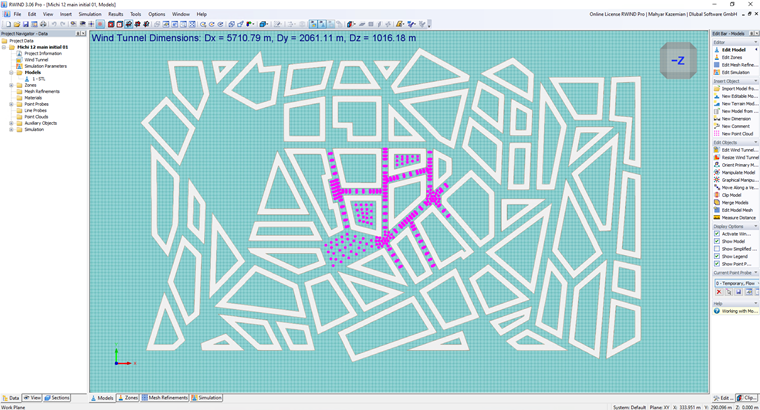
The investigation focuses on an idealized but geometrically detailed city model placed in an atmospheric boundary layer flow. The wind tunnel measurements were performed in the WOTAN facility, featuring a test section 18 m long, 4 m wide, and 2.75-3.25 m high. The corresponding roughness field was characterized by a roughness length of z0=1.53 m and a profile exponent α=0.27 representing "very rough" terrain conditions. A total of 1,838 measurement points were recorded for several roof configurations. The time-dependent horizontal velocity components u and v, including mean values, variances, correlations, and spectra, were obtained with a 2D Laser-Doppler Anemometer (LDA) at 500-600 Hz. Measurement points were distributed in vertical and horizontal profiles, in street canyons, and at defined repeatability locations. The Michel City dataset serves as a reference validation case (C5) according to VDI Guideline 3783 Part 9 [2]. For validation, in addition to the hit ratio, a relative deviation D=0.25 and an absolute deviation W=0.08 are applied to account for repeatability and measurement uncertainty. This dataset has been verified and adopted by several institutions (e.g., KalWin [3]) for CFD validation and model comparison purposes.
WTG-Merkblatt M3 Accuracy Requirement
The WTG-Merkblatt M3 provides two key methods for validating simulation results. The Hit Rate Method evaluates how many of the simulated values Pi correctly match the reference values Oi within a defined tolerance, using a binary classification approach (hit or miss). This approach assesses the reliability of the simulation by calculating a hit rate q, similar to confidence functions used in reliability theory. In contrast, the Normalized Mean Squared Error (e2) method offers a more detailed accuracy assessment by quantifying the average squared deviation between simulated and reference values, normalized to account for scale differences. Together, these methods provide both qualitative and quantitative measures for simulation validation.
Results and Discussion
The comparison between normalized velocity values (U/Uref) obtained from RWIND simulations and experimental measurements demonstrates a moderate level of agreement across the investigated dataset. A total of 43 validation points were analyzed at which the deviation values range from approximately 2% to nearly 50%, indicating that while the simulation captures the overall magnitude and trend of the velocity field, local discrepancies remain significant in certain regions. The hit rate analysis further highlights this behavior: only 18.60% of the data points fall within a strict ±10% tolerance, increasing to 37.21% when the tolerance is relaxed to ±20%. The normalized mean error value 𝑒2=0.2498 confirms a moderate overall deviation between predicted and measured values.
Spatially, lower deviations are observed in regions likely characterized by more stable or attached flow conditions, whereas larger discrepancies occur where stronger gradients or complex flow phenomena are expected, such as separation zones or wake regions. These differences may be attributed to limitations inherent in steady RANS turbulence modeling, wall-function assumptions, mesh resolution effects, or sensitivity to inflow conditions. Despite these limitations, the simulation demonstrates adequate performance for engineering-level analysis and trend prediction. However, for applications requiring higher local accuracy, further refinement of turbulence modeling, mesh resolution, or boundary condition definition may be necessary.
Table 1: Comparison of Normalized Velocity (U/Uref) Between RWIND and Experimental Data
| X | Y | Z | U/Uref – RWIND | U/Uref – Experimental | Deviation (%) |
|---|---|---|---|---|---|
| -67.25 | -41.76 | 2 | 0.113 | 0.0942 | 16.64 |
| -70.41 | -27.84 | 2 | 0.120 | 0.0787 | 34.42 |
| -73.58 | -13.92 | 2 | 0.096 | 0.0693 | 27.81 |
| -76.75 | 0 | 2 | 0.098 | 0.0959 | 2.14 |
| -63.23 | 0 | 2 | 0.144 | 0.1305 | 9.38 |
| -61.71 | -12 | 2 | 0.134 | 0.1285 | 4.10 |
| -59.44 | -21.99 | 2 | 0.113 | 0.1399 | 23.81 |
| -57.17 | -31.98 | 2 | 0.124 | 0.1385 | 11.69 |
| -56.89 | -44.45 | 2 | 0.158 | 0.1186 | 24.94 |
| -46.54 | -47.15 | 2 | 0.149 | 0.1393 | 6.51 |
| -48.19 | -23.16 | 2 | 0.117 | 0.156 | 33.33 |
| -48.19 | -12 | 2 | 0.105 | 0.154 | 46.67 |
| -49.71 | 0 | 2 | 0.177 | 0.1347 | 23.90 |
| -36.19 | 0 | 2 | 0.117 | 0.1547 | 32.22 |
| -36.19 | -16.61 | 2 | 0.210 | 0.1633 | 22.24 |
| 31.81 | 127.75 | 2 | 0.091 | 0.086 | 5.49 |
| 58.81 | 119.75 | 2 | 0.096 | 0.093 | 3.13 |
| 72.31 | 127.75 | 2 | 0.065 | 0.0558 | 14.15 |
| 72.31 | 115.54 | 2 | 0.082 | 0.0423 | 48.41 |
| 85.81 | 118.91 | 2 | 0.149 | 0.0748 | 49.80 |
| 85.81 | 127.75 | 2 | 0.192 | 0.0978 | 49.06 |
| -149.89 | -124.58 | 2 | 0.103 | 0.1115 | 8.25 |
| -156.52 | -106.63 | 2 | 0.632 | 0.4036 | 36.15 |
| -142.43 | -99.38 | 2 | 0.658 | 0.334 | 49.24 |
| -141.58 | -112.44 | 2 | 0.476 | 0.4192 | 11.93 |
| -130.02 | -143.76 | 2 | 0.117 | 0.1723 | 47.26 |
| -119.53 | -120.2 | 2 | 0.313 | 0.384 | 22.68 |
| -127.31 | -105.09 | 2 | 0.634 | 0.3833 | 39.54 |
| -114.27 | -84.87 | 2 | 0.119 | 0.0894 | 24.87 |
| -105.26 | -112.85 | 2 | 0.466 | 0.3084 | 33.82 |
| -100.19 | -77.62 | 2 | 0.174 | 0.1187 | 31.78 |
| -36.27 | -94.25 | 2 | 0.483 | 0.2455 | 49.17 |
| -35.24 | -109.91 | 2 | 0.249 | 0.2782 | 11.73 |
| -48.97 | -103.35 | 2 | 0.366 | 0.2337 | 36.15 |
| -55.52 | -120.02 | 2 | 0.220 | 0.284 | 29.09 |
| -69.23 | -113.45 | 2 | 0.265 | 0.2553 | 3.66 |
| -103.49 | -58.25 | 2 | 0.270 | 0.1459 | 45.96 |
| -118.54 | 21.4 | 2 | 0.024 | 0.0224 | 6.67 |
| -121.46 | 20.73 | 2 | 0.062 | 0.0361 | 41.77 |
| -120.54 | 30.17 | 2 | 0.117 | 0.0952 | 18.63 |
| -117.61 | 30.84 | 2 | 0.139 | 0.0896 | 35.53 |
| -122.53 | 38.95 | 2 | 0.170 | 0.0907 | 46.65 |
| -125.45 | 38.28 | 2 | 0.158 | 0.1128 | 28.61 |
Table 2: Validation Metrics for Normalized Velocity (U/Uref) Comparison
| Metric | Value |
|---|---|
| Total number of data points (N) | 43 |
| Hit Rate q (10% tolerance) | 18.60% |
| Hit Rate q (20% tolerance) | 37.21% |
| Deviation Form of Mean Error (e²) | 0.2498 |