Description
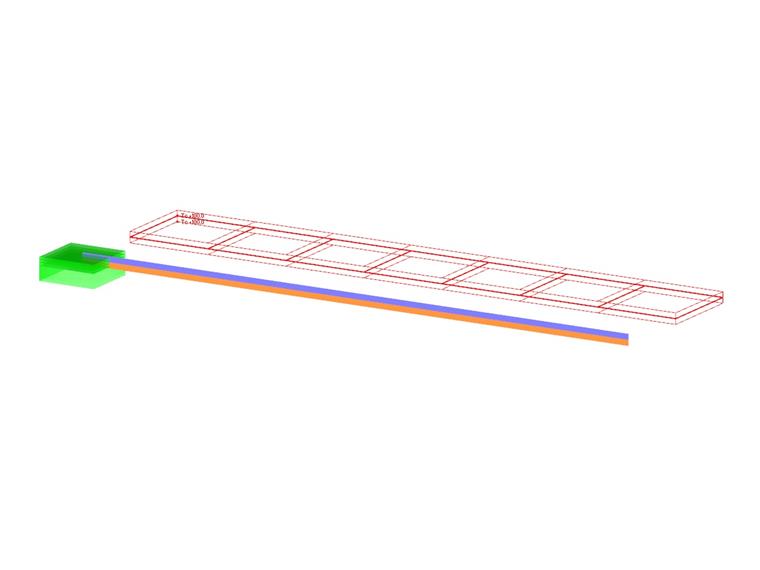
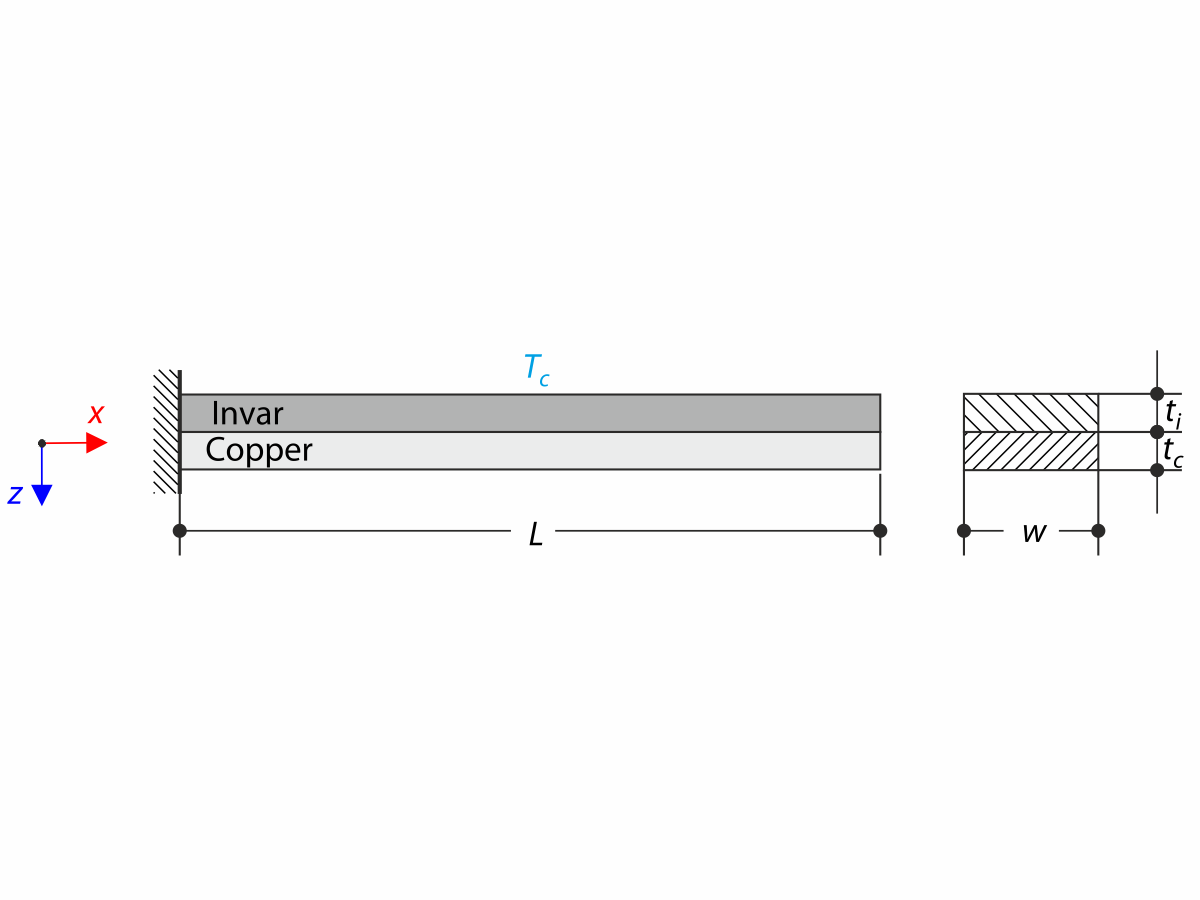
The bimetallic strip is composed of invar (an alloy of iron and nickel with a very low coefficient of thermal expansion) and copper. The left end of the bimetallic strip is fixed and the right end is free, loaded by temperature difference Tc according to the following sketch. While neglecting the self-weight, determine the deflection uz,max of the bimetallic strip (free end). The problem is described by the following set of parameters.
| Material | Invar | Modulus of Elasticity | Ei | 137000.000 | MPa |
| Poisson's Ratio | νi | 0.280 | - | ||
| Coefficient of Thermal Expansion | αi | 1,200 e-6 | °C-1 | ||
| Copper | Modulus of Elasticity | Ec | 130000.000 | MPa | |
| Poisson's Ratio | νc | 0.354 | - | ||
| Coefficient of Thermal Expansion | αc | 2 e-5 | °C-1 | ||
| Geometry | Cross-Section Width | w | 5.000 | mm | |
| Layer Thickness | t=ti=tc | 1.000 | mm | ||
| Length | L | 100.000 | mm | ||
| Load | Thermal Loading | Tc | 100.000 | °C | |
Analytical Solution
The bimetallic strip is made of two metals with different coefficients of thermal expansion. They are frequently used in instruments to sense or control temperatures. When the ambient temperature changes, the bimetallic strip bends. This bending is caused by the different elongations of the metals used.
The analytical solution is based on the approach introduced in the reference listed below. The following formula gives the dimensionless coefficient K1, which can be used for the calculation of the equivalent stiffness.
The maximum deflection of the bimetallic strip is then defined by the following formula:
RFEM Settings
- Modeled in version RFEM 5.26 and RFEM 6.06
- The element size is lFE= 0.250 mm
- Geometrically linear analysis is considered
- Isotropic linear elastic material model is used
Results
| Model | Analytical Solution | RFEM 6 | RFEM 5 | ||
| uz,max [mm] | uz,max [mm] | Ratio [-] | uz,max [mm] | Ratio [-] | |
| Plate | -7.049 | -7.047 | 1.000 | -7.047 | 1.000 |
| Solid | -6.956 | 0.987 | -7.064 | 1.002 | |