


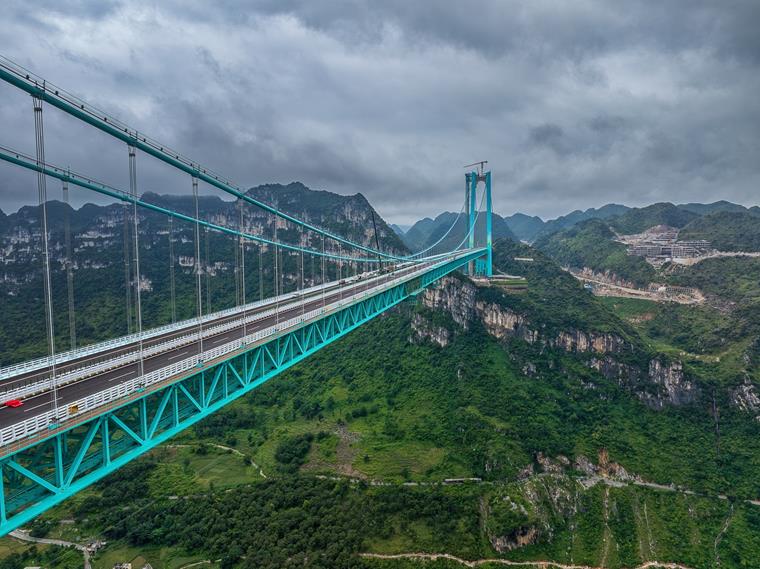
A major event is currently dominating the media. In a festive ceremony, the world's highest bridge was inaugurated. With an impressive total length of 2,900 m, the Huajiang Grand Canyon Bridge spans the Huajiang Grand Canyon, also known as the "earth fissure," in the region. Hardly any other area has such a gigantic difference between the mountain and the valley floor, just like the bridge itself.
It shines bright blue amid the already idyllic surroundings. Construction of the Huajiang Bridge took just over three years. This is a definite record, especially compared to Germany. In this blog post, we take a closer look at the structure.
Why China builds so many bridges?
Is this already another record-breaking bridge in China? Some people who keep up with world events might have thought so. Time and again, headlines flash across our media: New mega bridge opens in China! But why is the People's Republic building so many bridges, especially such large ones?
The secret behind it is no secret at all. Since opening the country to world trade, China's economy has grown stronger than anywhere else. There is a lot of production and research. Until recent years, what was missing was infrastructure that could keep pace with growth.
High-speed rail lines, highways, and planar bridges over large gorges are all that is needed to connect economic centers. Shorter distances mean less time and lower costs. So it's no surprise that one major project after another is being built.
Construction in China: Extreme Bridge Building
Wait a minute – Some of you may think. Anyone who follows our blog knows that the world's highest bridge is already in China. That's right; the Beipanjiang Bridge is located in the Chinese province of Guizhou and is only about 100 km away. At 565 m above river level, it was previously the frontrunner. If you want to read more about the bridge, click here:
Extreme Bridge Construction: Duge Bridge in China
.
However, it is not the country's first record-breaking bridge. In fact, 18 of the 20 highest bridges in the world are in China. However, this is probably only because they are measured from the bottom of the valley. In China, especially in the southeast, there are simply a lot of deep gorges. In terms of the structure itself, the Millau Viaduct in southern France is undoubtedly the highest bridge. And that's with "only" 343 m.
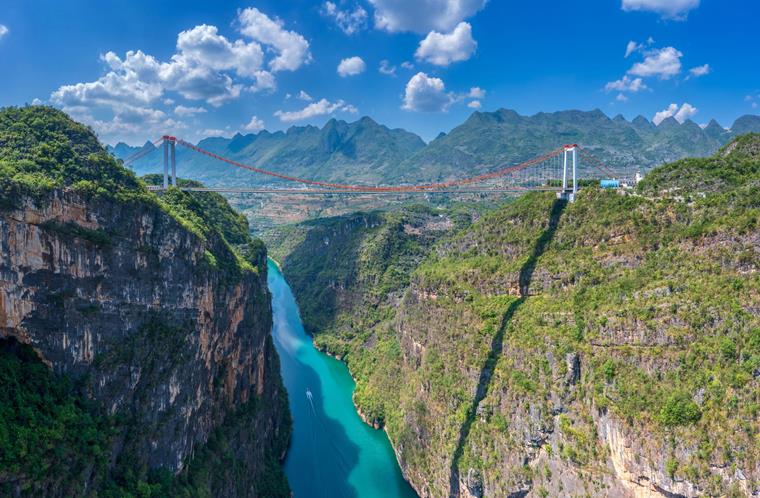
Special Features of Huajiang Bridge Location
China is a true expert in mega-projects, not only because of the sheer number of record-breaking bridges, but also because of the unique challenges they present. The bridges in China are particularly breathtaking, because the terrain permits no run-of-the-mill bridges.
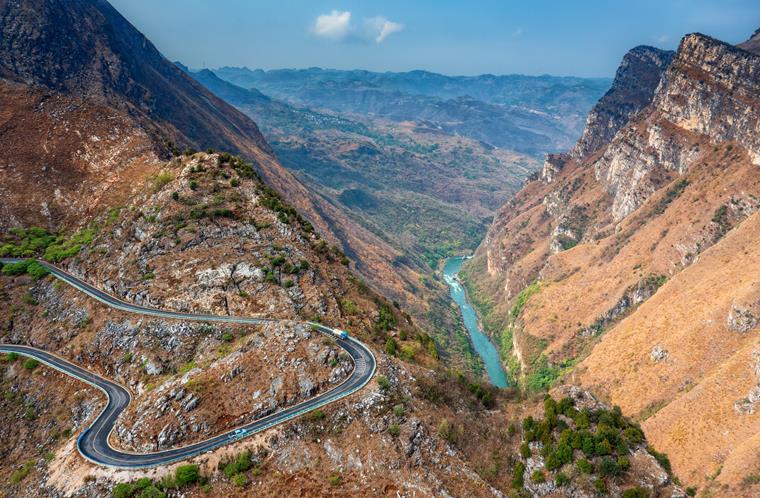
As mentioned earlier in this article, a great difference in altitude between mountains and valleys is rare in the world.
While such deep gorges may be impressive, they make trade difficult. The roads are long and winding, resulting in considerable travel time. Bridges are an excellent way to shorten the journey.
In the case of the Huajiang Bridge, the travel time in the mountainous province is reduced from about two hours to just a few minutes. However, the bridge is not just for normal traffic. It can do much more than that.
Huajiang Bridge in Detail
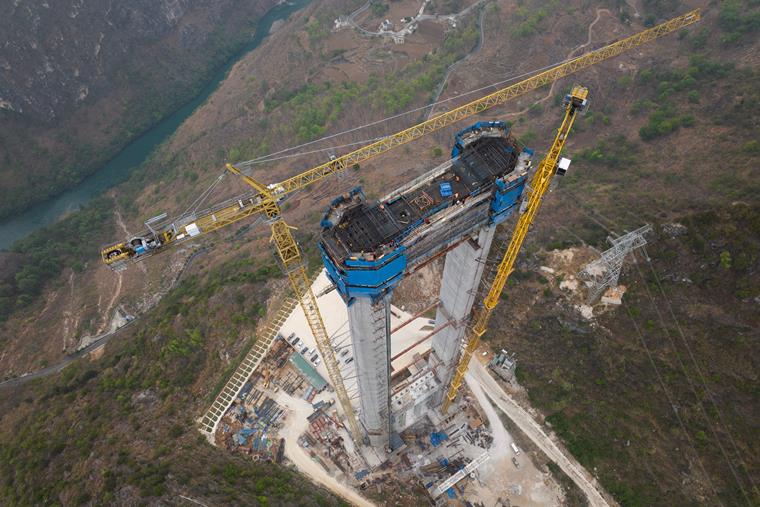
Construction of the world's tallest bridge took just over three years. According to the state news agency Xinhua, the bridge has a height of 625 m from the riverbed to the roadway. That's almost as high as the Shanghai Tower, which stands at 632 m. The Shanghai Tower is the tallest skyscraper in China.
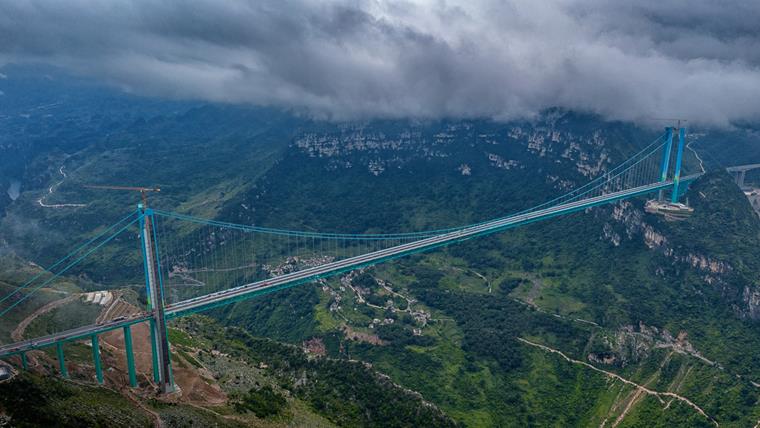
The steel truss suspension bridge has a length of 2,890 m and a remarkable span of 1,420 m from mountain to mountain. According to Chinese state media reports, the Huajiang Bridge mega-project cost over two billion yuan, equivalent to around €240 million. That's a lot of money for a bridge, especially in a mountainous region of China.
However, the Huajiang Grand Canyon Bridge is more than just a bridge; it is set to become a major tourist attraction. An exit leads to a visitor center where visitors can book a variety of activities.
An elevator system integrated into the 205-meter-high southern pylon provides access to the bridge. Designed with two glass cabins, it is no surprise that the elevator system is a highlight of the bridge. The elevator takes people comfortable with heights to a special attraction. 145 m above street level, the Stargazing Bar and Café awaits its guests. It is located right between the pylon tips.
The truss structure made of 1,420-meter-long girder is not just hollow. At a height of 8 m, inside, there are two pedestrian walkways. If that's not enough, these walkways lead directly to a restaurant and lounges with glass floors. For thrill-seekers, there is even a bungee jumping platform directly above the river.
Downside of Huajiang Bridge
As we all know, where there is light, there are also shadows. The same is true of China's infrastructure boom. For decades, the country has invested in its transportation networks to stimulate economic growth. However, the respective local province, not the state itself, pays for these projects.
This often leads to high debt in the region. It is difficult to reduce this debt. Large projects, such as the Huajiang Bridge, are therefore controversial. Guizhou Province, for example, home to the Huajiang and Beipanjiang bridges, is one of the most indebted regions in the country. These high debts are gradually hindering the goal of further promoting the economy.
Conclusion: Huajiang Bridge
Like its predecessor atop the highest bridges, the Huajiang Bridge is an impressive structure. Such a mega-project could only be completed in less than four years thanks to consistent advance planning, manageable bureaucracy, and capable, tightly scheduled trades.
In Germany, we can only dream of such timeframes. Our major projects are constantly plagued by problems. This even prompts the occasional pointed remark internationally. But why is this the case here? We explored this topic in another blog post and took a look behind the scenes. If you're interested in the whole story, feel free to take a look: Large-Scale Construction Projects in Germany .
The Huajiang Bridge is much more than just a symbol or a transportation route. The province has seized the opportunity to turn the bridge into a tourist attraction. This means that the Huajiang Bridge may eventually pay for itself. It also secures a firm place in tourism, which advances the region.
The concept of converting infrastructure into attractions that will draw tourists for decades is not new. In 1956, Fritz Leonhardt, a German engineer, did something very similar with the Stuttgart TV tower. Want to learn more? Then read on: Fritz Leonhardt – Engineer Who Makes Concrete Float .
By using the Huajiang Bridge to generate revenue, the heavily indebted province of Guizhou is in a somewhat better position. Let's hope so. What we know for sure is that China will continue delivering record-breaking buildings to the world in the coming decades. We are already looking forward to it.