


To explain the vibration analysis according to prEN 1995-1-1:2023 [1] for timber beam floors, an example design of an office floor slab is presented below.
A single-axis tensioned panel made of cross-laminated timber 150-L5s (30l-30w-30l-30w-30l) with a span of L = 4.6 m and a width of b = 5.0 m is considered. In addition, a 5 cm high screed is modeled over a surface release and included in the calculation. The stiffness of the screed may be used for the vibration calculation [1]. For the structural analysis, the screed can be neglected again using structure modifications.
The calculations are performed on a simple structural system to enable comparison with the literature [2].
However, the method presented can also be applied to complex floor structures.
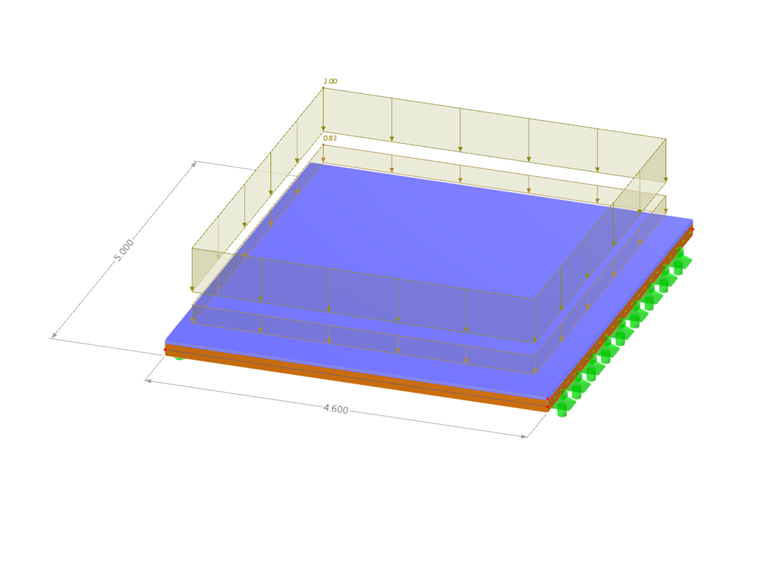
Actions
- Self-weight of the CLT plate: g1,k=0.15⋅5.5= 0.83 kN/m²
- Permanent loads – floor structure: g2,k = 2.00 kN/m²
- Imposed loads of Category B: qk = 3.00 kN/m²
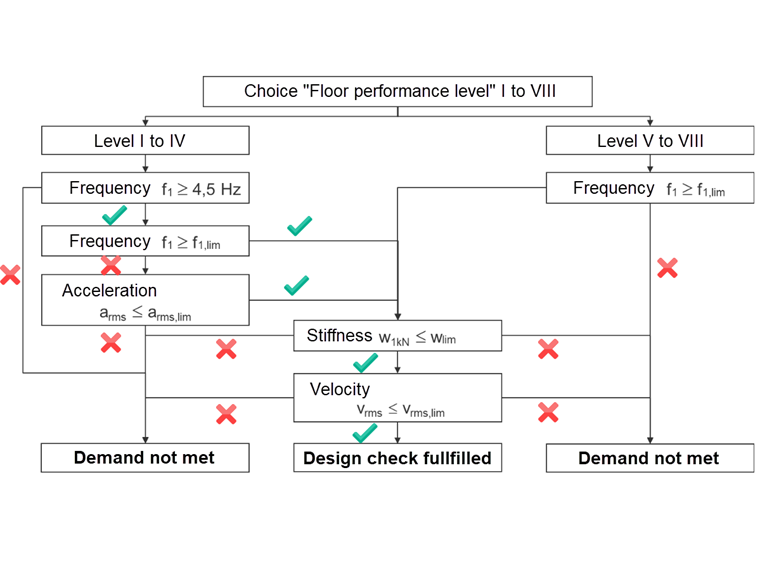
1. Selection of "Floor Performance Levels"
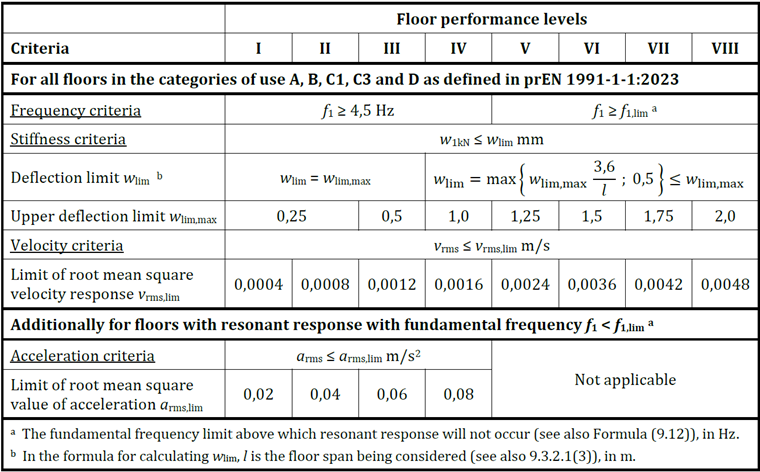
The requirements according to prEN 1995 are categorized into “floor performance levels,” which are divided into Categories I through VIII for residential and office buildings. The selection of the performance level should be coordinated with the building owner. In our example, we have selected Level III.
2. Frequency Criterion
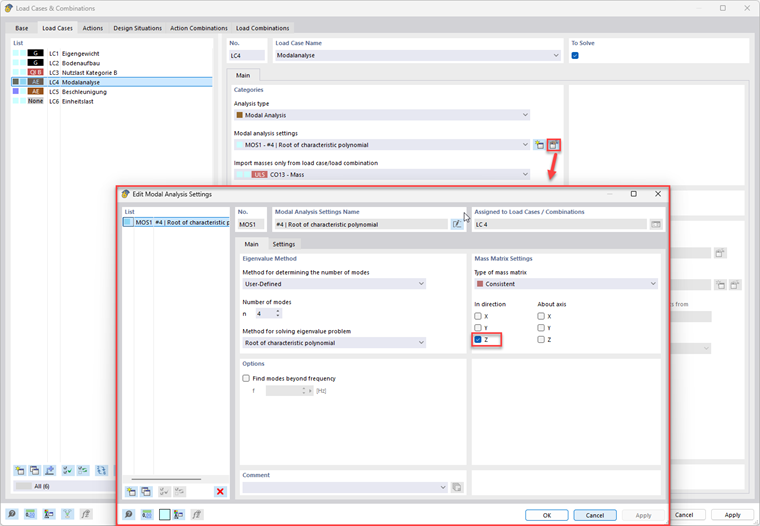
A modal analysis is used to determine the natural frequency of the slab. If it is below the limit value, there is a risk of noticeable vibrations, meaning that additional design checks are required.
First, the masses of the structural system are defined in a suitable load case or load combination. Then, a separate load case of the modal analysis type is created, taking these masses into account. In the modal analysis, the mass matrix should be configured in such a way that only movements in the Z-direction (perpendicular to the slab plane) are considered.
Result of Frequency Analysis
𝑓1 = 7.36 Hz
𝑓1,literature = 7.36 Hz [2]
𝑓1,lim = 8.00 Hz
𝑓1,min = 4.50 Hz
The required limit frequency is not reached. This means that, in addition to the deflection design based on a concentrated load at the most unfavorable location, an acceleration design is also required. The prerequisite for fulfilling the acceleration criterion is that the minimum frequency 𝑓 ≥ 4.50 Hz is maintained.
3. Acceleration Criterion
The slab is excited with a sinusoidal load at its natural frequency, causing it to resonate. The acceleration is recorded and checked to ensure that it is within allowable comfort limits.
To analyze the acceleration criterion, a new load case of the “Time History Analysis | Time Diagram” type is created first. A unit load is then applied to the center of the floor slabs.
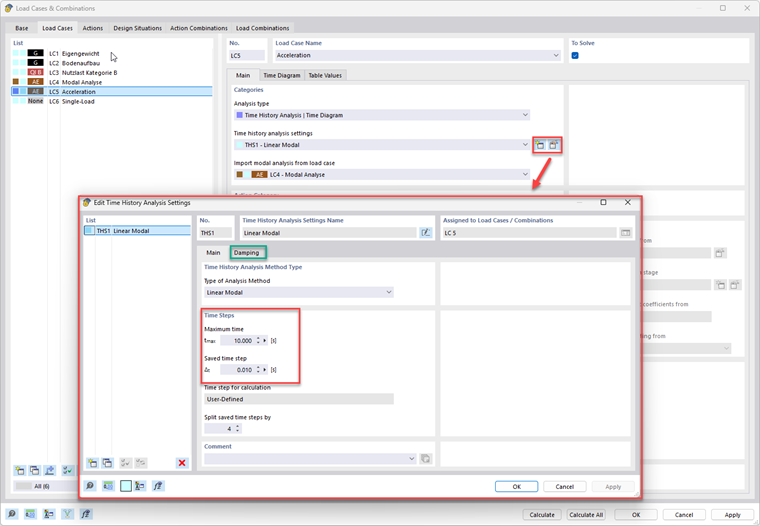
For the time history analysis settings, a total duration of 10 s, a time step of 0.01 s, and a Lehr damping of 0.040 are used for glulam slabs with floating screed [1].
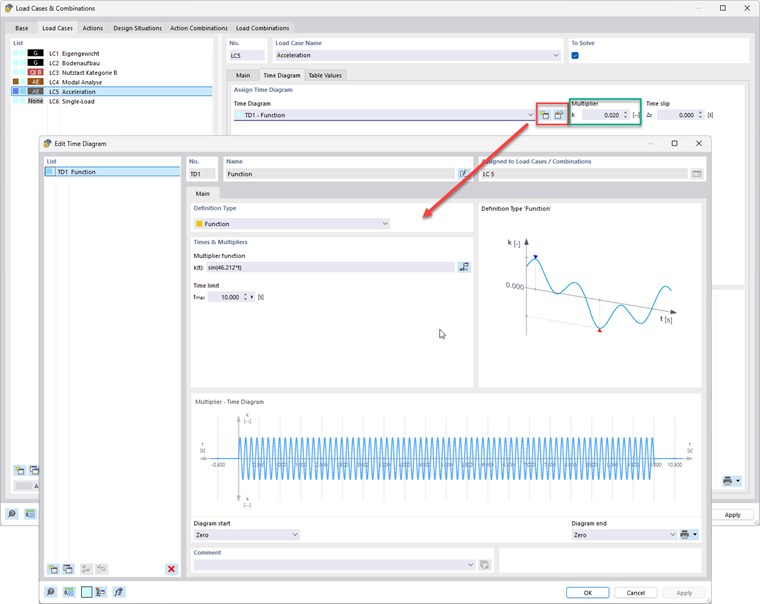
For the time diagram, a feature corresponding to the shape sin(ω*t) is selected. The natural frequency ω can be taken from the results of the modal analysis or calculated using ω = 2πf1 .
The multiplier k is calculated as follows [1]:
k = 𝑘res ⋅ 𝜇res ⋅ 𝐹dyn = 1 ⋅ 0.4 ⋅ 0.050 = 0.020
Result of Acceleration Analysis
apeak = 0.076 m/s²
arms = apeak / √2 = 0.054 m/s²
arms,lim = 0.060 m/s²
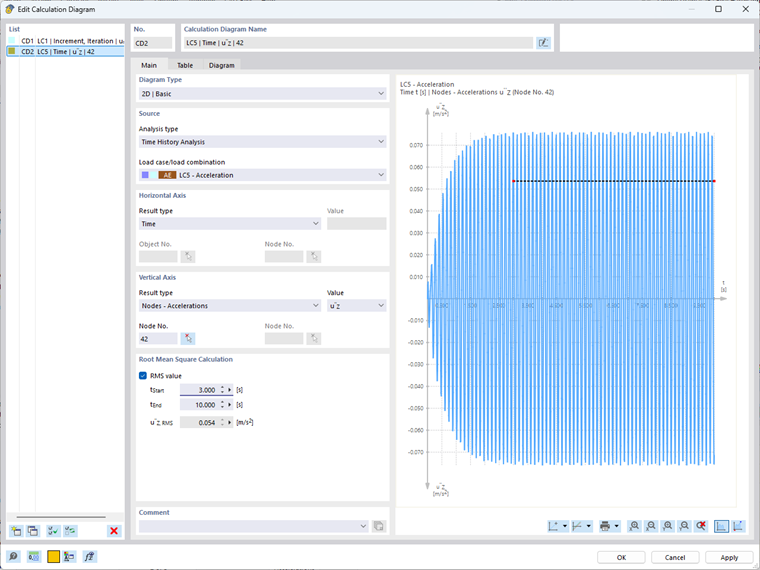
The maximum acceleration apeak can be obtained in the program. The acceleration criterion is fulfilled according to prEN 1995 for Level III, since the root mean square value of the acceleration arms is smaller than the limit value of the standard arms,lim.
The results of the analysis can be displayed in more detail in a calculation diagram monitor. The root mean square value can also be read out.
4. Stiffness Criterion
The deflection under a unit load is calculated and compared with a limit value. This is used to check whether the slab is sufficiently rigid to limit vibrations.
For the stiffness criterion, a unit load w1kN is applied to the structural system and the deflection from this load case is compared with the specified limit value [1]. In our example, the stiffness criterion for the unit load is fulfilled.
Result of Stiffness Analysis
w1kn = 0.22 mm
wlim,max = 0.50 mm
5. Velocity Criterion
The velocity criterion evaluates the dynamic behavior of the slab as a result of an impulse-like excitation (for example, walking). In contrast to the acceleration criterion based on harmonic excitation, the vibration velocity describes the vibration perceived directly by the user. It is determined from the applied impulse and the effective mass of the slab and compared with the limit values of prEN 1995-1-1.
Peak velocity pressure [1]:
v1,peak = kred (Imod,mean/(M* + 70))
Modal momentum [1]:
Imod,mean = (42 ⋅ 𝑓w1.43) / 𝑓11.3
For Imod,mean, multiplying by the factor kred (=0.7) results in a value of 5.91 Ns. The footfall is assumed to be 𝑓w = 2 Hz (1.5 Hz for residential ceilings) and the calculated natural frequency of 𝑓1=7.36 Hz is used [1].
In order to consider the additional mass of 70 kg, it is created in an additional load case and superimposed in a new load combination with the previous system masses. A separate modal analysis is then created with this mass.
To design the velocity, a new load case of the time history analysis type is created (the acceleration load case can be copied). A small time period can be selected for the new time history analysis settings.
In this case, a new time history analysis setting with a total duration of 0.5 s, a time step of 1e-03 s and Lehr's damping of 0.040 is used.
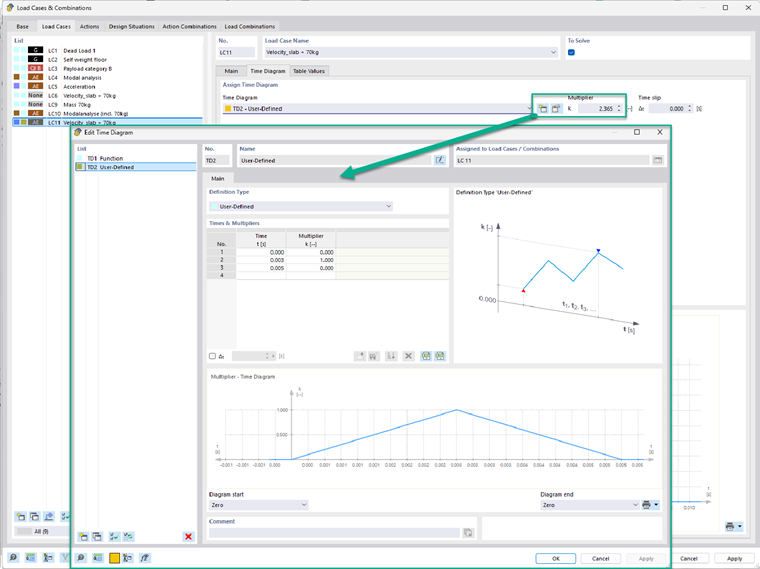
The pulse is plotted as a surface over the time diagram (Δ T =0.005 s). In this case, the momentum was applied as a triangular area and scaled by the multiplier.
k = 2 ⋅ I / T = (2 ⋅ 5.9136) / (0.005 ⋅ 1000) = 2.365
Result of Velocity Analysis
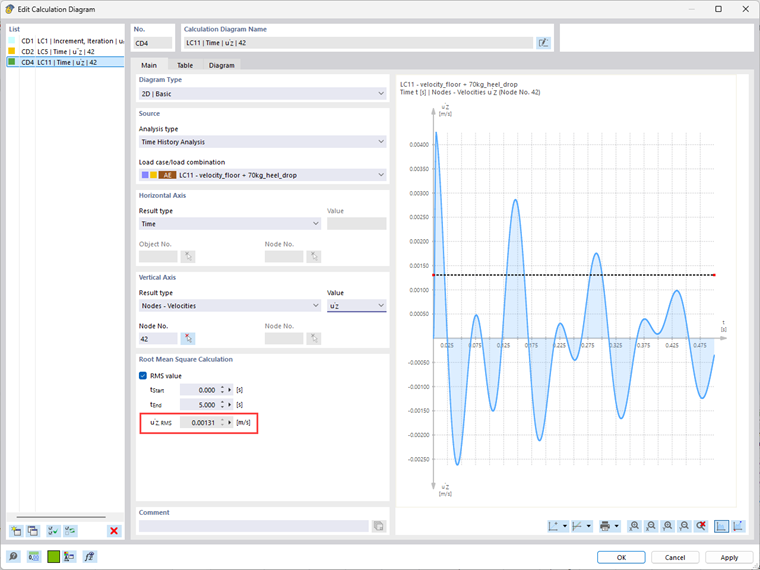
The result of the velocity analysis is given by the average value from the diagram. This slightly exceeds the specified limit value, which means that the design is not fulfilled.
vtot,peak = 0.0042 m/s
vrms = 0.0013 m/s
vrms,lim = 0.0012 m/s
Conclusion
The frequency, acceleration, and stiffness criteria fulfill the requirements for Level III, but the velocity criterion is exceeded. By selecting Floor Performance Level IV, the design checks can be fulfilled completely.