Case Study
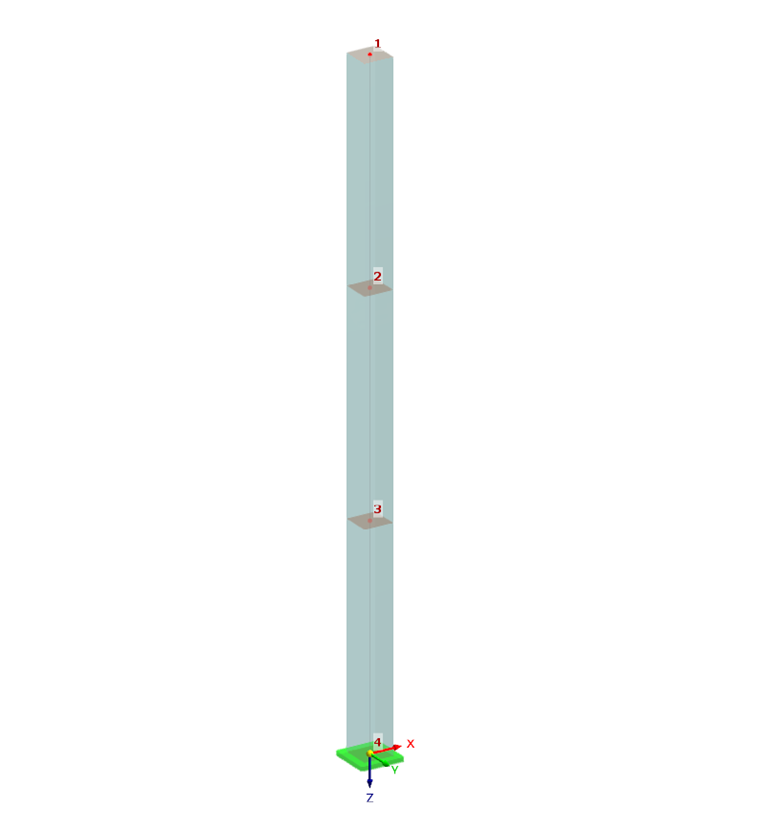
A three-story building can be simplified as a 3-DOF (degree of freedom) system. An idealized model is developed in RFEM, where each element is set to have mesh points only at the ends of the elements. The Mass Matrix Settings in the RSA only consider mass components in the X-direction. This ensures that the RFEM calculation is as close as possible to a “pure” 3-DOF system. This assumption corresponds to the classical analysis of a building, where all DOFs are assumed to be at the slab level.
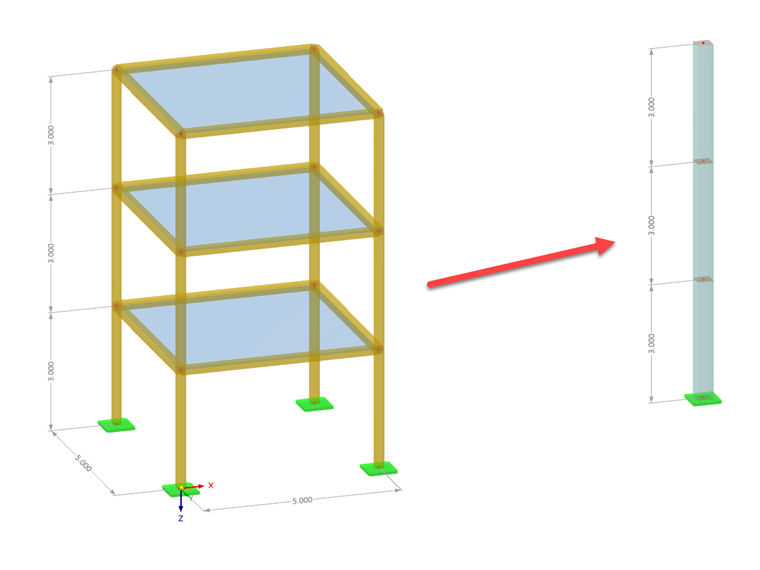
Vertical loads were defined at the nodes and used as the mass source. The cross-section is selected to achieve a fundamental period near the expected value for a three-story building, using the approximation rule of approximately 0.1 seconds per floor. The stiffness matrix is not treated in this example, but it is implicit in the modal shape results.

Input Data: Mode Shapes
The following information is extracted from the Modal Analysis in RFEM (LC2). Since there are only 3 DOFs in the system, the Modal Analysis settings must be configured to find a maximum of three modes.
- Mass Matrix
The table “Masses in Mesh Points” in “Modal Analysis” reports the assumed masses in the model. Based on this table, the following matrix can be constructed:
- Mode Shapes
The tab “Nodes by Mode Shape” in the table “Results by Node” in “Modal Analysis” summarizes the normalized displacements per mode. This information can be written as vectors:
|
ϕ1 |
Mode shape of the mode 1 |
|
ϕ2 |
Mode shape of the mode 2 |
|
ϕ3 |
Mode shape of the mode 3 |
- Natural Periods of Vibration
|
T1 |
Period of vibration of the mode 1 |
|
T2 |
Period of vibration of the mode 2 |
|
T3 |
Period of vibration of the mode 3 |
Reproduction of Modal Analysis Results
This section reproduces the Modal Analysis results that are required for the RSA using matrix operations. The results can be compared with the LC2 RFEM values.
1. Modal Mass
The Modal Mass can be obtained with the following cross-product matrix operation. For the first mode, the complete operation is shown; for modes 2 and 3, the value is reported. This format is maintained for all operations.
2. Participation Factors
Participation Factors can be calculated with the following operation:
|
|
Participation factor for the mode number i |
3. Effective Modal Mass
The Effective Modal Mass per Mode is obtained based on the two quantities calculated previously.
|
meff-i |
Effective modal mass of the mode number i |
4. Effective Modal Mass Factors
The Effective Modal Mass Factors can be calculated as the ratio of the Effective Modal Mass to the total mass in the system. The total mass in the system is the sum of all entries in the mass matrix.
|
feff-i |
Effective modal mass factor of the mode number i |
|
|
Total mass in the system |
RSA: Step-by-Step Calculation
1. Assessment of Modal Analysis Results
Most earthquake-resistant building codes require a certain percentage of mass participation when RSA is used. The most common rule is to reach 90% in the sum of the Effective Modal Mass Factors. The calculation of the Effective Modal Mass Factors serves the purpose of checking this requirement. The rule can be written for the case study as follows:
2. Read Spectral Acceleration from Response Spectrum for Each Period
The selection of the standard for the spectrum generation is irrelevant for the calculation, as long as the corresponding Spectral Acceleration values are used. The following information is directly extracted from the RSA Analysis (LC12) Settings in RFEM.
|
Sa-i |
Spectral acceleration of the mode i |
3. Calculate the Response Force Vector for Each Mode
This vector represents the forces that, when applied to the system, simulate the action of a mode on the system. In other words, the vector contains the static forces that simulate the dynamic problem for a given mode.
4. Alternative Procedure for Response Force Vector
An alternative procedure to obtain the force vector is to calculate the base shear for each mode and then distribute it according to the normalized mode shape. This formulation is closer to the approach of modern earthquake-resistant building codes, in which the base shear is used for controlling and checking the suitability of the dynamic analysis. The following steps summarize this approach; the calculation is carried out only for the first mode:
- Calculate base shear
- Calculate maximum floor force
- Calculate force vector
5. Static Solution for Each Force Vector and Physical Interpretation of Sign
The next step is to apply the force vectors per mode to the system and solve the system statically. The static solution provides the estimated displacement and internal forces on the system for each mode. Two important conditions of the calculated forces have not yet been considered. First, as the response is a vibration, the maximum value could occur either in the minus X or the plus X direction. Second, the earthquake can come either from the +X direction or the -X direction. Consequently, the calculated forces per mode must also be applied after being multiplied by minus one. For this, two load cases are defined per mode, considering the minus and plus X directions. LC3 through LC8 contain the complete set of forces for three modes and the plus-minus X directions. The next image summarizes the loads.
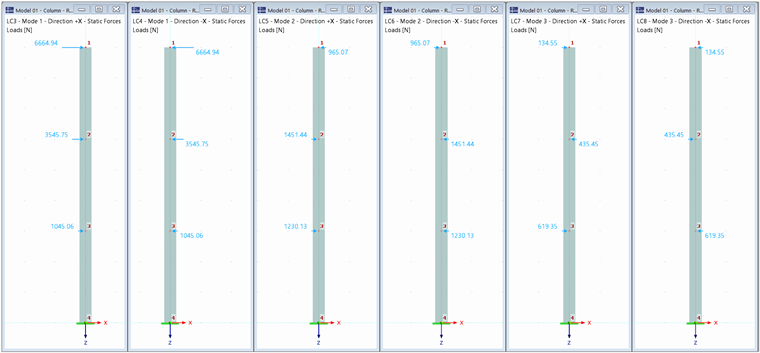
The results of the internal forces are shown in the next section, where they are directly compared to the corresponding RSA results.
6. Results Comparison Between RSA in RFEM and Generated Static LC with Force Vectors
Three RSA cases are defined in the RFEM model for result comparison with the static load cases from the previous section. LC9, LC10, and LC11 are RSA for Mode 1, Mode 2, and Mode 3, respectively. The following three images compare the results of one set of forces per mode with the RSA LC results in the program. For orientation, each window contains information about the LC number and the displayed internal forces. The correspondence between the results proves that the RSA internal forces calculated by RFEM match the step-by-step vector forces.


7. Final Results: Modal Combination Method
According to RSA assumptions, results from individual modes must be combined using an appropriate rule. The online manual (link below) provides an overview of the combination rules available in RFEM. In this example, the SRSS rule will be used due to its simplicity and suitability for hand calculation. The following table summarizes the Story Shear (Vz) calculation using the SRSS rule, with the operation written in the form of an equation.
| Node | Mode 1-Story Shear | Mode 2-Story Shear | Mode 3-Story Shear | Story shear combined |
|---|---|---|---|---|
| 1 | 6664.94 N | -965.07 N | 134.55 N | 6735.79 N |
| 2 | 10210.68 N | 486.37 N | -300.90 N | 10226.69 N |
| 3 | 11255.74 N | 1716.50 N | 318.44 N | 11390.33 N |
|
Vz-2 |
Story shear in node 2 using the SRSS modal combination method |
Another important RSA requirement is that operations between combined results are not allowed. An example of a parameter that requires special attention pursuant to this rule is Inter-Story Drift, which is the relative displacement between the top and bottom of a defined story. The relative story displacement must be calculated per mode, and then the modal combination method can be applied. It is against RSA principles to use “combined” results for displacement when calculating this parameter. For more insights on this topic, check out our Knowledge Base article:
Equivalent Loads Analysis (ELA) and RSA
In this section, a brief overview of the results in light of the ELA procedure is provided.
The manually created loads of LC3 through LC8 would be the core result of the ELA. In addition, a result combination would also be defined with the selected modal combination method. ELA uses RSA forces and does not calculate seismic loads independently. Thus, it can be concluded that ELA is based on modal analysis and RSA. ELA is popular among practitioner engineers because it is “capable of conserving the sign” and “easier to understand than RSA”. While the second statement is mostly true, it is debatable to claim that the RSA method does not preserve the sign. It is clear, for example, that the results of LC3 and LC4 are fully reproduced in LC9, including their sign.
Another particularity of the ELA is that the generated load cases can consider nonlinearities. As a result, it is often assumed that the ELA procedure has fewer limitations than RSA. Nevertheless, the basis of both RSA and ELA forces is Modal Analysis, which linearizes the structure if any nonlinearity is defined in the model. Hence, when using the ELA on a structure with nonlinearities, not all assumptions of the analysis are preserved: forces calculated on a linearized structure are applied to a structure with nonlinearities. This might lead to divergent results, and care must be taken when performing this type of analysis. The validity of this assertion depends on the type of nonlinearity and how much it affects the overall response of the system. A more detailed discussion on this topic is provided in the following Knowledge Base article:
Final Remarks
This RSA step-by-step calculation provides clarity on the origin of the RSA forces. RSA can be better understood as an application of Modal Analysis, rather than as a complete procedure in itself. The key to significant RSA results is a thoroughly examined Modal Analysis, as RSA performs operations based on the modal results without recalculating structural properties. ELA aims to reproduce RSA results while offering a simplified depiction of forces or a more simplified analysis. This article helps clarify the correlation between RSA, ELA, and Modal Analysis.