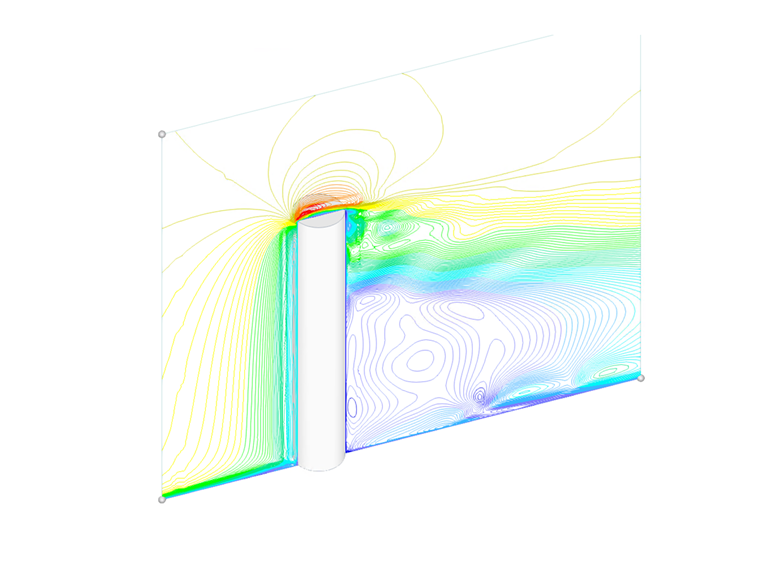
User Story
This example presents experimental measurements of aerodynamic forces and pressure distribution on a circular cylinder, which are widely used as benchmark data for validating CFD simulations in wind engineering. Flow around a circular cylinder represents a classical aerodynamic problem where flow separation, wake formation, and Reynolds number effects strongly influence the aerodynamic forces. Because of these phenomena, curved surfaces such as cylinders are particularly challenging for numerical simulations.
Experimental studies show that the aerodynamic coefficients of a cylinder vary significantly with the Reynolds number and surface roughness. At high Reynolds numbers typical of atmospheric wind flows, the measurements often show considerable scatter, indicating that the results depend not only on the Reynolds number but also on surface characteristics and turbulence conditions. The example can belong to Group 1, according to Figure 2.2 in WTG-Merkblatt-M3, based on investigating the average wind velocity value:
- G1: Qualitative values with low accuracy requirements for use in the basic investigation or preliminary design. The effort and the requirements for the level of detail are reduced, as often not all boundary conditions are fully clarified.
- R1: Solitary (without surrounding buildings), analysis of individual important wind directions.
- Z1: Statistical mean values, provided these concern stationary flow processes where fluctuations (e.g., due to approaching flow turbulence) can be sufficiently captured by other measures.
- S1: Static effects. It is sufficient to represent the structural model with the necessary mechanical detail, but without mass and damping properties.
Description
This validation example considers the flow around a finite circular cylinder mounted vertically on a flat plate under a uniform inlet velocity, providing a simplified and well-controlled benchmark for CFD simulations. The cylinder has a diameter of D = 30 mm and a height of L = 180 mm, and it is positioned within a wind tunnel-like domain where the incoming flow is aligned with the streamwise (X) direction, while Y and Z denote the lateral and vertical directions, respectively. Unlike atmospheric boundary layer (ABL) simulations, the inlet boundary condition is defined as a constant velocity profile, U(z)=Uo, with a free-stream velocity of 𝑈o=10, meaning that no vertical shear or velocity gradient is present. This assumption removes the complexity associated with boundary layer development and allows for a focused investigation of the fundamental flow physics around the cylinder.
At the given flow conditions, the Reynolds number based on the cylinder diameter is approximately 𝑅𝑒≈20,000, placing the flow in a subcritical regime where separation and vortex shedding are expected. The uniform inflow leads to a symmetric stagnation region at the front of the cylinder, followed by flow separation along the sides and the formation of a wake characterized by recirculation and periodic vortex shedding (in transient simulations). The interaction between the cylinder and the flat plate introduces additional complexity through near-wall effects and the development of a ground boundary layer, depending on the numerical resolution and wall treatment approach.
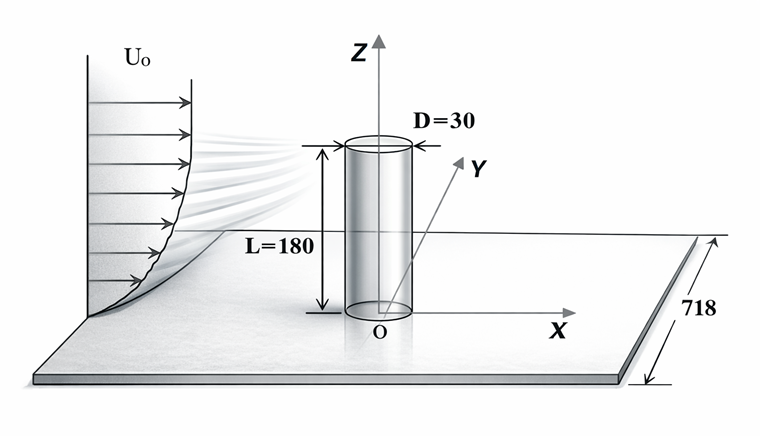
Table 1: Input data of the circular cylinder
| Parameter | Symbol | Value | Unit |
|---|---|---|---|
| Free Stream Velocity | u | 10 | m/s |
| Roof Height | Href | 180 | mm |
| Air Density – RWIND | ρ | 1.25 | kg/m³ |
| Turbulence Model – RWIND | RANS K-Omega | - | - |
| Kinematic Viscosity – RWIND | ν | 1.5×10⁻⁵ | m²/s |
| Scheme Order – RWIND | Second | - | - |
| Residual Target Value – RWIND | 10⁻⁴ | - | - |
| Residual Type – RWIND | Pressure | - | - |
| Minimum Number of Iterations – RWIND | 800 | - | - |
| Boundary Layer – RWIND | NL | 10 | - |
| Type of Wall Function – RWIND | Standard | - | - |
Computational Mesh Study
Figure 2 presents a mesh sensitivity analysis of a cylindrical model in RWIND. The calculated force coefficient (Cf) decreases slightly from 0.76 at a mesh density of 15% to 0.71 at 25%, and further to 0.70 at 35%. This gradual reduction indicates that the solution is stabilizing as the mesh is refined. The small variation in Cf at higher mesh densities demonstrates overall convergence, suggesting that further refinement has only a minor impact on the results.
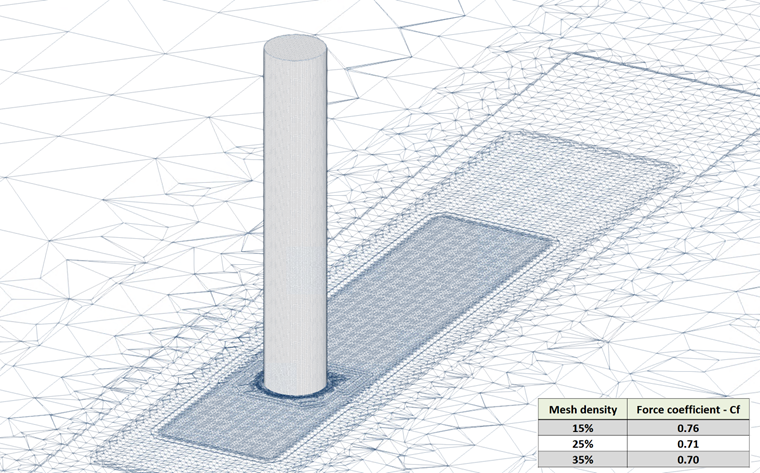
Also, the computational mesh study needs to be performed according to the following link:
WTG-Merkblatt M3 Accuracy Requirement
The WTG-Merkblatt M3 provides two key methods for validating simulation results. The Hit Rate Method evaluates how many of the simulated values Pi correctly match the reference values Oi within a defined tolerance, using a binary classification approach (hit or miss). This approach assesses the reliability of the simulation by calculating a hit rate q, similar to confidence functions used in reliability theory. In contrast, the Normalized Mean Squared Error (e2) method offers a more detailed accuracy assessment by quantifying the average squared deviation between simulated and reference values, normalized to account for scale differences. Together, these methods provide both qualitative and quantitative measures for simulation validation.
Results and Discussion
Figure 3 compares the mean pressure coefficient (Cp) from RWIND and experimental data across different wind directions. Both show strong agreement in overall trends, including stagnation at 0°, pressure drop due to flow separation, and recovery at higher angles. The minimum Cp occurs around 60°–70° and is well predicted by RWIND. However, RWIND slightly underestimates suction in the wake region at higher wind directions. Overall, the results indicate good global accuracy with minor deviations.
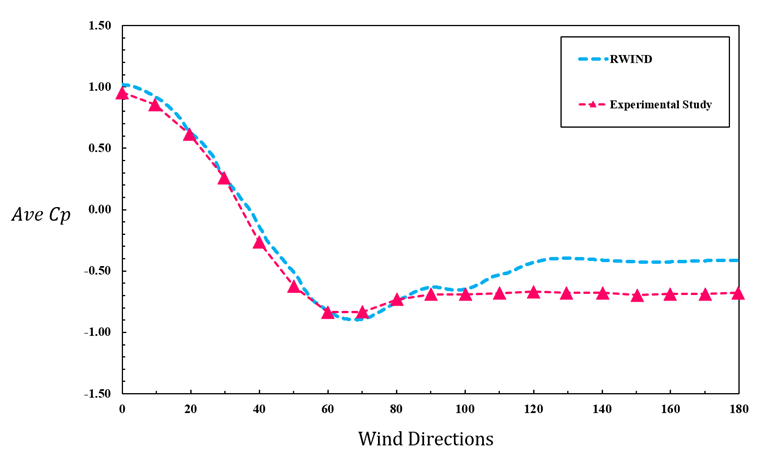
The comparison between RWIND and experimental pressure coefficients shows very good agreement for wind directions between 0° and 100°, where deviations remain below 10% and all data points meet both the 10% and 20% hit rate criteria. The largest discrepancies occur in the wake region (110°–180°), where RWIND systematically underestimates suction, leading to higher deviations of up to approximately 43%.
Overall, 58% of the results fall within a 10% (and 20%) deviation range. The global error metrics (e² = 0.05, MAE = 0.12, RMSE = 0.16) indicate acceptable predictive accuracy, with deviation mainly concentrated in the separated flow region.
Table 2: Comparison of Pressure Coefficient (Cp) Between RWIND and Experimental Data
| Degree | Cp – Experimental (Oi) | Cp – RWIND (Pi) | Pi-Oi | Deviation (%) | Hit rate ≤10% | Hit rate ≤20% |
|---|---|---|---|---|---|---|
| 0 | 0.95 | 1.02 | 0.07 | 7.37 | 🟢 | 🟢 |
| 10 | 0.86 | 0.91 | 0.05 | 5.81 | 🟢 | 🟢 |
| 20 | 0.61 | 0.61 | 0.00 | 0.00 | 🟢 | 🟢 |
| 30 | 0.26 | 0.25 | 0.01 | 3.85 | 🟢 | 🟢 |
| 40 | -0.26 | -0.24 | 0.02 | 7.69 | 🟢 | 🟢 |
| 50 | -0.63 | -0.57 | 0.06 | 9.52 | 🟢 | 🟢 |
| 60 | -0.84 | -0.84 | 0.00 | 0.00 | 🟢 | 🟢 |
| 70 | -0.83 | -0.89 | 0.06 | 7.23 | 🟢 | 🟢 |
| 80 | -0.73 | -0.75 | 0.02 | 2.74 | 🟢 | 🟢 |
| 90 | -0.69 | -0.63 | 0.06 | 8.70 | 🟢 | 🟢 |
| 100 | -0.69 | -0.65 | 0.04 | 5.80 | 🟢 | 🟢 |
| 110 | -0.68 | -0.53 | 0.15 | 22.06 | 🔴 | 🔴 |
| 120 | -0.67 | -0.44 | 0.23 | 34.33 | 🔴 | 🔴 |
| 130 | -0.68 | -0.39 | 0.29 | 42.65 | 🔴 | 🔴 |
| 140 | -0.68 | -0.42 | 0.26 | 38.24 | 🔴 | 🔴 |
| 150 | -0.70 | -0.43 | 0.27 | 38.57 | 🔴 | 🔴 |
| 160 | -0.69 | -0.43 | 0.26 | 37.68 | 🔴 | 🔴 |
| 170 | -0.69 | -0.42 | 0.27 | 39.13 | 🔴 | 🔴 |
| 180 | -0.68 | -0.42 | 0.26 | 38.24 | 🔴 | 🔴 |
| Metric | Value |
|---|---|
| Number of Data Points (N) | 19 |
| Hit Rate (10%) | 0.58 |
| Hit Rate (20%) | 0.58 |
| Normalized Mean Squared Error, e² | 0.05 |
| Mean Error, ME | 0.11 |
| Mean Absolute Error, MAE | 0.12 |
| Root Mean Squared Error, RMSE | 0.16 |