


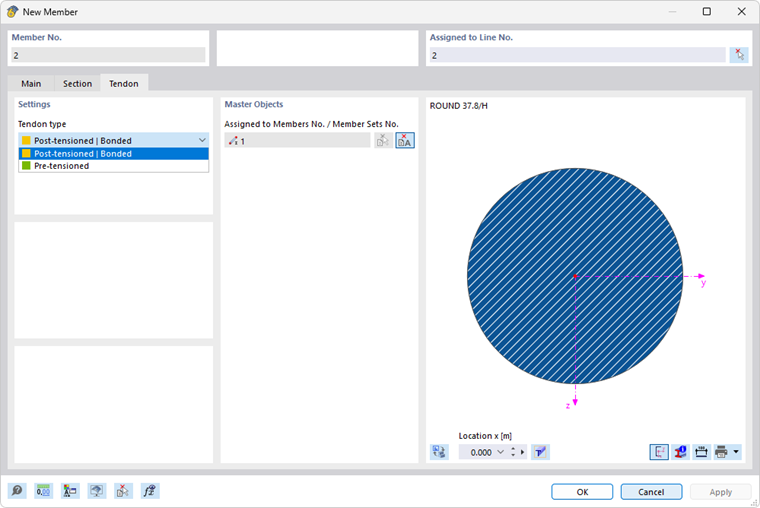
The special parameters of the post-tensioning tendon are defined in the “Tendon” tab of the “Edit Member” dialog box.
Settings
In prestressed concrete structure, there are two basic types of prestress and connection between the tendon and the concrete. The difference lies in the timing and the way in which the tendon is connected to the concrete.
- Immediate bonding: The tendon is placed in a sheath or directly in the concrete before concreting. During concreting, the fresh concrete encloses the tendon so that immediate bonding between the tendon and the concrete is established after hardening. The prestress is usually applied before concreting.
- Subsequent bonding: The tendon is laid in a sheath tube that is not filled during concreting. The tendon is only tensioned after the concrete has hardened. The sheath tube is then grouted with injection mortar, creating a post-tensioned bonding between the tendon and the concrete.
Select the “Tendon type” from the list (see the image Defining Specific Properties of Tendon).
Master Objects
As described in the chapter Prestressed Concrete Cross-Section, the tendons are located inside the cross-section of a prestressed concrete member. These members (member sets) are referred to as “master objects.”
The geometry of the prestressed concrete cross-section and the distribution of the tendon line enable the program to recognize in which member or member set the tendon is located. The numbers of the master objects are preset. This automatically connects the prestressed concrete member to the tendon.
If you want to assign the prestressed concrete member manually, deactivate the
 button. You can then select the member graphically in the work window using the
 button.
Outlook
The following features for tendons are under development:
- Anchor properties
- Concrete hardening