


All objects belonging to the floor of a defined story are automatically combined with this floor in a floor set. The floor sets are listed by floor in the Navigator - Data.
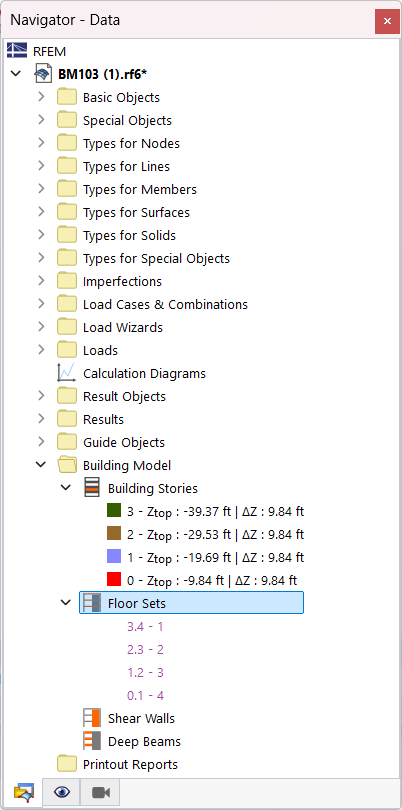
The objects are labeled in the navigator using a specific syntax. For example, the entry "0.1 - 5" refers to the story 0 with the floor set 1 , which manages all objects for floor surface No. 5.
Floor Set Properties
By double-clicking a navigator entry, you can check the properties of the floor set in a dialog box.
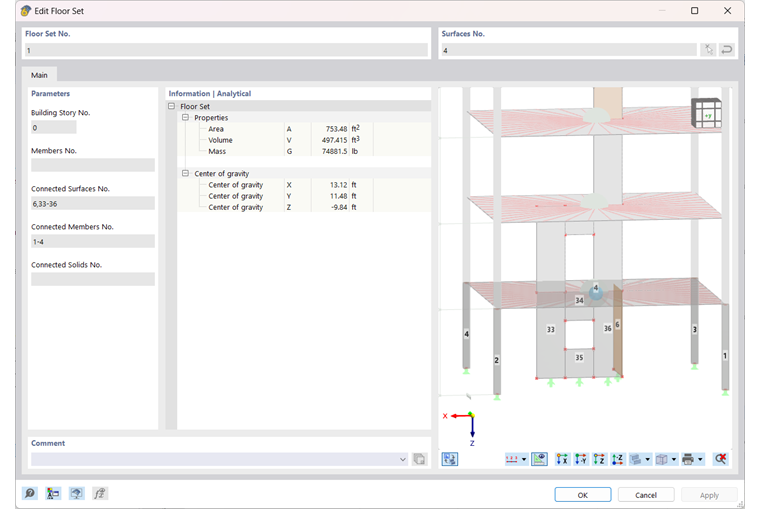
The surfaces of the floor are specified in the Surfaces No. section.
Parameters
In this section, you can see the number of the story and the members that are available in the floor of the story. You can also check which objects—surfaces, members, solids—are assigned to the story below the floor.
Use the
 button to display the objects of the floor set in the model view.
Information
In this section, you can find specific information about the current floor set. The first column of values lists the analytical information about the story, while the second column lists the information calculated based on the generated FE mesh.
Floor Properties of Floor Sets
When creating a floor set, the properties of the surface that represents the floor in the floor set are adjusted. You can check the changes in the "Edit Surface" dialog box.
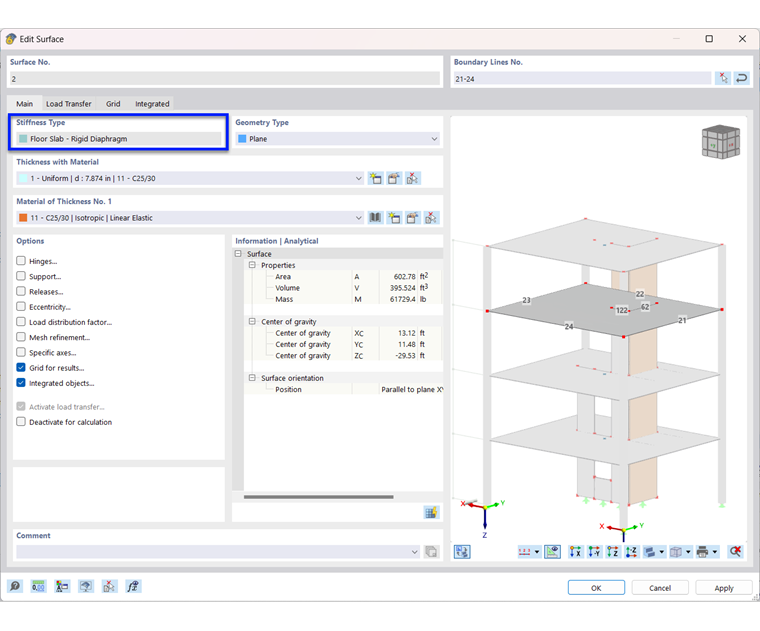
The "Stiffness Type" section shows the modeling type that you have specified for the story modeling .
You can check the load transfer parameters on the Load Transfer tab.
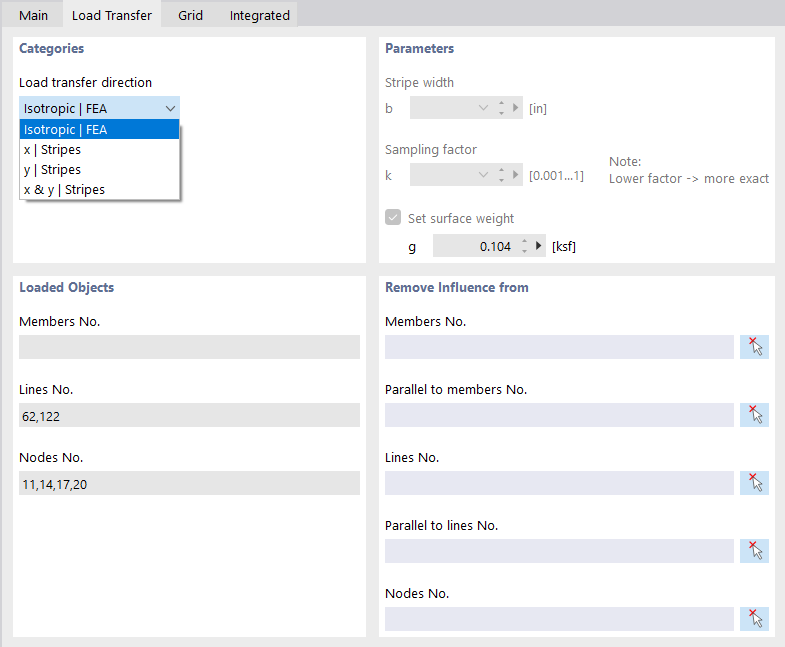
If necessary, you can adjust the 'Load transfer direction' and, for example, specify an orthotropic distribution. It is also possible to exclude certain objects—members, lines, or nodes—from load transfer. To do this, use the graphical selection via the
 button.