This chapter describes special features to consider when modeling a structure for the Building Model add-on.
Openings
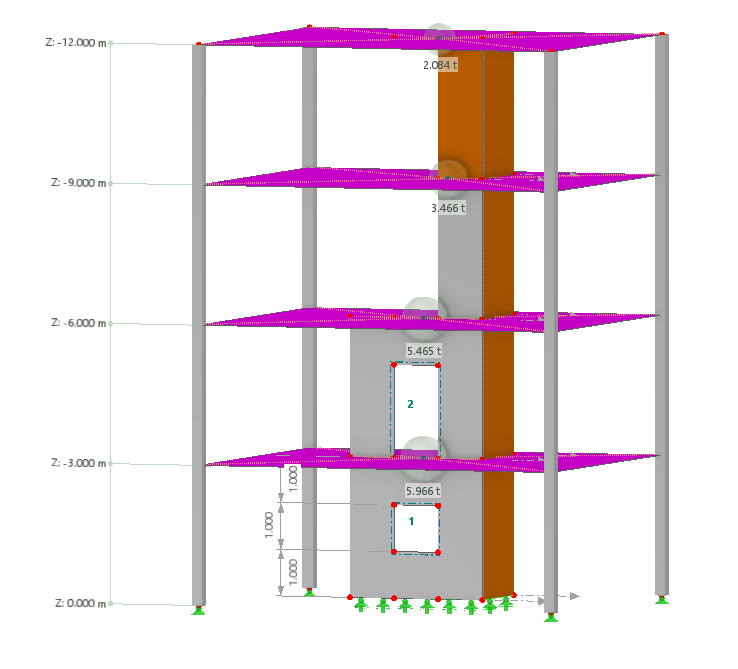
In a building model, openings must not be modeled as basic objects of the 'Opening' type. The following image shows such invalid modeling. In this case, it is not possible to output internal forces for each wall section (see chapter Results).
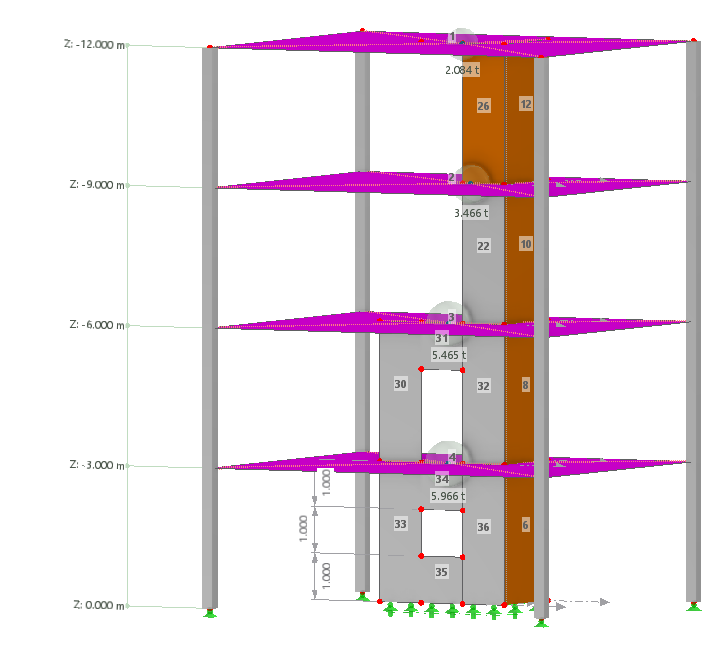
If, however, the openings are modeled using surface segments, as shown in the following image, the internal forces can be output for each wall section.
Rigid Diaphragms
If a rigid diaphragm is used to connect the individual structural components in a story, the floor is no longer represented with its actual stiffness. If you want to consider expansion joints, Isokorb elements, or similar elements, for example, use a different story modeling.
A rigid diaphragm couples all structural components of a story rigidly in the floor plane. Therefore, this option is not suitable for flexibly connected components, such as a timber frame or masonry walls. In this case, select the floor stiffness None | Original Stiffness. You can then consider the flexible connection through appropriate modeling, for example, using line hinges.
With the 'Rigid Diaphragm' floor stiffness, all structural components of a story – members, surfaces, and solids – are connected with a rigid link in the plane of the upper point of the floor. The connection is made at the center of gravity of the story. The governing criterion for this is therefore the weight of the individual connected components. Consequently, a very heavy member on one side of the story shifts the center of gravity in the corresponding direction.
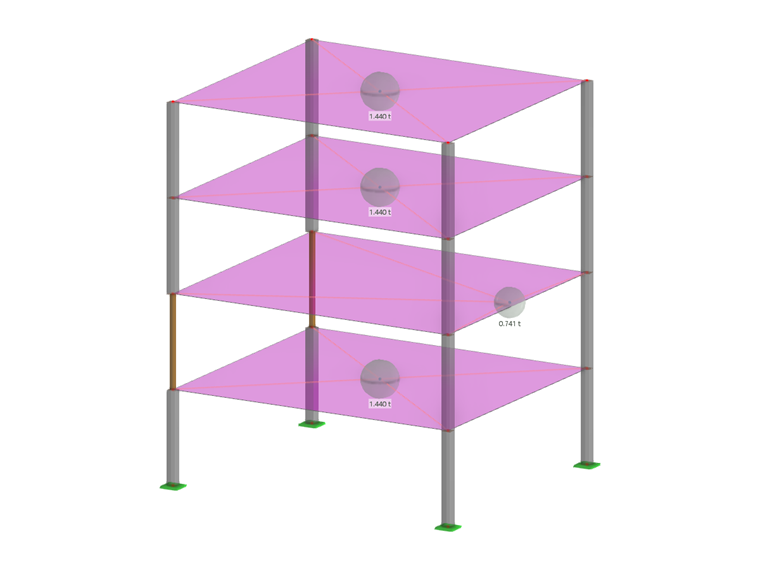
In the following model, there are relatively light timber members on one side of the second story. This causes the center of gravity to shift to the other side of the story.