


The 'None | Original Stiffness' story modeling corresponds to the familiar modeling in RFEM. Neither a floor set nor a load transfer surface is generated.
Nevertheless, the building model provides a wide range of improved and simplified information:
- Centers of mass and rigidity
- Mass per story
- Center of mass
- Cumulative mass / center
- Story actions
- Story forces
- Delta story forces
- Location of resultant story forces
- Interstory drifts
- Displacement
- Delta interstory drift
- Story center of gravity
Center of Mass and Rigidity
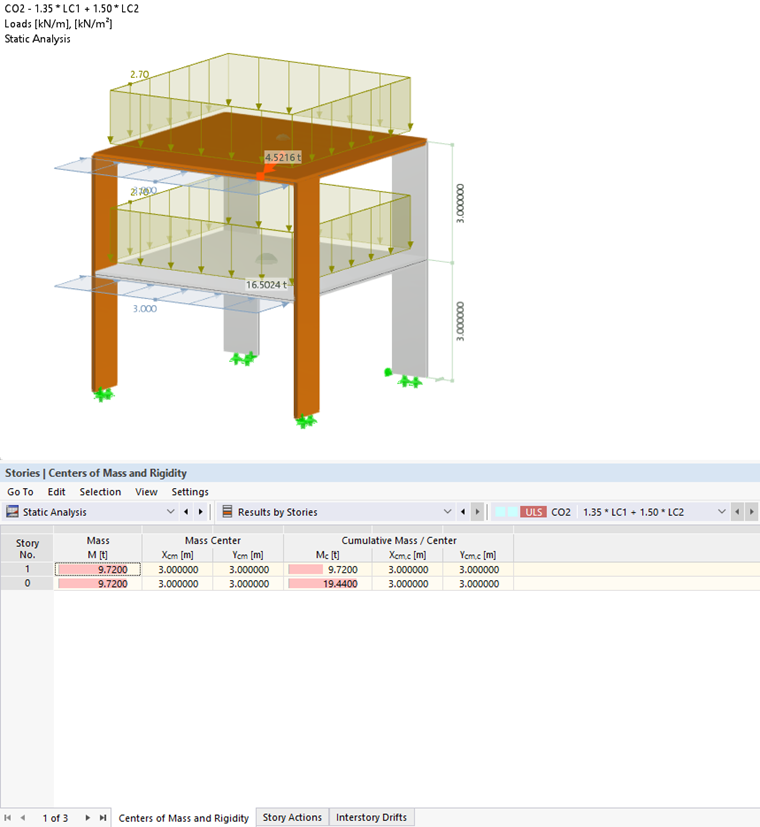
The center of mass, just like the mass listed in the table Static Analysis - Results by Stories - Centers of Mass and Rigidity, refers to the mass including the applied vertical loads. For the example shown here, a surface load of 2.7 kN/m² is applied in load combination 2. For a surface with 6m x 6m, this results in a mass of 9.72 tons. The center of mass is located at the center of the building. This output is helpful when there are many different loads on a single story.
The center of mass and the mass are calculated for each defined story.
Mass of 1st story for the example used here:
- 2 concrete walls at 0.9 t each
- 2 CLT walls at 0.151 t each
- Concrete floor 14.4 t
- 2*0.9+2*0.151+14.4=16.5 t
The cumulative mass and its center refer to the story above in each case.
Story Center of Gravity
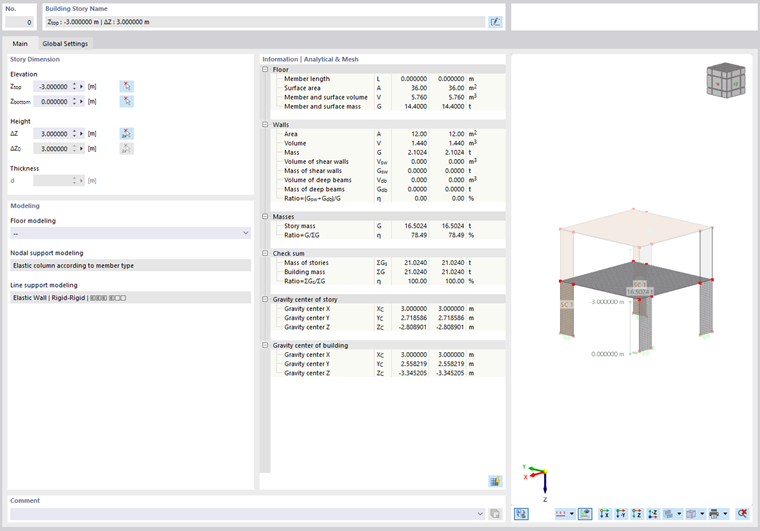
The story center of gravity is the center of gravity in each story. This point is displayed both in the Building Stories dialog box and in the Structure - Building Model - Building Story table.
For the 1st story of this example in Y-direction:
The following image shows the result from the building model for comparison
Story Actions
The Story Actions result table contains the story forces, the difference of story forces per story, and the location of the resultant story forces.
The story forces are always output for the top and bottom point of a story. For the example in this chapter, in load case 2, this results in a horizontal force in Y-direction of 2 kN/m × 6 m = 12 kN, which is introduced in each story. With a correspondingly refined FE mesh setting, this result is readily achieved, as shown in the following image.

The slight deviations from the manual calculation result from the warping or rotation of the shear walls at the line hinges and line supports.
Interstory Drifts
Similar to the Story Actions table, the Interstory Drifts table lists the displacements of each story and the difference in displacement in each story.
In the attached example, the maximum displacement in the top story, LC2, is 8.25 mm in the global Y-direction. Since the displacement in the story below is 3.4 mm, a value of 4.85 mm is output here as the difference.

Vertical Result Lines
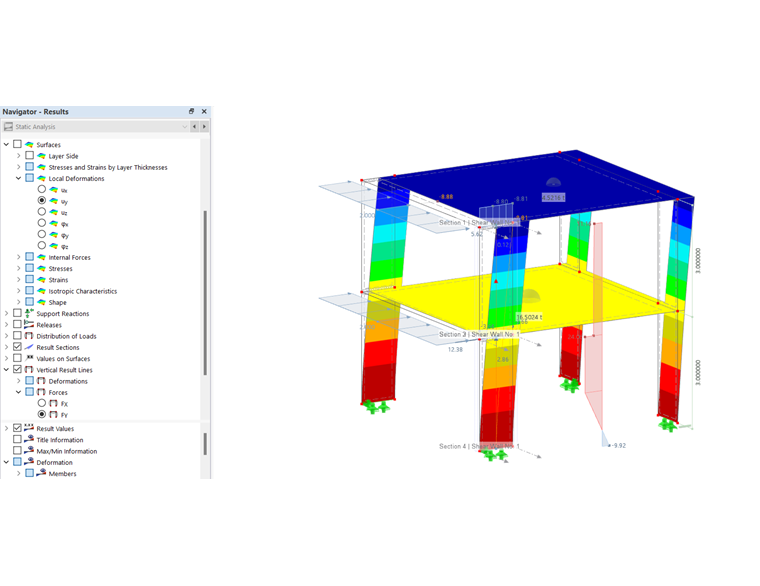
As soon as a building story is defined, vertical result lines for that story appear in the Navigator - Results. This allows all deformations and forces in the respective story to be displayed graphically.
Shear Walls
The definition of walls and deep beams is described in the preceding chapters of this manual. In this example, a shear wall is defined on the cross-laminated timber wall in surfaces 11 and 12.
Once shear walls are defined, two additional result tables are displayed.
The Forces in Shear Walls table shows the total forces and the forces per unit length.
These forces are converted into member forces in the Member Forces in Shear Walls table via a result beam. These forces are also used to design the shear walls in the Concrete or Timber Design add-on. In addition, these forces are available in the Navigator - Results, just like normal member internal forces.
Furthermore, the shear walls automatically generate result sections at the top and bottom of the story. Among other things, the resultant force of a wall is also displayed graphically here.
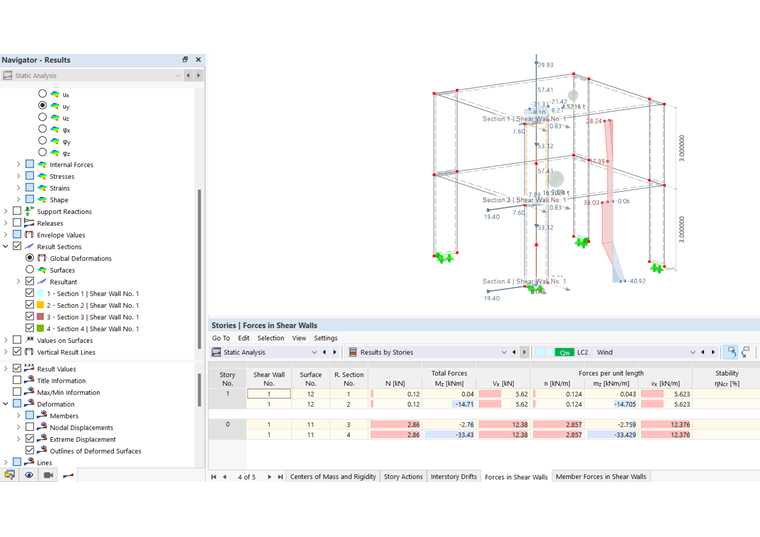
The Member Forces in Shear Walls table lists the percentage of the critical compressive load as well as the compression. For this example, this is calculated in load case 1 as follows:
ηNcr=N/Ncr=22.3 kN/1737 kN=1.28%
The column ηNc is calculated from the allowable compressive force divided by the existing compressive force.
ηNc=N/Nc=22.3 kN/2520 kN=0.89%
Nc=fck=2.1 kN/cm²*1200 cm²=2520 kN

