


Material Behavior
An overview of the properties of the modified Mohr-Coulomb model is provided in the corresponding chapter of Theoretical Principles.
Input Dialog Box
In order to represent the material behavior, the model requires the following parameters to be entered.
- φ – Friction angle
- c – Cohesion
- ψ – Dilatancy angle
- E – Modulus of elasticity
- ν – Poisson's ratio
The shear strength parameters—friction angle and cohesion—as well as the dilatancy angle of the soil can be entered in the specific input tab for the Mohr-Coulomb model. This is shown in the image below.
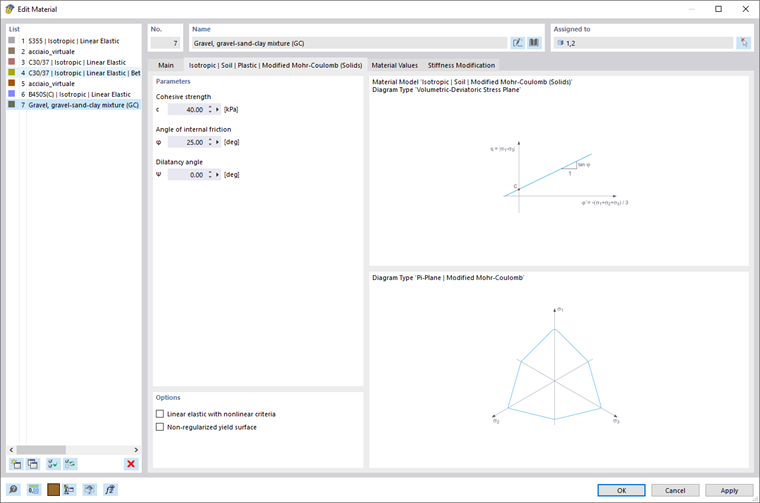
The modulus of elasticity and the Poisson's ratio have to be defined in the “Main” tab, which is shown in the parent chapter Input – Materials of Soil Type.
Options
Linear Elastic with Nonlinear Criteria
This option allows for a short-term deactivation of the material nonlinearity. This can be useful if you need to determine the cause of instabilities.
Non-Regularized Yield Surface
This option controls whether the rounding of the yield surface corners should be taken into account for the Mohr-Coulomb model.
- If this check box is not activated, the Modified Mohr-Coulomb model is applied including the rounding of the yield surface corners according to Abbo-Sloan.
- If this option is activated, the classic Mohr-Coulomb model without a regularized yield surface is applied with the corners of the yield surface rounded off.
Additional Notes
Cohesion
When using numerical methods, such as FEM, in geotechnical engineering, it is recommended to always apply a non-zero cohesion. Therefore, a small cohesion between 0.5 and 1.0 kN/m² can be applied even for non-cohesive soils.
Dilatancy Angle
The following relation can be used for the dilatancy angle. [1]