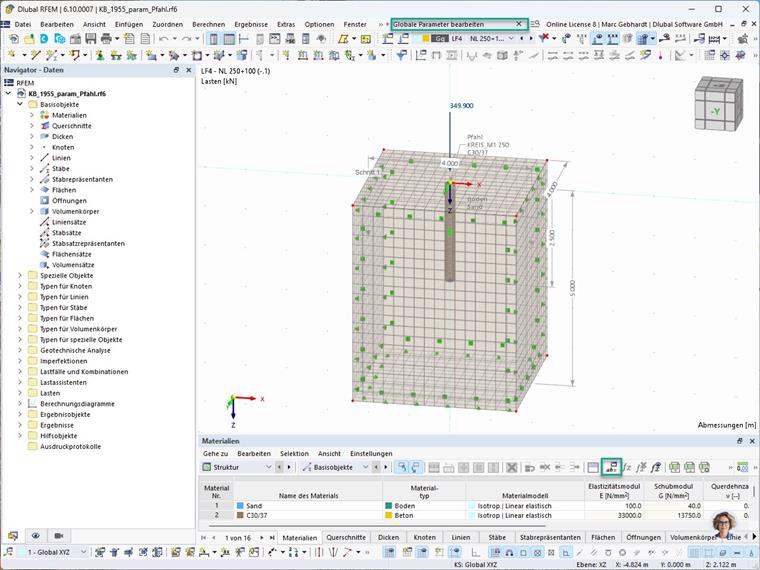
In RFEM, piles are modeled as beams. These beams are connected to the surrounding soil and can therefore transfer forces. The modeling is described in the chapter on Pile and Anchor member types.
The connection is carried out by friction in the surface area and peak pressure.
Implementation in RFEM
In RFEM, the connection between the pile and the surrounding soil solid is currently created using a release, which can be imagined as an eight-armed spoked wheel. These spoked wheels have their center at each FE node of the member. The release is characterized by a linear-elastic ideal-plastic behavior defined by the pile resistances.
Here, the member is assumed as a cylinder, with a variable cross-section along its length, if necessary. The diameter results from the cross-sectional area assumed to be a circular surface. The end points of the rigid links are then connected to the solid mesh of the surrounding soil via independent meshing, weighted according to their distance. The following image shows this in detail:
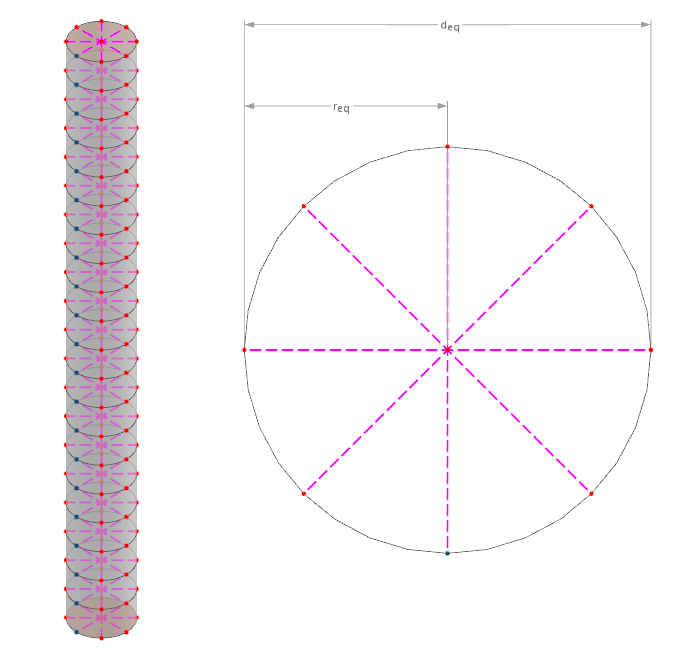
The equivalent diameter can thus be calculated as shown in the following formula.
Pile Resistances
Calculation of Resistances
The shear strength can be calculated using the bond length and the equivalent diameter from the total shear strength. This is shown in the following formula, assuming a constant shear strength and cross-section.
|
Fr,s |
Total resistance of the pile shaft (friction) |
|
deq |
Equivalent pile diameter (circular surface) |
|
lb |
Bond length of the pile |
The axial strength at the pile tip can also be determined from the total resistance using the equivalent pile diameter, as shown in the following formula.
|
Fr,b |
Total resistance of the pile tip |
|
deq |
Equivalent pile diameter (circular surface) |
Calculation of Stiffnesses
The stiffness can be calculated based on test loadings and/or empirical values. Franz Tschuchnigg suggests another option in his dissertation [1] using empirically determined formulas. These are listed below for shaft resistance and axial stiffness. Furthermore, the recommended adjustment factors for input in RFEM are included here.
|
|
Shear modulus of the in-situ soil (from Poisson's ratio and modulus of elasticity; modulus of elasticity for nonlinear material model: simple (for example, Mohr-Coulomb) initial load Eprim or higher-order (for example, hardening soil) Eur~5 x E(50),prim) |
|
Γs |
Adjustment factor for the pile shaft (empirical; recommended: 1) |
|
Δs |
Initial value of the skin friction (empirical; recommended value: 0) |
|
fs,RF |
Adjustment factor RFEM (recommended value: 1) |
|
G |
Shear modulus of the in-situ soil (from Poisson's ratio and modulus of elasticity; modulus of elasticity for nonlinear material model: simple (for example, Mohr-Coulomb) initial load Eprim or higher-order (for example, hardening soil) Eur~5 x E(50),prim) |
|
Γb |
Adjustment factor for the pile tip (empirical; recommended: 5 to 10) |
|
req |
Equivalent radius of the pile tip |
|
fb,RF |
Adjustment factor RFEM (recommended value: 0.01) |
By inserting the recommended values, the shaft resistance and axial stiffness can be entered using the following formulas.
|
|
Shear modulus of the in-situ soil (from transverse strain and elastic modulus; elastic modulus for nonlinear material model: simple (for example, Mohr-Coulomb) initial load Eprim or higher order (for example, hardening soil) Eur~5 x E(50),prim) |
|
req |
Equivalent radius of the pile tip |