


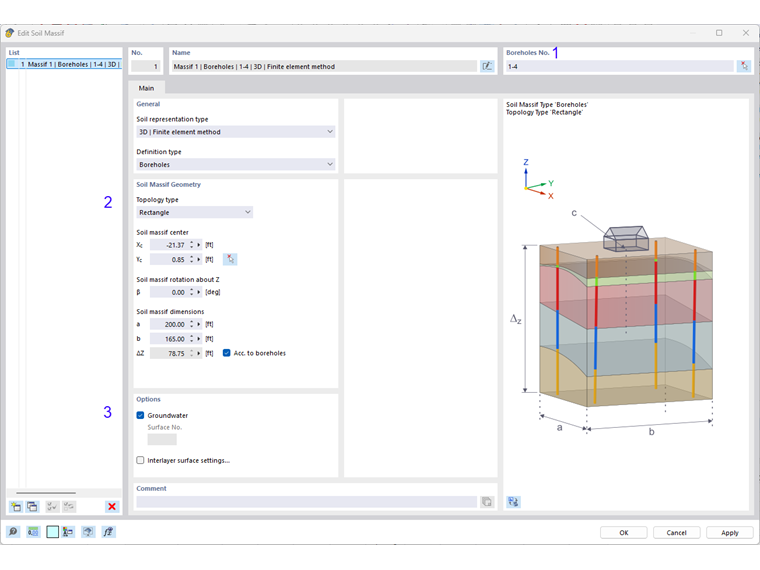
You can enter the “Boreholes” type of soil massif using the dialog box displayed below.
Boreholes
The boreholes from which the solid is to be generated are assigned to the solid in Area (1). This can be done directly by entering the number of the respective sample in the corresponding text box or by selecting it graphically.
Soil Massif Geometry
In Area (2), you can define the soil massif geometry. The topology type describes the shape of the soil massif area.
It is necessary to specify the center of the soil massif area. The dimensions a and b describe the total lengths of the outer edges of the massif.
The upper edge of the massif is determined by the upper edge of the soil samples. The depth of the massif is described by ΔZ.
A rotation around the z-axis can be defined for the massif.
Options
If the groundwater level is to be taken into account in the subsequent analysis of the soil massif, the corresponding check box must be selected under Options in Area (3). By activating the check box, the groundwater surface is generated from the respective groundwater levels of the assigned soil samples and entered in the text box of the check box.
Furthermore, the “Enable interlayer surface settings” check box can be activated here. A tab with the same name will appear next to the main tab of the soil massif. Here, you can specify the support points of the splines that define the layer boundaries.
Both options and their effects are shown in the following image.

Generate
If the soil mass is fully described by the input values, it can be generated using the “OK” or “Apply” buttons.
Using the Generate function, a soil mass consisting of one solid of the “Soil” type per layer is created from the soil samples in accordance with the specified geometry and layering. For this purpose, the boundary surfaces of the solid soil layers are approximated using NURBS surfaces. If a two-dimensional type is selected as the soil representation type, the generated solids are deactivated for the calculation, as they are only required for determining the elastic constants of the support.
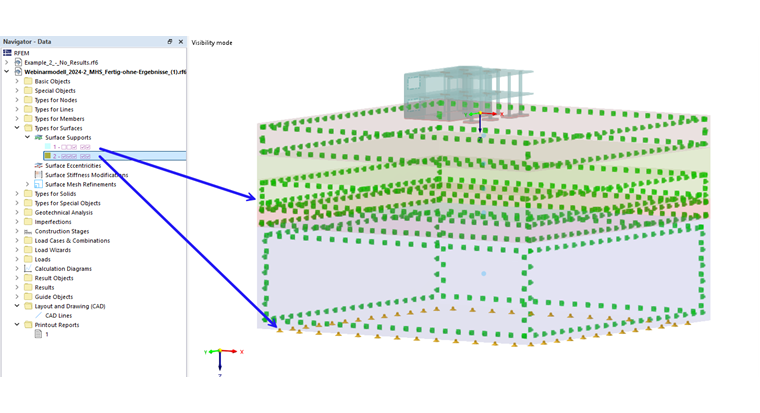
Furthermore, the surface supports for the lateral and lower edge surfaces are generated if you have selected the three-dimensional soil representation. The supports used here are hinged surface supports on the bottom side and loose supports that allow displacements parallel to the surface for the lateral edge surfaces.
The generated support can be found and viewed in the Navigator – Data in the surface support subfolder of the Types for Surfaces folder, as shown in the following image.
Video
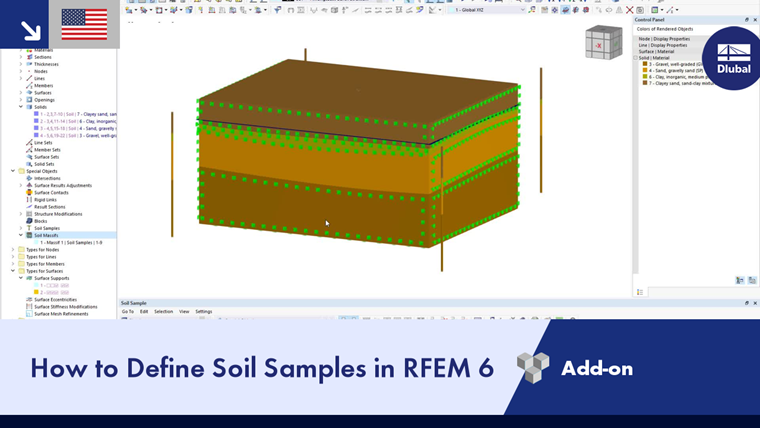
The following video briefly shows the procedure for creating soil massifs in RFEM 6 by generating them from boreholes.

>