


In the case of the “Static Deformation” imperfection type, the imperfections are based on the deformations of a load case or a load combination.
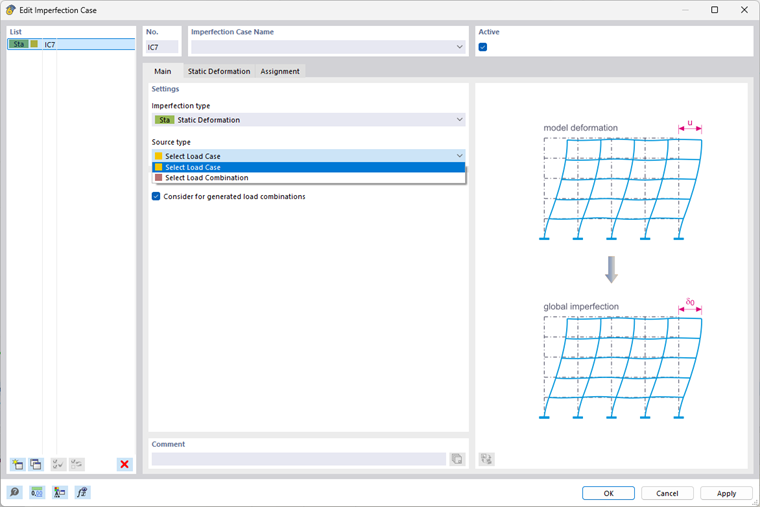
In the “Static Deformation” tab, select a load case or load combination as the source for the deformation or create a new load case or load combination.
When selecting a new load case, make sure that it is defined without an action category so that it is not included in the load combinations.

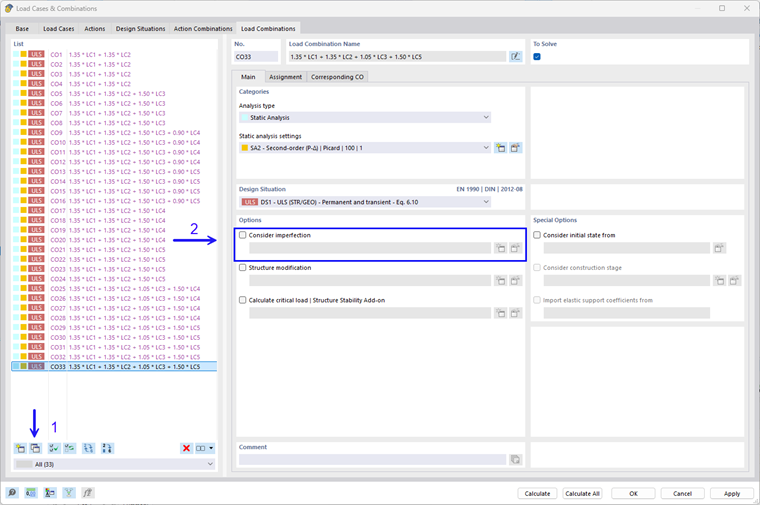
If you want to generate the imperfection from the deformation of an existing load combination, it is necessary to copy it first and deactivate the imperfections. Then, select the copied load combination as the basis for the imperfection.
Imperfection Magnitude
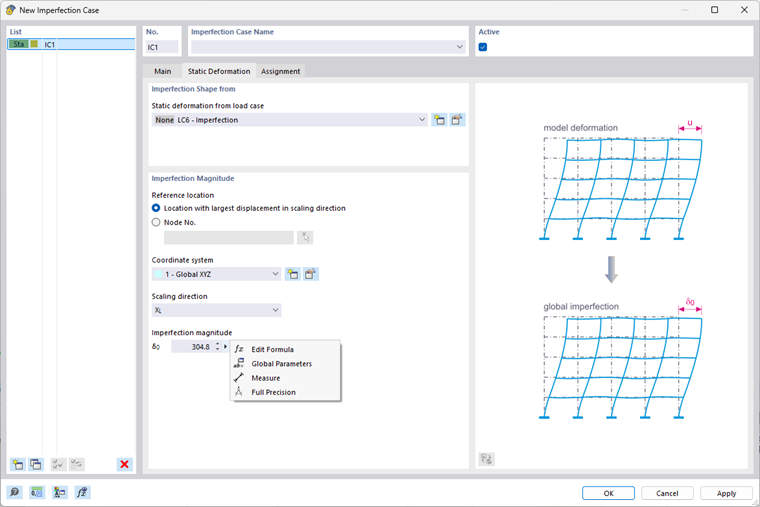
As in the case of the Buckling Mode imperfection type, you should also select a reference point and a scaling direction here. The deformation from the selected load case is scaled in such a way that the specified deformation value in the scaling direction is reached at the reference point. This means that the load values in the specified load case or load combination have no relevance for the generated imperfection.
Specify the deformation value for the scaling directly or using a formula. By using the formulas, you have the option of defining a dependency on a member length.
Calculation of Imperfection Case
After calculating the imperfection case, you obtain the scaled deformations of the structure as a result of the “Static Analysis”, which are considered as imperfections. This type of imperfection is not taken into account using equivalent loads, but rather a displacement of the FE elements in the calculation.
If the imperfection case is assigned to a load case or load combination to be calculated, the imperfection case is calculated automatically.