General
The time-dependent analysis of the Long-term effects is performed using the time-step method. For this, the time period to be analyzed is incrementally decomposed into time points, between which a linearized calculation of the stress and deformation state is carried out. The time points to be calculated can be distributed linearly or logarithmically. However, due to the general nature of time-dependent behavior (decaying exponential function), a logarithmic distribution is recommendable. Its definition is discussed in more detail in Chapter Input. The approach is performed according to the definition in Input of the time-dependent parameters. The shrinkage strain is applied as loading according to the time-vector values and, depending on the system, generates strains and/or constraint stresses. For aging, an increase or decrease of the material parameters (modulus of elasticity and strength) is applied according to the time-vector definition per time increment. A somewhat more complex approach is required for creep and relaxation, which is why the following point discusses this in more detail. In simplified terms, a material law with memory is applied based on the input.
Viscoelastic Behavior
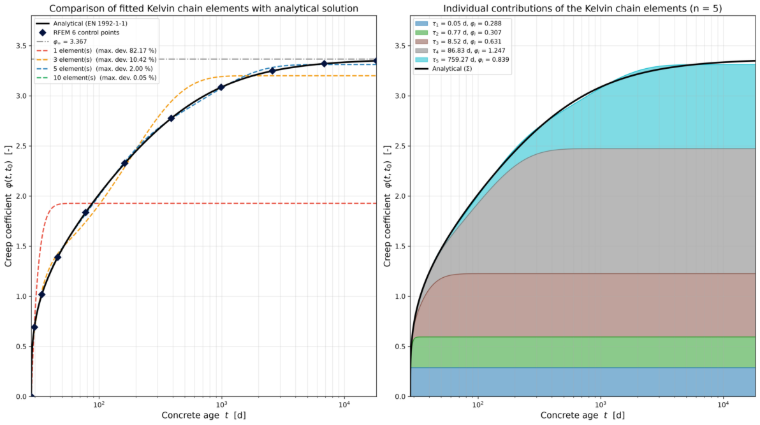
Within the framework of the finite element analysis for creep and relaxation, the models described in Chapter Rheological Models are time-discretized from the differential equation form. For this purpose, the time-dependent kernel functions are numerically implemented in each time step via internal variables, stress, strain, and retardation time. This results in a sum of exponentially decaying functions per time step. Thus, in each step, the strain of the FE element is determined from the displacement field. Subsequently, the internal variables are updated, and the stresses are determined from the material law. If geometric or material nonlinearities exist, the nonlinear equation system must be solved iteratively.
Creep of Concrete Using the Creep Coefficient According to Eurocode
According to EN 1992-1-1, Section 3.1.4, the creep coefficient φ(t,t0) is a dimensionless quantity that describes the ratio of creep to instantaneous strain:
|
|
Creep coefficient |
|
|
Creep strain |
|
|
Elastic strain |
|
|
Concrete strain over time |
|
|
Immediate strain of concrete |
|
|
Strain of concrete over time |
|
|
Immediate strain of concrete |
|
|
Creep coefficient |
|
|
Stress (constant) |
|
|
Mean modulus of elasticity of concrete |
|
|
Strain of concrete over time |
|
|
Stress (constant) |
|
|
Creep coefficient |
|
|
Mean modulus of elasticity of concrete |
|
|
Weight factor (conditions: greater than 0, and their sum must equal 1) |
|
|
Time increment |
|
|
Number of time increments |
|
|
Creep coefficient at time i |
|
|
Creep coefficient (infinite) |
|
|
Current element |
|
|
Number of elements |
|
|
Euler's number |
|
|
Time at time i |
|
|
Delay time of the current element |
For a simplified creep approach, the creep of concrete can be applied as a reduction of the mean to the effective modulus of elasticity through a time-independent calculation (no time-step method). It should be noted that this simplification is only valid for proportional, monotonically increasing loading and is not equivalent to the Kelvin chain. It underestimates the creep deformation under variable load and does not account for relaxation.
|
|
Effective modulus of elasticity of concrete |
|
|
Mean modulus of elasticity of concrete |
|
|
Creep coefficient (infinity, related to the initial time) |