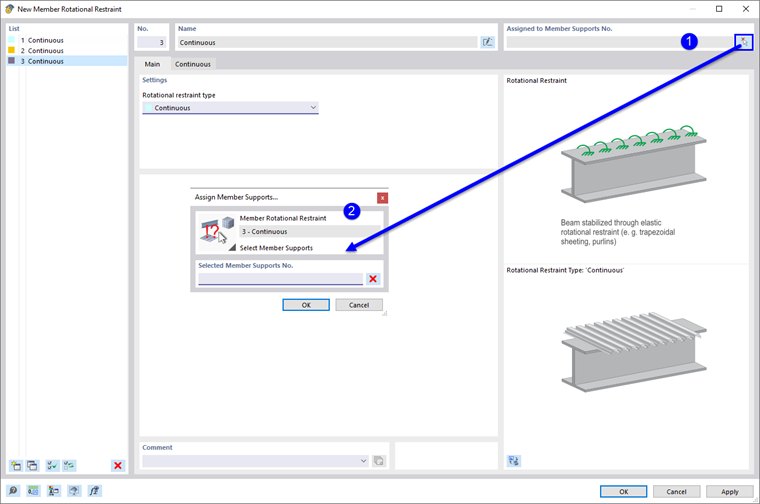
Member torsional restraints offer the possibility of taking into account the restraint against twist of a member or member set about its longitudinal axis by components such as bracings or the roof sheathing. A member torsional restraint is considered when determining the critical lateral-torsional buckling moment or the bifurcation load factor for lateral-torsional buckling, if this is determined with the internal eigenvalue solver. A constant rotational spring is assumed over the entire member or member set.
Member torsional restraints are of less interest for timber structures, as there are no timber-specific studies in the literature on the consideration of rotational springs. For completeness, this option is nevertheless available in the program.
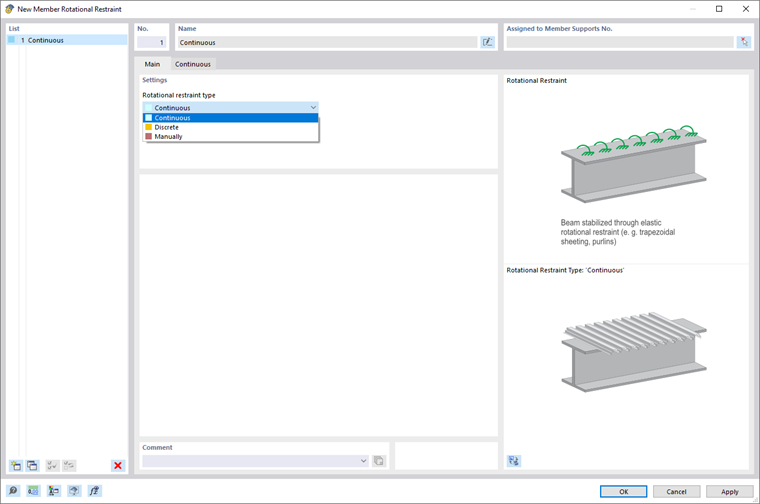
Type of Torsional Restraint
Several torsional restraint types are available in the list (see image Dialog 'New Member Torsional Restraint')
- Continuous
- Discrete
- Manual
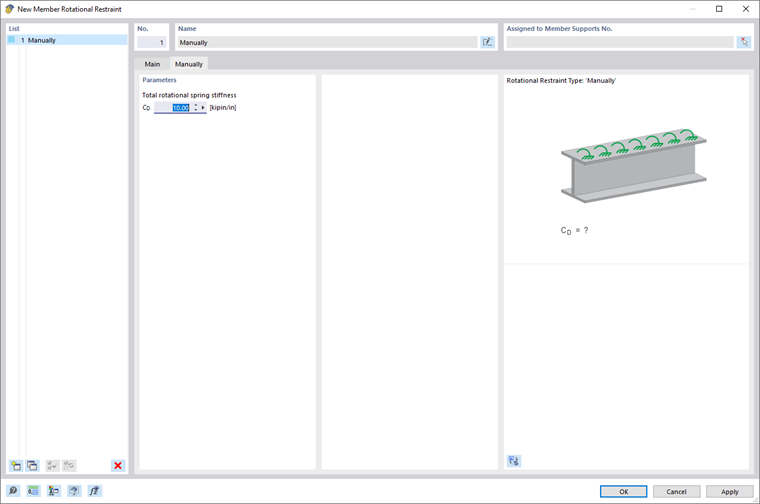
Manual
You can manually define the value of the rotational spring stiffness CD.
Assignment via Member Support
The member torsional restraint is to be assigned to a member or member set via a Member Support. Use the graphical selection option via the
 button for this purpose (see image Assign Member Support) or use the Member Support dialog. There, select the Torsional restraint about x option in the 'Nonlinearity / Fictitious Stiffness' list.
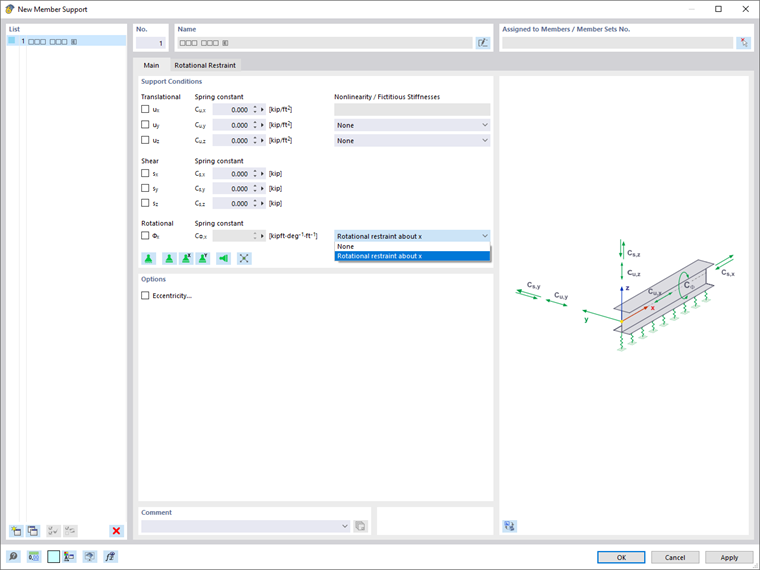
In the 'Torsional Restraint' tab, you can assign the appropriate member torsional restraint.
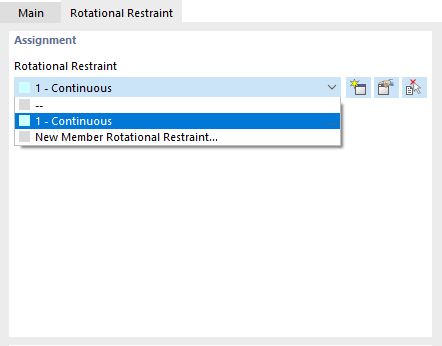
It is also possible in the member torsional restraint editing dialog to assign the torsional restraint graphically to a Member Support via the
 button. However, a fictitious stiffness of the 'Torsional restraint about x' type must already be available for the member support.