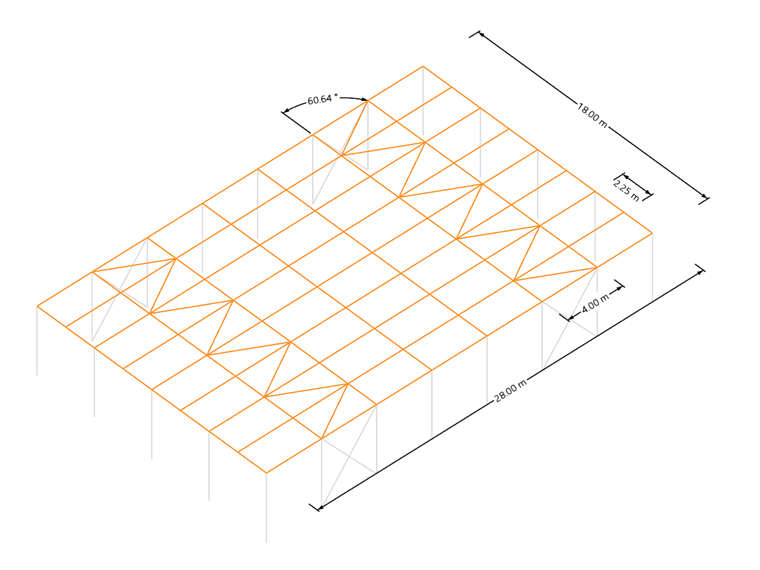
Member shear fields offer the possibility of accounting for the lateral restraint of members or member sets by bracing systems or the roof sheeting, and thus considering the shear stiffness of these components for the lateral-torsional buckling of the beams. A member shear field in y is considered when determining the critical lateral-torsional buckling moment or the bifurcation load factor for lateral-torsional buckling if it is determined with the internal eigenvalue solver. A constant displacement spring is applied over the entire member or member set.
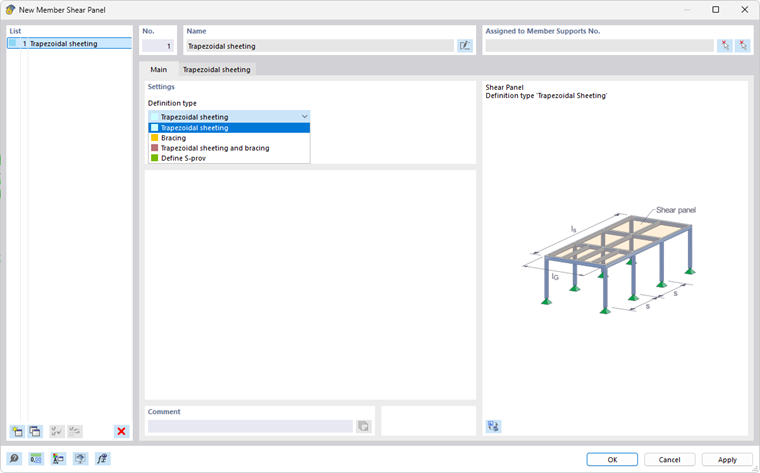
Definition type
Several shear field types are available in the list for selection (see image Dialog 'New Member Shear Field']):
- trapezoidal sheeting
- bracing
- trapezoidal sheeting and bracing
- define S-vorh
define S-vorh
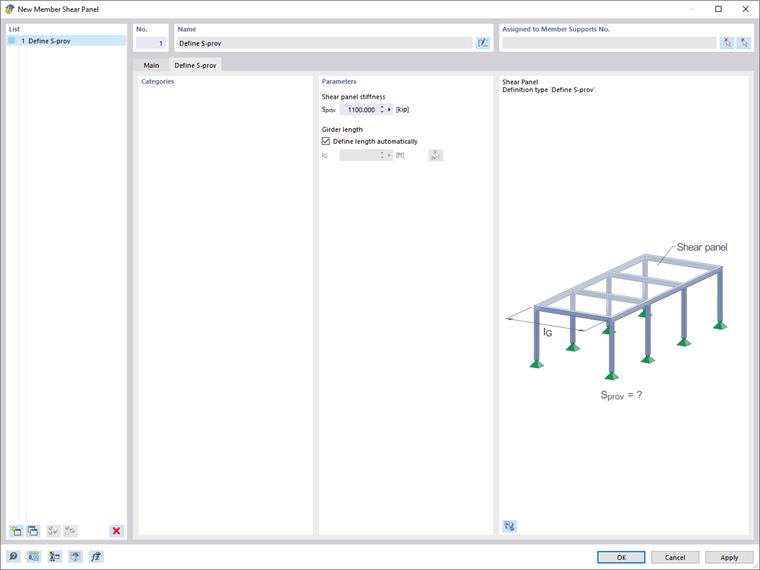
The shear field stiffness currently has to be determined manually (see example in the technical article on the right). The following entries are required for this purpose:
- shear field stiffness
- beam length
Starting from the member bedding, the shear field stiffness can be determined as follows:
The beam length is automatically taken from the member or member set. If you want to specify the beam length manually, deactivate the 'Define length automatically' check box.
Assignment via member support
The member shear field must be assigned to a member or member set via a member support. To do this, use the graphical selection option via button
 (see image Assign member support) or use the member support dialog. There, select the Shear field in y or Shear field in z option in the 'Nonlinearity / Fictitious Stiffnesses' list.
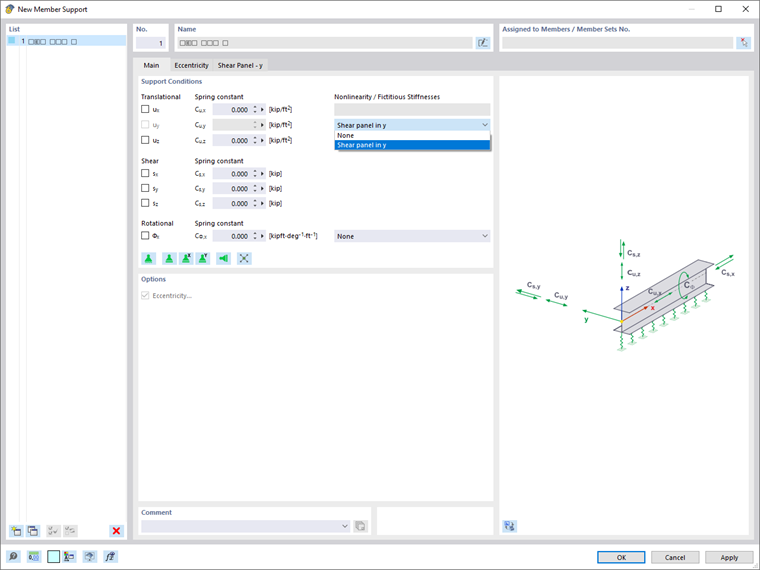
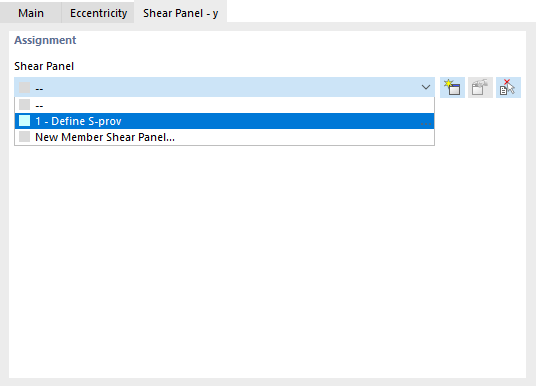
In the 'Shear Field - y' or 'Shear Field - z' tab, you can assign the appropriate shear field.
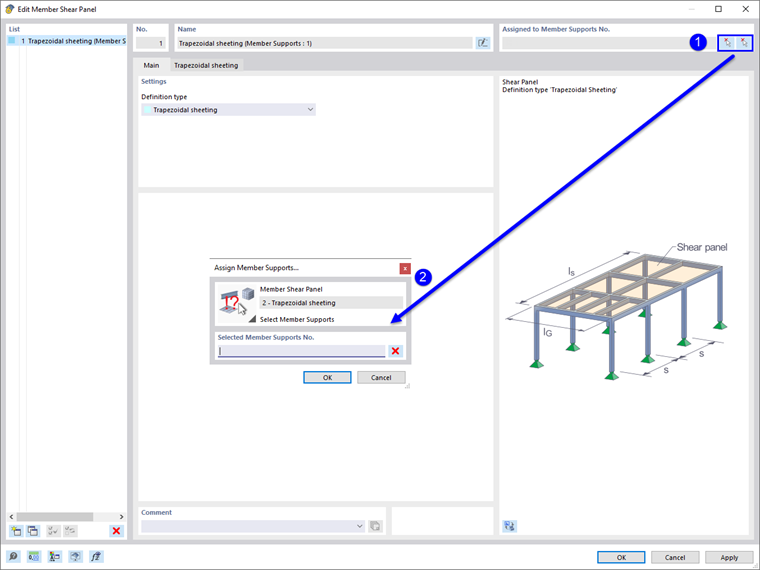
It is also possible to assign the shear field graphically to a member support in the member shear field dialog via button
 . However, a fictitious stiffness of the 'Shear field' type must already be available for the member support.
Position of the shear field on the cross-section
You can define the position of the shear field on the cross-section in the 'Eccentricity' tab of the New member support dialog.
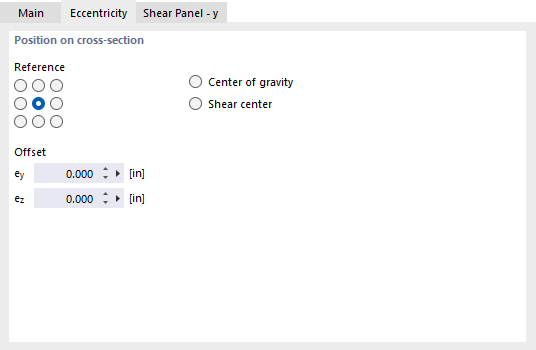
The nine 'Reference' check boxes symbolize distinctive points on the section. The center point represents the centroid; the eight peripheral points stand for the intersections of the member axes y and z with the boundary lines of a rectangle enclosing the cross-section. In addition, the centroid and the shear center are available as reference points.
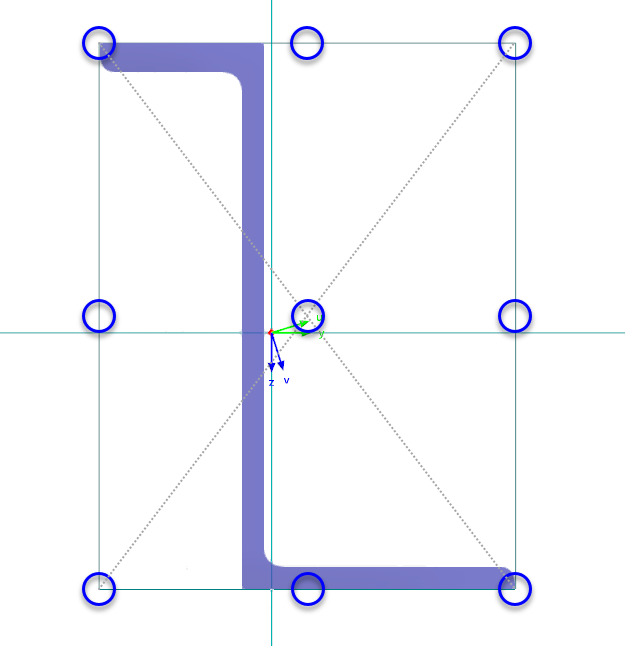
In the 'Offset' input fields, you can manually define the eccentricities ey and ez of the shear field. The distances refer to the local member axes y and z. The shear field is positioned by the distance defined as offset to the selected reference point on the cross-section.