


The results tables of the Stresses on Members category include the determined stresses with the respective design ratios.
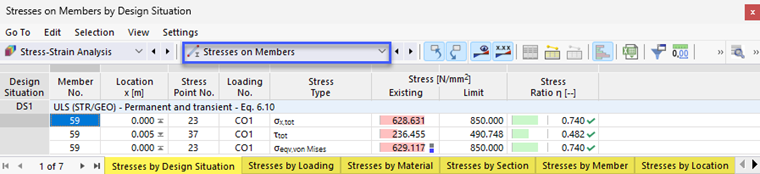
The member stresses are sorted in the tabs according to the following criteria:
- Loads (design situations, load combinations)
- Member properties (materials, cross-sections)
- Design location (member locations, stress points)
Member No.
For each stress type, the number of the member with the highest value is specified.
Location x
This column shows the position on the member for which the maximum design ratio was determined. The distance refers to the member start.
Stress Point No.
The stress analysis is performed at the "stress points" of a cross-section. These points are defined by centroidal distances, static moments, and thicknesses of the cross-section parts. All standard cross-sections of the library as well as the thin-walled areas of the RSECTION cross-sections are provided with stress points at the design-relevant locations of the cross-section.
You can check the stress points in the "Information About Section" dialog box. You can access this dialog box using the
 button in the table toolbar.

Design Situation
This column indicates the number of the design situation for which the individual stresses are available.
Loading
The numbers of the load or result combinations that are governing for the respective stress are specified.
Stress Type
This column lists the stress types that you have defined and assigned in the Member Configurations.
Stress Existing / Limit
For each stress type, the provided stress is indicated with the corresponding limit value.
Stress Ratio η
The last column shows the stress ratios (design ratios) related to the limit value. The utilization degree is expressed by the length of the colored bar.
Filtering Stresses by Design Ratio
The list on the right in the table toolbar allows you to filter the tables by the utilization degree. The Max option only shows the governing maximum stress ratio for each object.
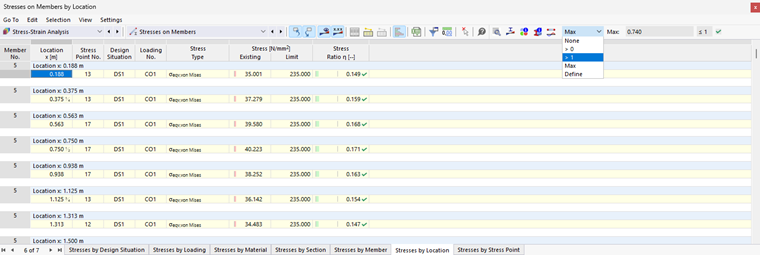
You can also define your own filter options in the format "> #.##" in this list. Thus, only the ratios greater than the user-defined value are displayed in the table.
