


Stress range is a measure of the variation in stress in a material under cyclic loading. It is defined as the difference between the maximum and minimum stress during a load cycle. Mathematically, the stress range Δ𝜎 is given by:
Stress ranges are relevant for the fatigue analysis of materials and structures. They describe how the load can lead to a gradual deterioration of the material and ultimately to fatigue failure. They are required for fatigue design checks.
The tables in the Stress Range category show the stress differences for the objects you have selected for analysis in the Objects to Analyze – Stress Range table.
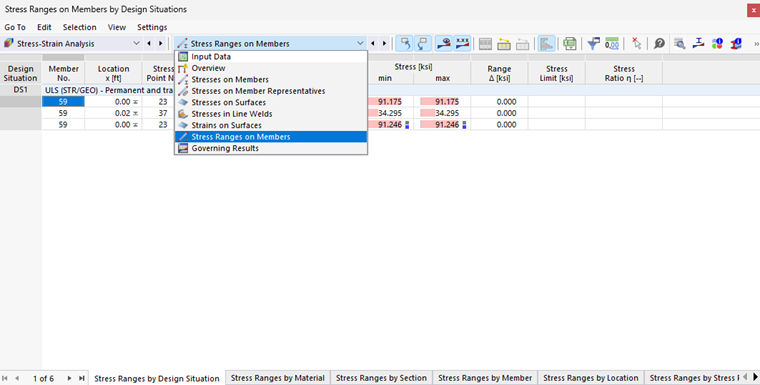

The stress ranges are sorted in the tab according to the following criteria:
- Loads (design situations, load combinations)
- Object properties (materials, cross-sections, thicknesses)
- Design location (member locations, stress points, surfaces, FE mesh points)
The stress ranges are determined for each design situation with the respective assigned load combinations.
Member / Surface / Solid / Line Welded Joint / Representative No.
For each type of stress, the number of the object with the largest stress range is specified.
Location x / Stress Point No.
For members, you can specify the position on the member for which the maximum stress range was determined. The distance refers to the member start. The number of the relevant stress point is also specified.
Mesh Node No. / Mesh Node Coordinates
For surface and line welded joints, you can specify the number of the FE mesh node at which the maximum stress range occurs. The global coordinates X, Y, and Z of the FE mesh nodes are also displayed.
Design Situation min / max
This column specifies the numbers of the minimum and maximum design situations for which the individual stress ranges are available.
Load min / max
The numbers of the load or result combinations are specified, whose results lead to the minimum and maximum stresses at the respective stress points or mesh nodes.
Stress Type
This column lists the stress types that you have defined and assigned in the “Stress Ranges” tab for the respective configurations (see the chapters Member Configurations , Surface Configurations , Line Welded Joint Configurations , and Solid Configurations ).
Stress min / max
The minimum and maximum stress values are shown in the two columns.
Stress Range Δ
The values represent the stress ranges resulting from the minimum and maximum stresses according to the equation of Stress Range Δ𝜎. The equation applies similarly to the shear stresses τ.
Stress Limit
This column is usually empty, as the default setting in the “Configuration” dialog box is “None” for the limit stress type. However, if you have defined user-defined limit stresses, they will be specified here.
Stress Ratio η
If limit stresses have been defined, the last column shows the stress ratios (design ratios) related to the limit value. The utilization degree is expressed by the length of the colored bar.