


The Surface Configuration dialog box manages the basic specifications for the stress-strain analysis of surfaces. The concept of the configuration dialog box is described in the chapter Stress-Strain Analysis . It also explains how you can assign the objects.
Stresses
In the Stresses tab, you can select the stresses to be calculated and specify the type of limit stress.
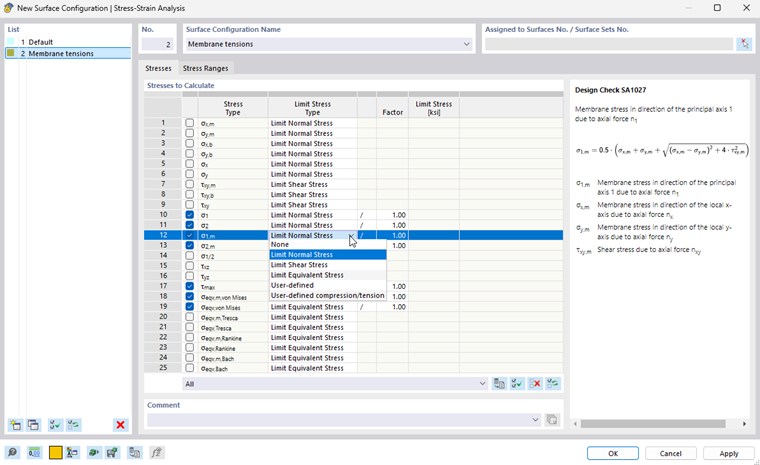
If you want to increase or reduce the limit stress for a stress type, you can scale it accordingly in the "Factor" column. If you select the "/" option, the stress is divided by the factor multiplied by "*".
If you want to use a user-defined stress as a reference instead of the limit stress stored in the material properties, select the “User-defined” limit stress type from the list. This enables you to access the text box in the “Limit Stress” column.
The "User-defined compression/tension" limit stress type allows you to specify sign-dependent limit stresses for certain stress components.

Stress Ranges
In the Stress Ranges tab, you can select the stress types for which the stress ranges are to be calculated and whether limit stresses are relevant.
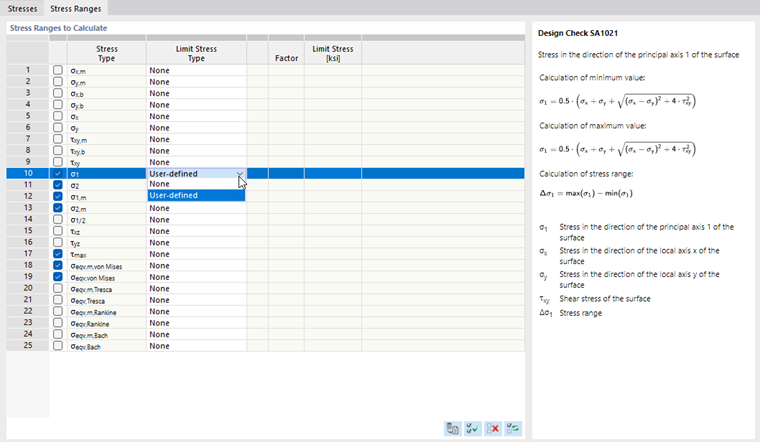
The “None” limit stress type is preset. This should allow for standard-independent use for the analysis of stress ranges. If you want to specify a limit stress, select the “User-defined” stress type from the list and then enter the corresponding value.
Strains
The Strains tab is available if you have activated the corresponding check box in the Global Settings dialog box. Here, you can select the strains to be calculated.

If you want to specify a limit strain, activate the Nonlinear Material Behavior add-on in the model base data (a license is required). Then, assign the Plastic (Surfaces/Solids) material model. During the analysis, the plastic strains are then compared with the limit strains.