


You can access the global settings for the stress-strain analysis using the shortcut menu in the navigator entry or by clicking the
 button in the table toolbar for the stress-strain analysis. This chapter describes the parameters available in the Global Settings dialog box.
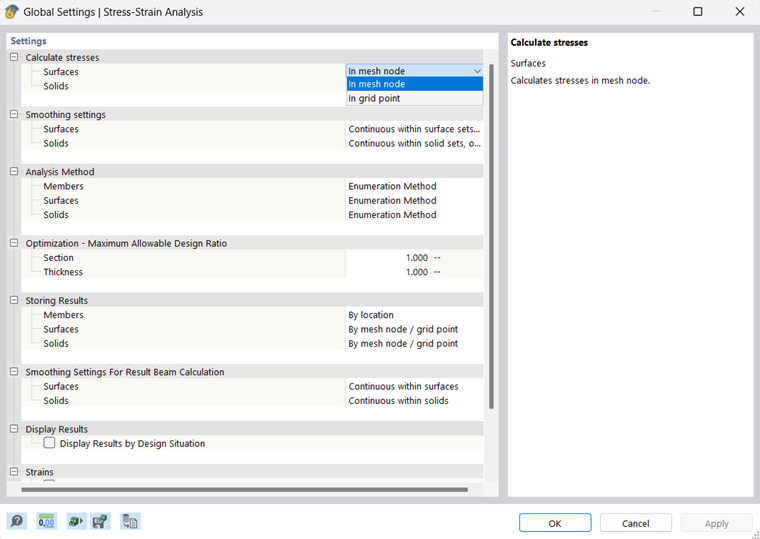
Use the
 button at the bottom of the dialog box to restore the default settings.
Calculate Stresses
By default, the stresses are output in the FE mesh points ("In mesh node"). Alternatively, it is possible to output the results in the user-defined points of the grid ("In grid point"), which are defined in RFEM in the properties of surfaces and solids.
Smoothing Settings
The options for smoothing results are described in the chapter Result Smoothing of the RFEM manual.
Analysis Method
This section controls how the design internal forces of load and result combinations are transferred to the design. You can select from three analysis methods in the list.
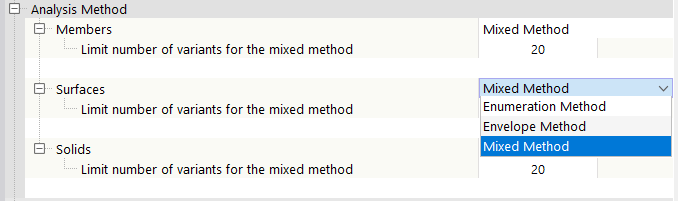
- Using the Enumeration Method, all load and result combinations of a design situation are calculated individually. This usually leads to the most accurate results, but may also lead to increased calculation time.
- Using the Envelope Method, the enveloping internal forces of all load and result combinations of a design situation are calculated first and then the design checks are carried out using them. This generally leads to shorter calculation times compared to the enumeration method.
- Using the Mixed Method, you can define an upper limit for the number of load and result combinations of a design situation that are to be designed according to the enumeration method. If the number of combinations exceeds this limit, the design is carried out according to the envelope method.
Optimization – Maximum Allowable Design Ratio
The add-on provides the option to optimize standardized cross-sections (see also the section Cross-Sections) and surface thicknesses (see also the section Thicknesses). When checking the possible variants, the design ratio of a variant is compared with the maximum value defined at this point.
Storing Results
The result files can become very large for complex models with several thousand objects if all results are saved in them. Depending on the selected setting, a result is saved by location, by stress, or by grid point or by object. In this way, it is possible to influence the file size accordingly. Regardless of this, you can display all results in the program, as missing results are automatically recalculated.
Strains
If you select the “Strain analysis” check box, the program performs an analysis of the surface strains in addition to the stress analysis.