


In the Design Checks category of the Navigator, you can specify which design checks are displayed with the respective design ratios on the objects to be designed. You can display the envelope from all types of design checks or the design ratios separately by limit state and design type.
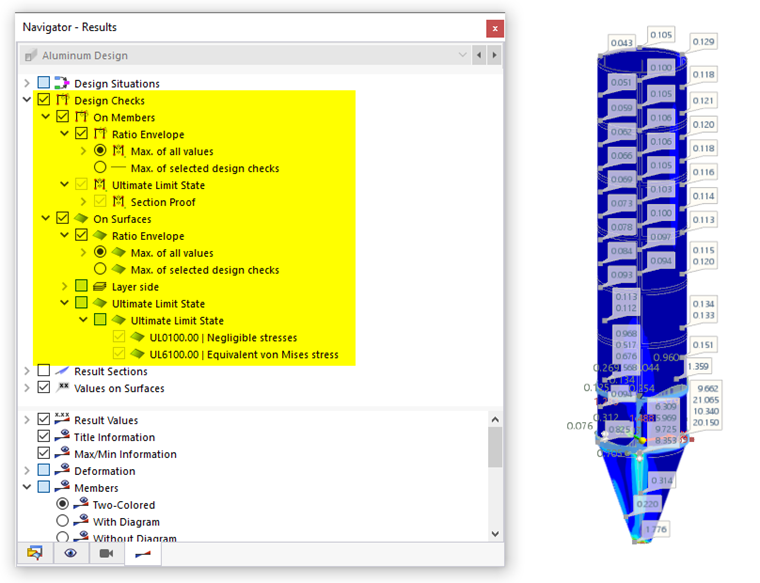
Ratio Envelope
The maximum design ratios from all design checks are displayed at each point of the designed object. Since all design types and limit states are summarized, the result diagrams are usually not continuous.
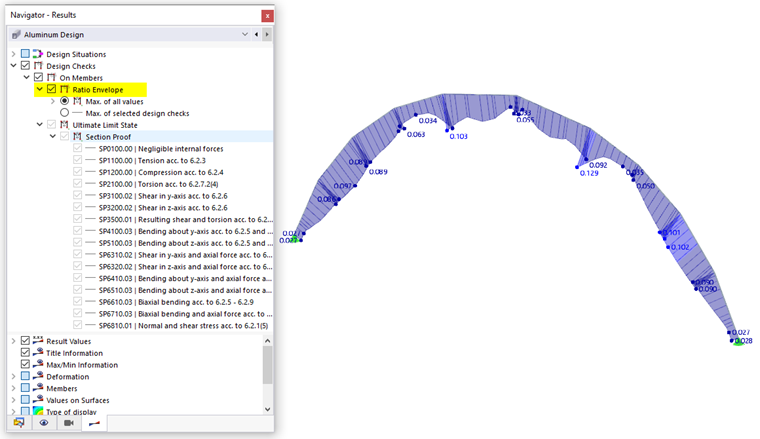
The ratio envelope is suitable for quickly obtaining and documenting an overall view of the design ratio for various objects. Errors in the display of the design checks can be ignored if the entirety of the valid design checks is to be displayed. You can also use the “Max. of all design checks without errors” option for this purpose.
If only certain design checks are to be considered for the envelope, activate the “Max. of selected design checks” option. You can then select the relevant design types.
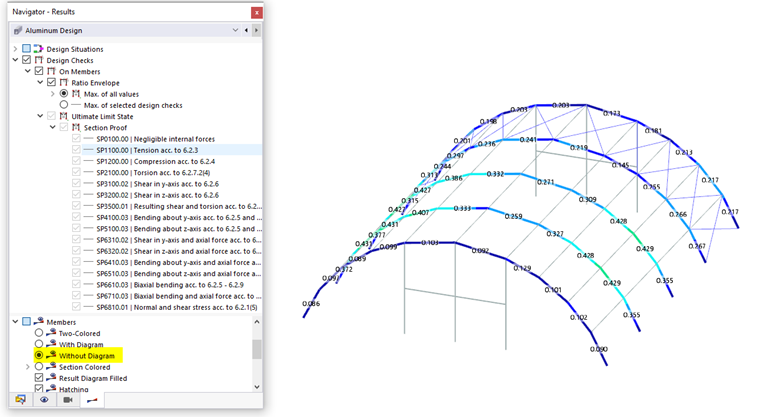
For an overview of critical areas in a beam structure, the “Without diagram” display type is recommended. The design ratios are displayed as colored lines according to the color scale in the control panel. You can use this option when the envelope or a single result type is displayed.
Design Ratio by Limit State and Design Type
The results can be displayed specifically for each limit state with the individual design types.
For members, the maximum design ratio of the results for the selected types of design is displayed at each location. Using this option, you can see which design type is governing at a specific location.
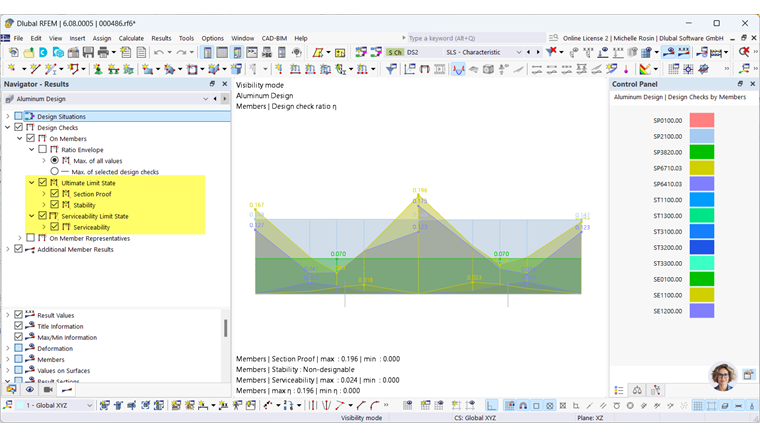
The selected results are displayed simultaneously on the model. In the control panel, you can view the colors of the types of design and adjust them, if necessary.
For surfaces, the design ratios are displayed as isobands.
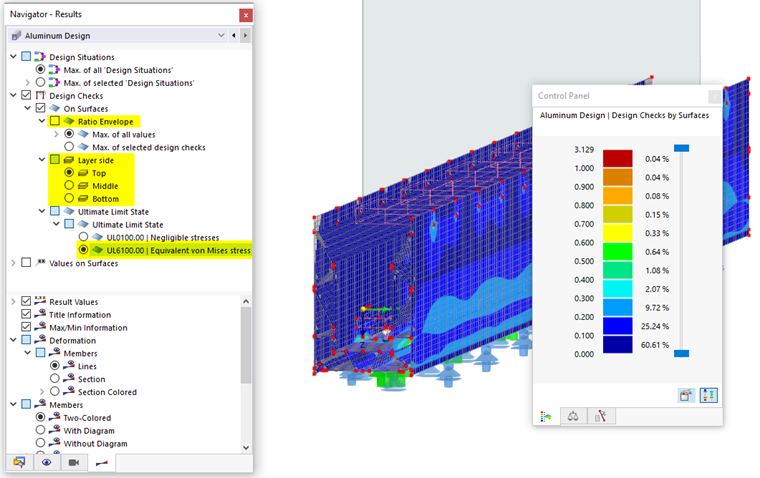
You can also select the layer side whose results are to be displayed:
- Top
- Middle
- Bottom
The following applies: If the local z-axis is aligned downwards in the local-axes model base data, the top side is located on the surface side in the direction of the negative z-surface axis (−z), and the bottom side is located in the direction of the positive z-axis (+z). If the local z-axis is oriented upwards in the Base Data, this definition is reversed.