


The strength configuration is divided into several tabs, which clearly structure the specifications for the individual design checks.
Members | Main
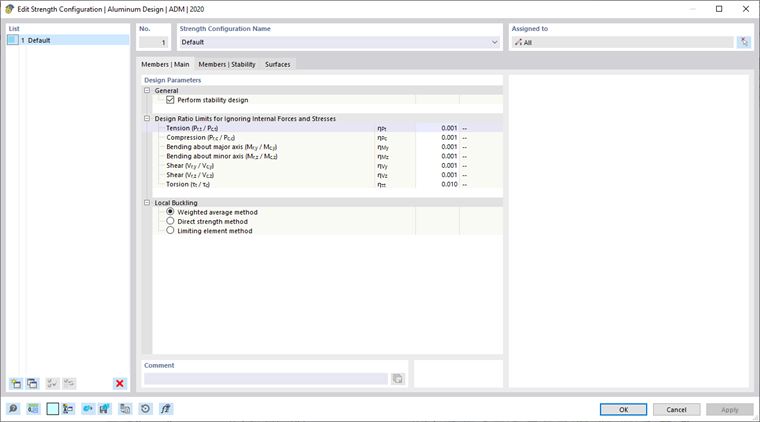
In the Members | Main tab of the ‘‘Strength Configuration’’ dialog box, you can define the basic settings for the design of members and member sets.
General
The “Perform stability design” check box controls whether stability analyses, such as against flexural buckling or lateral-torsional buckling, are performed in addition to cross-section checks. You should deactivate the check box if you do not want to perform stability design.
If the stability analysis is activated, it is necessary to define and assign effective lengths to the respective members or member sets. If this is not the case, no stability analysis is possible. After the calculation, a corresponding message is displayed in the Errors & Warnings result table. Cable members and tension members are excluded from this, as they can only absorb tensile forces and do not require stability analysis.
Design Ratio Limits for Ignoring Internal Forces and Stresses
The design standards, which are mostly based on manual calculations, contain design check formulas or interaction conditions that are often only designed for certain combinations of internal forces. However, when calculating the structural design on a 3D model, the values for internal forces are usually very small. Although thez are insignificant from an engineering point of view in terms of load-bearing capacity, strict adherence to the design standard may prevent certain design checks or force the use of less favorable interaction formulas. The “Design ratio limits for ignoring internal forces and stresses” therefore provide a simple and transparent way of neglecting certain internal forces during the design and avoiding the above-mentioned problems.
The limit value η describes the ratio of the effective shear force to the cross-section resistance, which is determined in a simplified manner using the cross-section properties. These are not standard-compliant design capacities: Standard-specific regulations are therefore not taken into account; this is not the purpose of setting limit values. You should therefore only use high limit values for testing purposes.
If a shear force is below the limit value condition, the design is performed without a warning that the shear force is neglected. However, in the design check details, you can use the “Negligible” note for the design internal forces to check which internal forces were neglected as a result of the limit values and were not taken into account in the design. If all internal forces are negligible at a point, only the check of the negligible internal forces is specified as design.
Local Buckling
In this section, you can specify the method used for the calculation of the local buckling resistance. If you select the “Weighted Average Method” option, the calculation is performed according to Section E.3.1 or F.3.1. If you select the “Direct Strength Method” option, the calculation is performed according to Section E.3.2 or F.3.2. If you select the “Limit Elements Method” option, the calculation is performed according to Section F.3.3.
Members | Stability
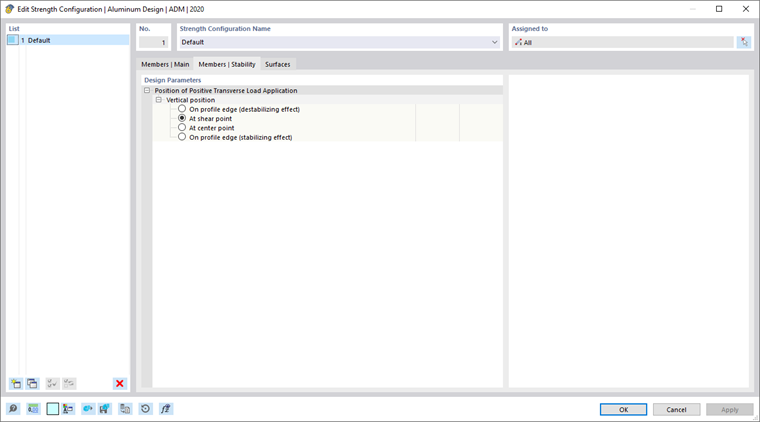
The Members | Stability tab is available if the you have selected the ‘'Perform stability design’' check box in the ‘'Members | Main’' tab. You can specify additional settings for the stability analyses here.
Position of Positive Transverse Load Application
If there are transverse loads (in the direction of the minor axis), it is important to define where these forces act on the cross-section. They can significantly influence the ideal elastic critical moment: A load acting on the upper flange of a bending beam in the direction of the shear center has a destabilizing effect.
If the load acts on the bottom chord, it has a stabilizing effect. Use the selection boxes to define the “Vertical position”.
Surfaces
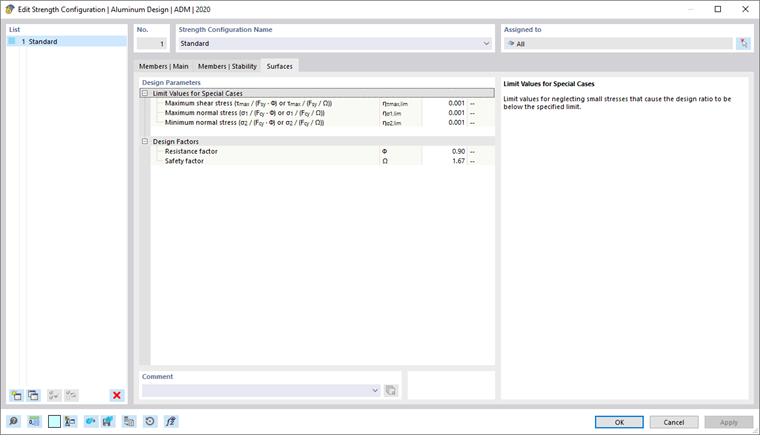
In the “Surfaces” tab of the “Strength Configuration” dialog box, you can configure basic settings for the design of surfaces.
Design Ratio Limits for Ignoring Internal Forces and Stresses
This category manages several limit values that apply to very small stresses. If the stress is below the defined ratio η, it is not taken into account in the design. The background for this option is described in closer detail in the chapter Members | Main.
Design Factors
Here you can adjust the resistance factor Φ (for LRFD) and the safety factor Ω (for ASD), which are to be applied for the design of surfaces.