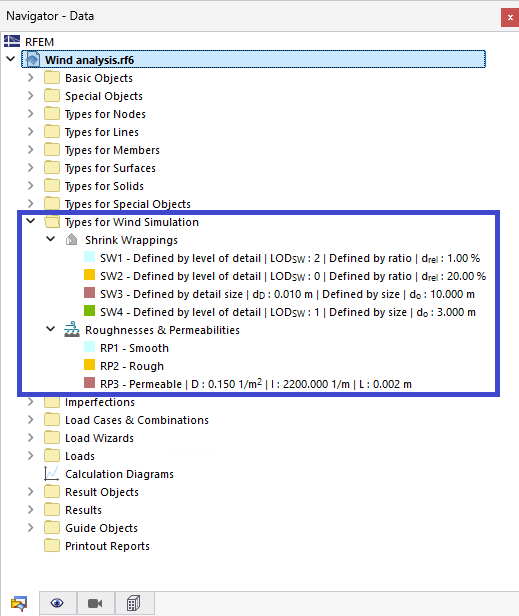
Properties of the model for wind simulation are controlled using two "Types for Wind Simulation": "Shrink Wrapping" and "Roughnesses and Permeabilities".
Shrink Wrapping
The shrink wrapping method is a special algorithm that creates the correct topology for topologically incorrect models by "wrapping" the model using a double mesh of triangles (i.e., topologically correct; for details, see Chapter Computational Mesh and Model Simplification).
It wraps non-manifold edges or intersecting triangles, as well as wrapping overly small details and closing openings.
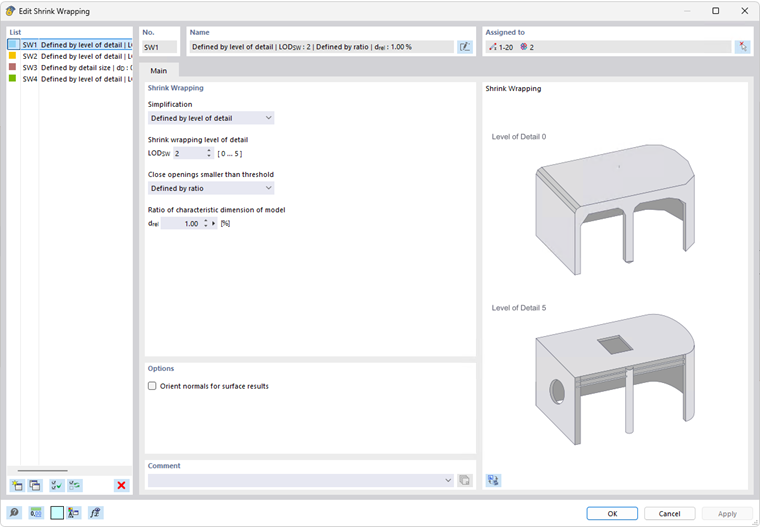
The shrink wrapping level of detail defines the accuracy on a scale from 0 (rough) to 5 (fine). Alternatively, the shrink wrapping simplification can be defined in an absolute manner by detail size. However, note that even the detail size is considered at intervals, depending on the model size.
Shrink wrapping also enables the user to "wrap" (i.e. close) openings or holes of defined dimensions. The dimensions can be defined either relatively, using a percentage of the model characteristic dimension, or in an absolute manner, by size.
The option "Orient normals for surface results" helps the user to unify element orientation on surfaces to display the results correctly. Models from RFEM are usually unified, so we recommend keeping this option deactivated (for more information, see Chapter Edit Model - General )
Roughnesses and Permeabilities
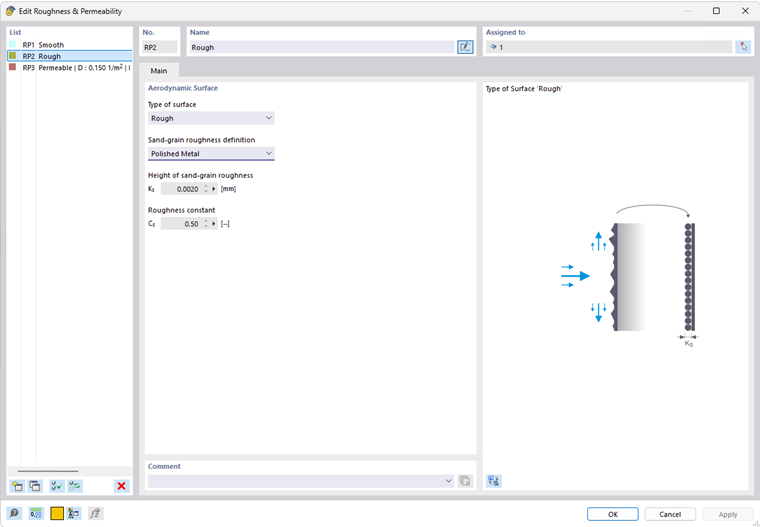
This type for wind simulation controls the properties of the model surface in CFD wind calculation. It can be smooth, rough, or permeable. All surfaces are smooth by default.
For rough surfaces, the equivalent sand-grain roughness model is used. The parameters can be defined manually by a height of sand grain K_s and a roughness constant C_s, or predefined values for some materials can be selected. For more information, see CFD Direct explanation or implementation in OpenFOAM.
A permeable type of surface can be assigned only to RFEM surfaces with non-considered thickness. For other RFEM objects, physical interpretation of the permeability model used is not valid. Permeability is defined by Darcy coefficient D, inertial coefficient I, and porous media length in flow direction l. For more details, see Chapter Permeability and KB 1792 How to Use Permeable Surfaces Feature in RWIND Pro.