


The result tables of the Design Ratios on Surfaces category contain the result data for the design checks carried out with the respective design ratios.
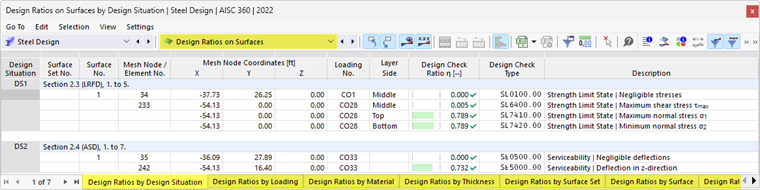
The surface results are sorted in the tabs according to the following criteria:
- Loads (design situations, load combinations)
- Surface properties (materials, thicknesses)
- Objects (surfaces, FE mesh points)
Surface No.
For each design criterion, the number of the surface with the highest design ratio is specified.
Mesh Node / Element No.
The number of the FE mesh node for which the maximum design ratio was determined is specified.
Mesh Node Coordinates
The three columns display the global coordinates X, Y, and Z of the FE mesh nodes.
Design Situation
This column names the numbers of the design situations for which the individual design ratios are available.
Loading
The numbers of the load or result combinations that are governing for the respective design checks are specified.
Layer Side
The equivalent stresses are analyzed for the following points of the surface cross-section:
- Top
- Middle
- Bottom
You can show or hide the surface axes using the Local axis systems of surfaces on/off entry in the surface shortcut menu. Alternatively, use the "Navigator - Display" (Model → Basic Objects → Surfaces → Surface Axis Systems x, y, z).
Design Criterion
The design conditions according to standard are specified in this column. The degree of the respective design ratio is expressed by the length of the colored bar.
Type of Design
Each design is designated by an identifier with a number. For example, the ultimate limit state design checks according to Eurocode have the identifier “UL”, the stability analyses have the identifier “ST”, and the serviceability design checks have the identifier “SE”. The type of design is explained in the Description column.
Design Check Formula
You can activate this column in the result table manager. It specifies the equations of the standard according to which the design checks are carried out.
Description
Each design check is explained by a short description with reference to the chapter in the standard.
The design check details for a specific design ratio can be displayed by clicking the
 button or by double-clicking on the line.
Filtering Results
The chapter Design Ratios on Members describes how you can filter the results by limit state and design ratio.