


The navigator category Additional Member Results allows for displaying the mode shapes of members and member sets graphically. The mode shapes are not output in the tables.
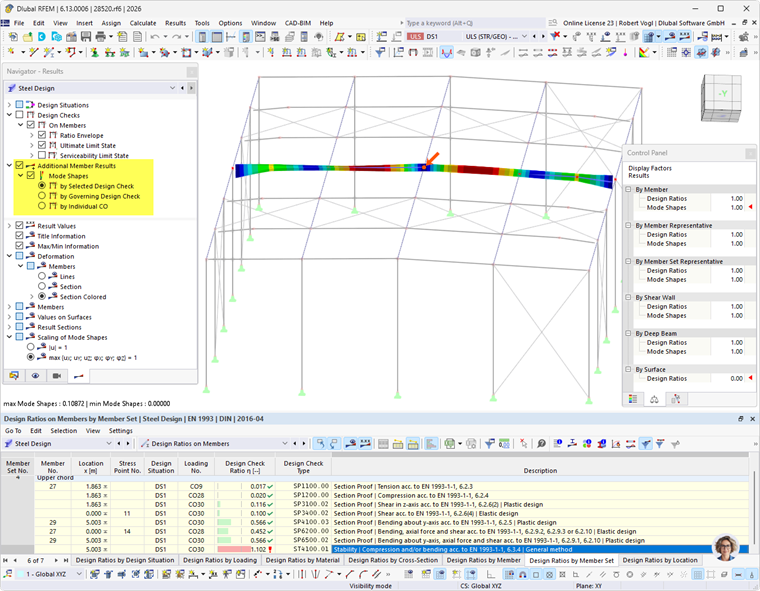
Mode Shapes
If the eigenvalue method is used for the lateral-torsional buckling design to determine the critical moment Mcr or the critical load factor αcrit, the corresponding mode shape is also available as a graphical result.
The mode shapes can be displayed based on different criteria:
- According to selected design
The mode shape is displayed specifically for the design selected in the results table. In this case, the design always refers to a member or member set. The mode shape of this object for the load situation used in the specific design is displayed in the work window. This option is suitable for the targeted check of a specific design.
- According to governing design
The mode shapes that are governing for the respective stability analysis are displayed for all objects. Thus, several mode shapes are shown side by side in the graphic, although they occur independently of each other or can be based on different load situations. This option is particularly suitable in conjunction with visibilities for documenting the results when the mode shapes of the visible objects are to be displayed.
- According to individual LC
The mode shapes applicable for a specific load combination are displayed for all objects – regardless of whether this LC is governing for the design. Set the load combination using the load list in the toolbar. This option is suitable for plausibility checks of the defined boundary conditions and nodal supports.
Scaling of Mode Shapes
In the lower navigator section, you can select how the dimensionless numerical values of the mode shapes are to be scaled to the reference length 1. This method is also known as "normalization".
- |u| = 1
The value of the mode shape vector is scaled to 1. The maximum total displacement |u| is considered.
- max {uX; uY; uZ; φX; φY; φZ} = 1
This approach considers the entire eigenvector including the rotational components. The maximum is found as the reference, and this component is then set to 1.
|
uj |
Translational component (j is the direction X/Y/Z) |
|
𝜑j |
Rotational component (j is the direction X/Y/Z) |