The Members | Plasticity tab is available if the "Perform advanced plastic design" check box is selected in the Members | Main tab. Here, you can specify settings for a plastic analysis according to the partial internal forces method (PIFM) or the simplex method.
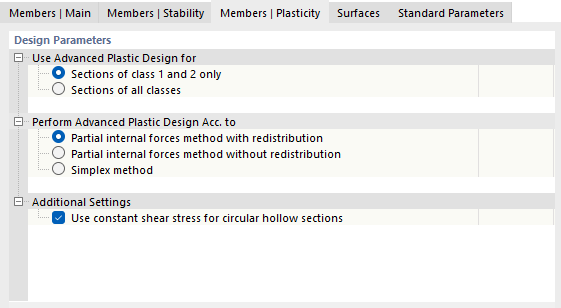
Use Advanced Plastic Design for
The partial internal forces method should be used to design “Sections of class 1 or 2 only” with plastic capabilities. For testing purposes, it is also possible to analyze “Sections of all classes”.
Perform Advanced Plastic Design Acc. to
Plastic design can be performed using the partial internal forces method or the simplex method.
Partial Internal Forces Method
The partial internal forces method (PIFM) is based on the approach described by Kindmann/Frickel [1]. The allowability of this method depends on whether the design standard permits alternative calculation methods for determining the plastic cross-section resistance and on the requirements imposed on the alternative methods. The conditions, according to EN 1993-1-1, Section 6.2.1(6), for example, are fulfilled, so that the partial internal forces method can be applied for this standard.
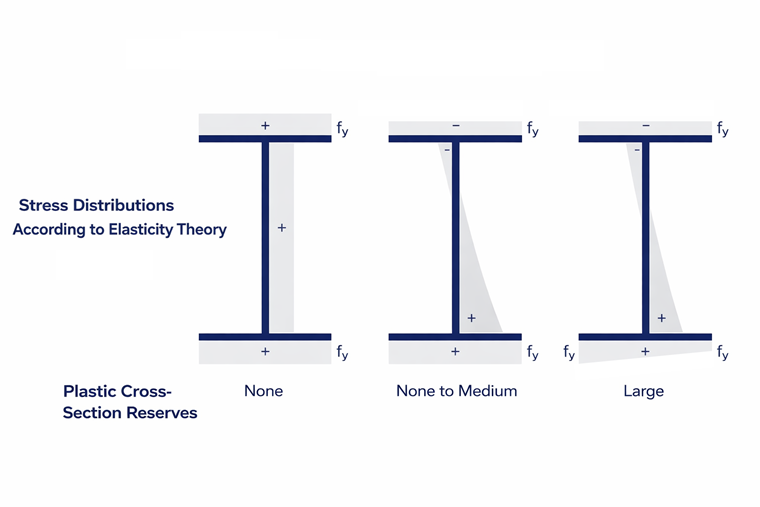
The partial internal forces method allows for plastic reserves to be utilized even with more complex combinations of internal forces and cross-section shapes—especially in the case of highly variable stress distributions in the cross-section. In the case of uniform stresses, however, it provides little advantage, as only small plastic reserves can be utilized.
There are two different methods for partial internal forces.
- Partial Internal Forces Method with Redistribution
In this method, the internal forces in the partial cross-sections are redistributed. This allows thin-walled hot-rolled or welded cross-sections consisting of two or three plates to be designed: upper flange, web, and lower flange, if applicable. It is necessary to arrange the flanges horizontally and the web vertically.
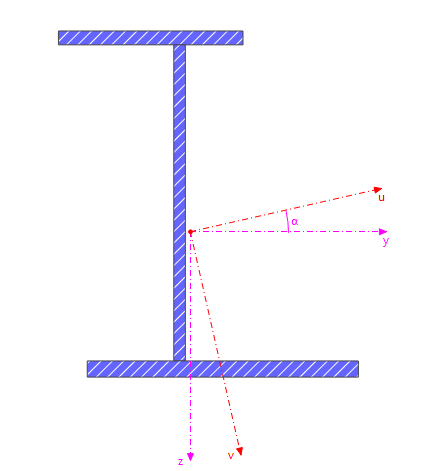
This method is also suitable for flat steel, tubes, and hollow sections, covering most of the cross-sections commonly used in steel structures.
- Partial Internal Forces Method Without Redistribution
This variant allows you to design all thin-walled cross-sections, regardless of the manufacturing method. There is no redistribution of the partial internal forces. This makes it less efficient.
Simplex Method
This method can be used to analyze general cross-sections with thin-walled element thicknesses. The cross-section is discretized into a finite number of surface particles that are as small as possible as part of a linear optimization task. If all internal forces at a point x are multiplied uniformly by a factor, the plastic load-bearing capacity is reached at a certain value. The combination of internal forces—as a result of an elastic calculation—can be described by a vector:
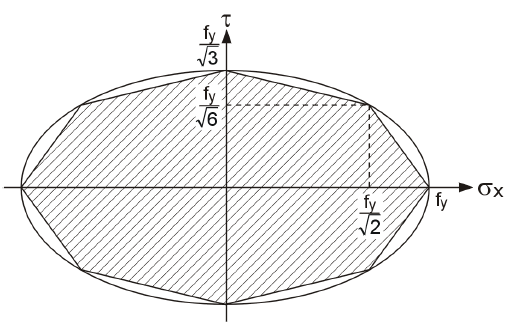
During the calculation of the plastic load-bearing capacity, a constant ratio of the components is assumed in this vector, so that the factor extends the shear force vector to the yield surface. The factor is determined as the maximum of a linear optimization task using a “revised simplex algorithm”. Using the von Mises yield conditions, an ellipse is obtained in the coordinate plane of axial and shear stresses, which is approximated by an inscribed octagon.
Additional Settings
The “Use constant shear stress for circular hollow sections” check box allows you to control whether constant shear stresses are taken into account throughout the entire cross-section according to [1], Figure 10.28.