


For some standards, the Surfaces tab of the 'Ultimate configuration' or 'Strength configuration' dialog is available. Here you can make basic settings for the design of surfaces made of solid timber, glued-laminated timber, or wood-based materials.
The 'Design parameters' are divided into several categories that differ depending on the design standard. The parameters of these standards are described in the following sections:
EN 1995
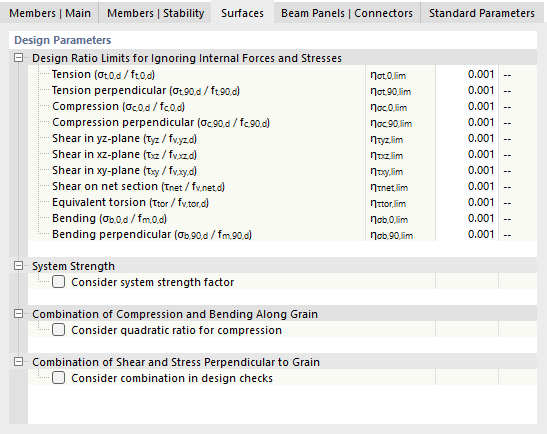
Utilization limits for ignoring internal forces and stresses
This category manages user-defined limit values that concern very small stresses: If the ratio η of the existing stress to the design value of the strength is smaller than the limit value, the stress is not taken into account in the design. The background of this option is described in more detail in the chapter Members | Basis.
System strength
If the continuous load distribution system is able to transfer the loads from one surface to adjacent surfaces for similar structural components with equal spacings (for example, ceiling joists all identical side by side), the strength of the structural components may be increased by the factor ksys according to [1] 6.6. In this case, check the check box.
Combination of compression and bending in grain direction
If no stability analysis is performed, the compression component may be taken into account quadratically for combined actions of bending and compression according to [1] 6.2.4(1). This option can be activated for solid timber, but not for cross-laminated timber.
Combination of shear and stress perpendicular to grain direction
If the interaction of shear in the xy-plane and tension or compression perpendicular to the grain direction is to be taken into account in the designs, check the check box.
NDS
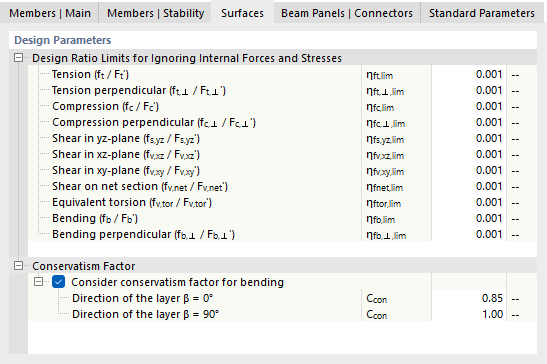
Utilization limits for ignoring internal forces and stresses
This category manages user-defined limit values that concern very small stresses: If the ratio η of the existing stress to the design value of the strength is smaller than the limit value, the stress is not taken into account in the design. The background of this option is described in more detail in the chapter Members | Basis.
Conservatism factor
When designing cross-laminated timber panels, the calculated moment resistances in the strong strength direction (β = 0°) should be multiplied by the coefficient 0.85 for conservative reasons according to ANSI/APA PRG 320. This coefficient for out-of-plane bending is called 'Conservatism factor' Ccon in the program and is activated by default. You can check the coefficients for the directions of the layers and adjust them if necessary.
CSA
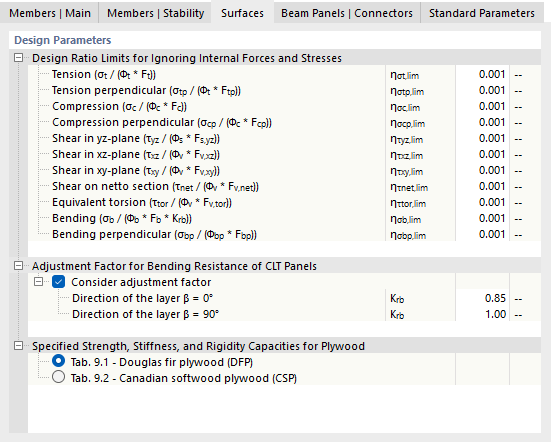
Utilization limits for ignoring internal forces and stresses
This category manages user-defined limit values that concern very small internal forces: If the ratio η of the existing stress to the design value of the cross-section resistance is smaller than the limit value, the stress is not taken into account in the design. The background of this option is described in more detail in the chapter Members | Basis.
Adjustment factor for bending capacity of cross-laminated timber panels
When designing cross-laminated timber panels, the calculated moment resistances in the strong strength direction (β = 0°) should be multiplied by the coefficient 0.85 for conservative reasons according to [3] Section 8.1.4.3.1. This adjustment factor for out-of-plane bending is activated by default. You can check the coefficients Krb for the directions of the layers and adjust them if necessary.
- Specified strength and stiffness capacities for plywood
For surfaces made of plywood, different strength capacities apply depending on the material. Select the appropriate option in the list: