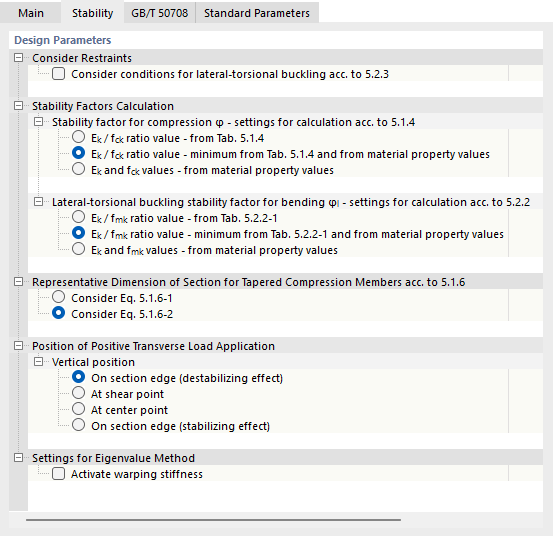
The Members | Stability tab is available if the 'Perform stability analysis' check box is selected in the Members | Basis tab. Here you can specify further settings for the stability analyses.
The 'Design parameter' are divided into several categories, which differ depending on the design standard. The following sections describe the parameters of these standards:
EN 1995
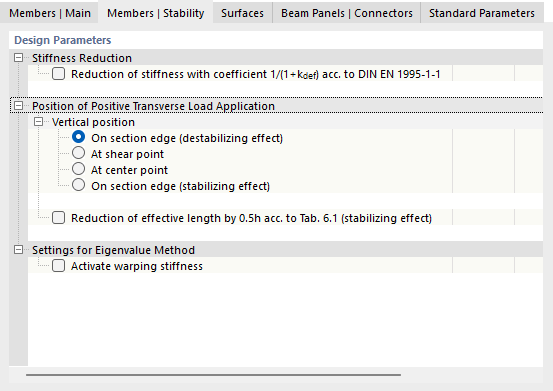
Stiffness reduction
This category is relevant for the time-dependent behavior of compression members with large permanent load ratios: According to the German National Annex NCI NA.5.9, for compression members in service classes 2 and 3, the influence of creep must be considered if the design value of the permanent and quasi-permanent load ratio exceeds 70 % of the design value of the total load. This consideration can be made by reducing the stiffness by the factor 1/(1 + kdef).
Load application point
In the Effective Lengths dialog box, you can define how the ideal elastic critical moment Mcr is determined. When using the Eigenvalue Method, the load application point can significantly influence the critical moment for lateral-torsional buckling: A load acting on the top chord of a bending beam towards the shear center has a destabilizing effect. If, however, the load acts on the bottom chord, it has a stabilizing effect. Use the selection fields to define the 'Vertical position'.
For members with a constant cross-section, the load application point also influences the definition of the equivalent member lengths according to the footnote in [1] Table 6.1.
Settings for eigenvalue method
The 'Activate warping stiffness' check box is relevant when the ideal elastic critical moment Mcr is determined using the eigenvalue method. You can use it to control whether the warping resistance Iω should be considered for lateral-torsional buckling. In the analytical equations of the standard for determining the critical lateral-torsional buckling moment, the influence of warping stiffness is neglected on the safe side.
NDS
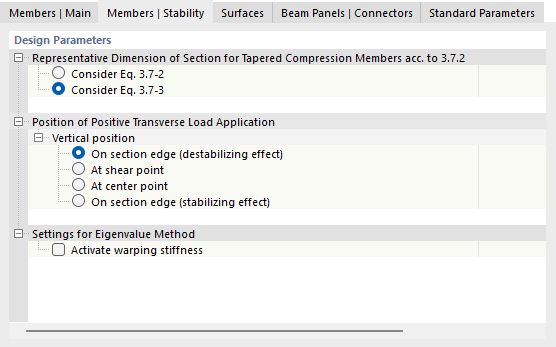
Representative cross-section dimension for tapered compression members according to 3.7.2
In this category, you can define which equation should be used to determine the representative cross-section dimension of tapered compression members:
- Eq. 3.7-2: for certain standard support conditions
- Eq. 3.7-3: for all other support conditions
Load application point of positive transverse loads
In the Effective Lengths dialog box, you can define how the ideal elastic critical moment Mcr is determined. When using the Eigenvalue Method, the load application point can significantly influence the critical moment for lateral-torsional buckling: A load acting on the top chord of a bending beam towards the shear center has a destabilizing effect. If, however, the load acts on the bottom chord, it has a stabilizing effect. Use the selection fields to define the 'Vertical position'.
Settings for eigenvalue method
The 'Activate warping stiffness' check box is relevant when the ideal elastic critical moment Mcr is determined using the eigenvalue method. You can use it to control whether the warping resistance Iω should be considered in lateral-torsional buckling. In the analytical equations of the standard for determining the critical lateral-torsional buckling moment, the influence of warping stiffness is neglected on the safe side.
CSA O86
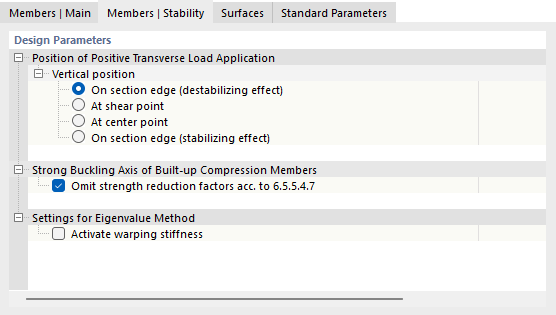
Load application point of positive transverse loads
In the Effective Lengths dialog box, you can define how the ideal elastic critical moment Mcr is determined. When using the Eigenvalue Method, the load application point can significantly influence the critical moment for lateral-torsional buckling: A load acting on the top chord of a bending beam towards the shear center has a destabilizing effect. If, however, the load acts on the bottom chord, it has a stabilizing effect. Use the selection fields to define the 'Vertical position'.
Strong buckling axis of built-up compression members
With the 'Do not apply strength reduction factors according to 6.5.5.4.7' check box, you can control whether the strength reduction factors for buckling in the strong axis of the lamellae specified in sections 6.5.5.4.2 to 6.5.5.4.5 may be omitted.
Settings for eigenvalue method
The 'Activate warping stiffness' check box is relevant when the ideal elastic critical moment Mcr is determined using the eigenvalue method. You can use it to control whether the warping resistance Iω should be considered for lateral-torsional buckling. In the analytical equations of the standard for determining the critical lateral-torsional buckling moment, the influence of warping stiffness is neglected on the safe side.