


In the Surfaces tab of the 'Serviceability Configuration' dialog, you can define the limit values that apply to the deformations of surfaces.
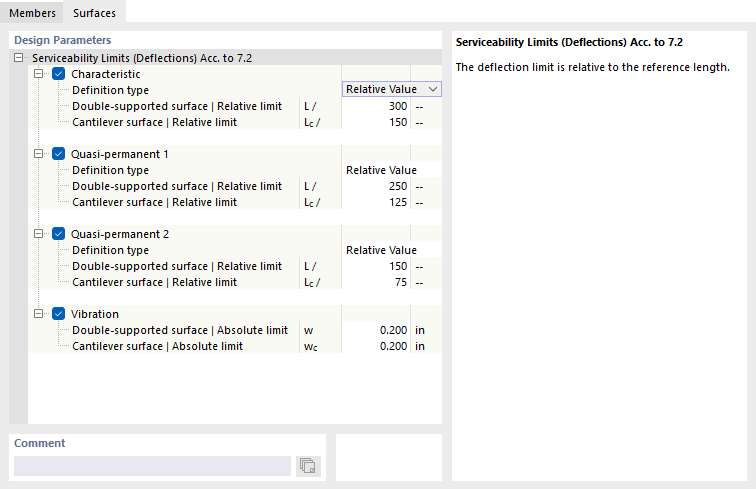
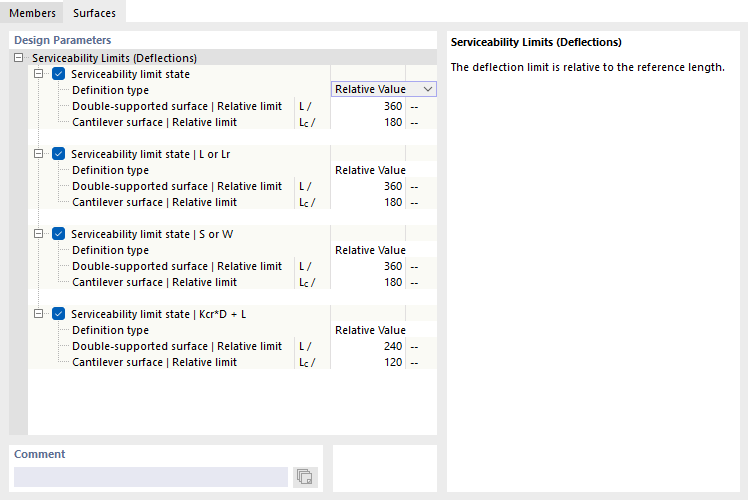
As for the members, there are various design situation types for serviceability limit state designs, which differ depending on the design standard. For each combination type, you can define specific limit values for deflections. They are related to the lengths of the structural components.
The list next to the 'Definition type' contains several options for defining a limit value (see image Define deformation reference):
- Relative value: The limit value is related to the length of the surface.
- Absolute value: The value of the maximum deflection is defined directly.
- Sum of relative and absolute value: The limit value is the sum of the relative value and the absolute value.
- Min of relative and absolute value: The smaller value of the relative or absolute value applies as the limit value.
- Max of relative and absolute value: The larger value of the relative or absolute value applies as the limit value.
Depending on the support of the structural component – a surface supported on both sides or a cantilever surface supported on one side – different limit values for the deflection are generally relevant. This support is to be defined as a 'Surface type' in the properties of the surface or surface set in the Deflection tab. There, you can also specify whether the maximum displacements refer to the undeformed system, a deformed reference plane, or a parallel surface, and how the reference length should be determined. For flexible supports, such as a floor beam, the deformation analysis can be performed via a result beam (see chapter Design Supports and Deflection).
If necessary, adjust the preset limit values for the deformation analyses of the objects.