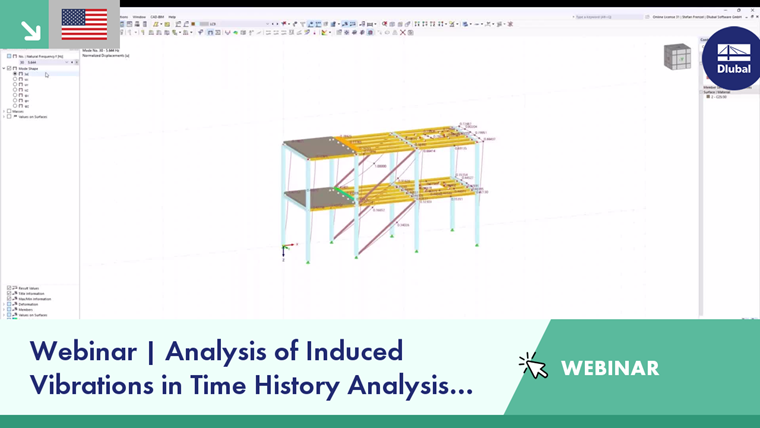
The Time History Analysis add-on allows for a dynamic structural analysis of external excitations, such as machine-induced vibrations, impact forces, explosions, or seismic loads. You can define various excitation functions in tables or as a function of time. The time history analysis is performed using the modal analysis or the linear or nonlinear implicit Newmark analysis.
The following analysis types are available for the time history analysis:
- Time History Analysis | Accelerogram
- Time History Analysis | Time Diagram
The user interface of the Time History Analysis add-on is adapted to the analysis type.
Time History Analysis of Accelerograms
The time history analysis of accelerograms (acceleration-time diagrams) is used to analyze a model with regard to an earthquake: Accelerograms excite the model on its supports. The equation of motion is as follows:
|
M |
Mass Matrix |
|
D |
Damping Matrix |
|
K |
Static stiffness matrix |
|
ü |
Absolute acceleration |
|
u˙ |
Absolute velocity |
|
u |
Absolute displacement |
|
üg |
Basic acceleration |
Time History Analysis of Time Diagrams
Using a time history analysis of time diagrams (transient or harmonic force-time diagrams), you can excite any point of the model in any direction. The equation of motion is as follows:
|
M |
Mass Matrix |
|
D |
Damping Matrix |
|
K |
Static stiffness matrix |
|
ü |
Absolute acceleration |
|
u˙ |
Absolute velocity |
|
u |
Absolute displacement |
|
p(t) |
External excitation |