


EN 1997-1: Highly Eccentric Loads
According to EN 1997-1 [1] 6.5.4, no special precautions are required if the following generally applies to a rectangular base area:
The formulas refer to the limitation of the 2nd core width, which is elliptical. The eccentricities ex and ey are considered separately.
For rectangular foundations, the eccentricity of the load resultant must therefore not exceed 1/3 of the side length; for circular foundations, it must not exceed 0.6 of the radius. If the eccentricity exceeds these specified limit values, special provisions must be made in accordance with Section 2.4.2.
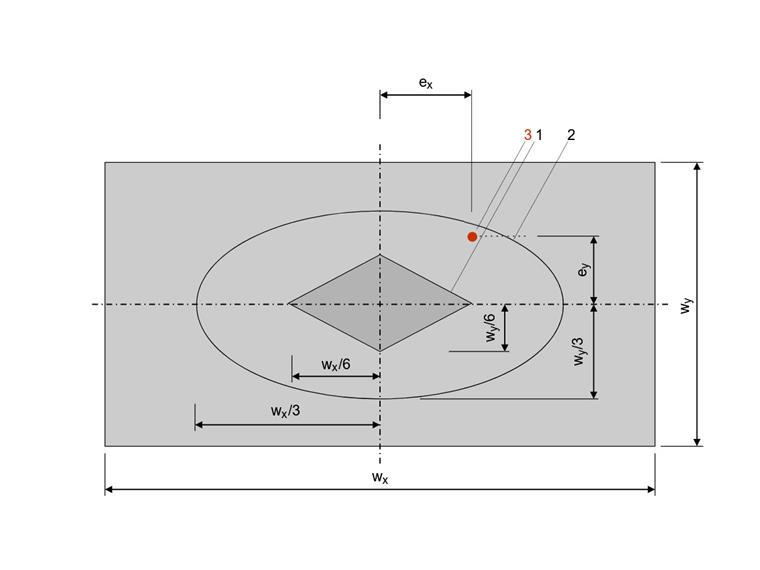
Marking 1 : The limitation of the 1st core width is represented by a rhombus.
Marking 2 : The limitation of the 2nd core width is represented by an ellipse.
Marking 3 : The point of application of the resultant is the point where the total resultant load acts on the foundation base.
IBC 2021 / ACI 318-19 (ASD): Loads with Large Eccentricities
Purpose of Verification
The verification for loads with large eccentricities checks whether the resultant vertical load remains within the permissible eccentricity limits of the foundation base. This ensures that the resultant force lies within the core section of the foundation and full-surface contact between the foundation and subsoil is maintained.
General Procedure
The verification is performed separately for both principal directions of the foundation. The eccentricities of the resultant vertical load result from the acting bending moments and the total vertical load:
|
ex, ey |
Calculate the average of the resulting vertical load [ft] |
|
My, Mx |
Bending moments at the foundation base [tilt] |
|
P |
Total vertical load on the foundation [kip] |
Eccentricity Limits
The permissible eccentricities are determined based on the foundation dimensions:
Verification
The governing condition results from the larger normalized eccentricity:
If the resultant lies outside the core section of the foundation, a partial loss of contact occurs, and the assumption of a linear stress distribution is no longer valid.
Software Configuration
The verification is automatically performed for all defined load combinations. The bending moments and vertical forces are taken from the selected load cases and load combinations. The foundation dimensions required to determine the eccentricity limits are taken from the defined foundation geometry.