


In the Geometry tab, you define the dimensions of the foundation slab and the bucket.
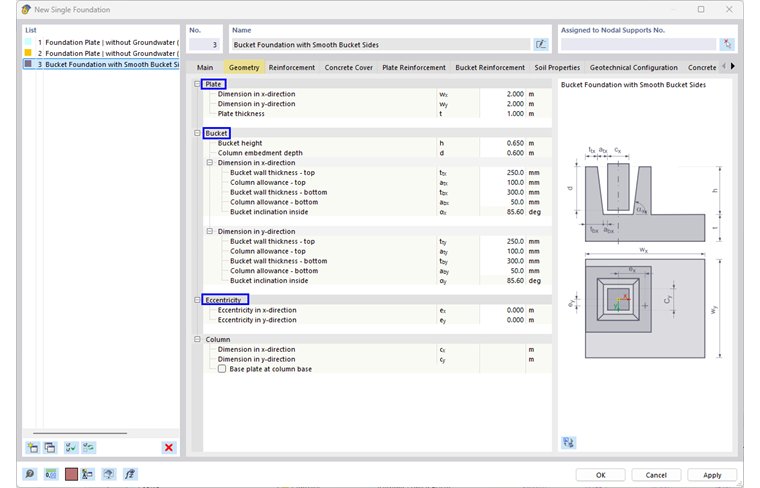
The following table lists the parameters used to describe the geometry of the slab, bucket, and eccentricity.
| Variable | Label |
|---|---|
| wx / wy | Foundation slab dimension in the x- and y-direction, respectively |
| t | Foundation slab thickness |
| h | Bucket height |
| d | Embedment depth of the column |
| ttx / tty | Bucket wall thickness at the top in the x- and y-direction, respectively |
| atx / aty | Column clearance at the top in the x- and y-direction, respectively |
| tbx / tby | Bucket wall thickness at the bottom in the x- and y-direction, respectively |
| abx / aby | Column clearance at the bottom in the x- and y-direction, respectively |
| αx / αy | Inner wall inclination in the x- and y-direction, respectively |
| ex / ey | Eccentricity in the x- and y-direction, respectively |
| cx / cy | Column dimension in the x- and y-direction, respectively |
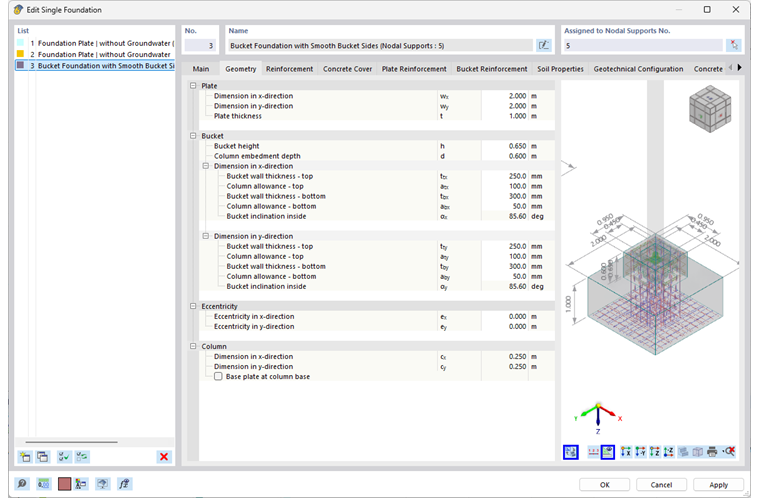
Using the
 button below the system sketch, you can display the dynamic model with the dimensions directly in the tab.
Minimum Dimensions
Certain minimum dimensions must be maintained to ensure the correct geometric execution of the bucket foundation.
Embedment Depth
The embedment depth must not be greater than the height of the bucket.
Upper Bucket Wall Thickness
The minimum thickness of the upper bucket wall results from the maximum of four individual minimum values. The greatest of these thicknesses defines the required wall thickness:
The bucket wall (depending on the stirrup arrangement type) must be designed so that the mandrel diameter, the diameter of the statically required vertical stirrups in the x-direction, the diameters of the horizontal stirrups in the y-direction (inside and outside), as well as twice the concrete cover can be sufficiently taken into account:
|
ck |
Concrete cover of the bucket wall |
|
dm,v,x |
Minimum mandrel diameter of the vertical static stirrups in the x-direction |
|
ds,v,x |
Diameter of the vertical static stirrup |
|
ds,h,x |
Diameter of the horizontal stirrup in the X-direction (inside) |
|
ds,h,outer |
Diameter of the outer horizontal stirrup |
|
ds,h,y |
Horizontal stirrup in the y-direction |
|
ds,v,y |
Diameter of the vertical stirrup in the y-direction |
The second condition depends on the width of the column and the column clearance (top and bottom):
The third condition is a geometric specification that depends on the width of the column:
To ensure an absolute minimum limit, a minimum wall thickness of 10 cm is applied regardless of the reinforcement and geometry.
Further Minimum Dimensions
These relationships ensure that the total width of the bucket at the top and bottom is identical in each direction.
All the relationships mentioned ensure that
- the wall thickness at the bottom is at least as large as the wall thickness at the top, and
- the column clearance at the top is at least as large as the column clearance at the bottom.
The inner wall of the bucket can either be vertical or inclined outwards. An inward inclination is prevented.
Rotation of Foundation via Nodal Support
Rotation of a foundation about the Z-axis is carried out via the local coordinate system of the associated nodal support. Direct rotation of the foundation is not possible. A prerequisite is that the local z-axis of the nodal support is parallel to the global Z-axis.
Create a user-defined local coordinate system and assign it to the nodal support. The foundation adopts the orientation of this local coordinate system.
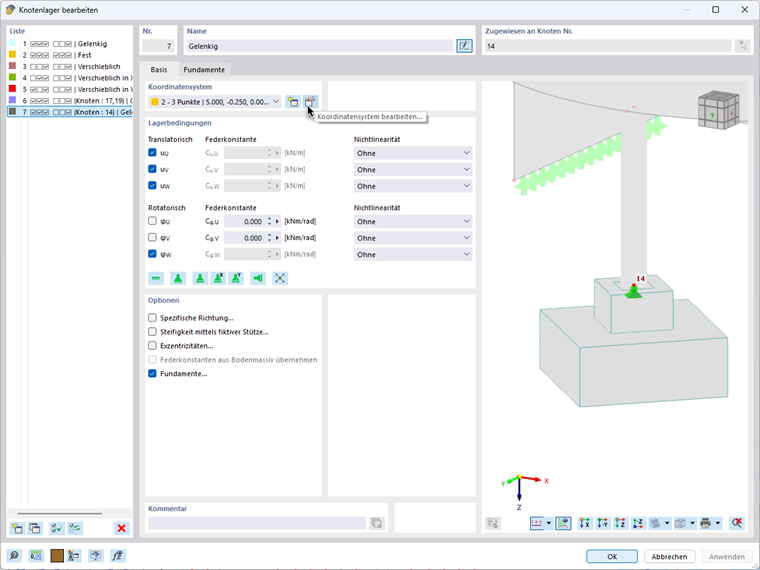
The orientation of the column has no influence on the alignment of the foundation. Rotation of the column about the global Z-axis can occur independently of the foundation and is not necessarily required for the design of the foundation, although a column orientation parallel to the global Z-axis is required for the use of foundations.