


The bearing capacity of the subsoil can be verified in different ways depending on the standard. In the Eurocode, the verification is carried out by comparing design values of actions and resistances (bearing resistance design), while North American standards often use allowable soil pressures. Both approaches describe the same structural behavior of the subsoil but differ in terms of safety concept and design format.
EN 1997-1: Bearing resistance design
In the bearing resistance design according to EN 1997-1, the resistance can be determined either via specified allowable soil pressures or by calculating the bearing resistance considering the soil layers and soil parameters.
Verification with specified allowable soil pressure
In this verification type, the existing soil pressure is compared with the specified allowable soil pressure. The value of the allowable bearing capacity σa is defined in the Geotechnical Design Configurations of the "Concrete Foundations" add-on in the "Allowable Soil Pressure" section.
Determination of stresses in the soil joint and the load eccentricities
The design shear force with additional foundation loads Vz,+add and the resulting design bending moments My,+add and Mx,+add at the center of the foundation base are required to determine the eccentricity of the effective vertical loads:
Determination of the effective foundation area
In the bearing resistance design, only a part of the actual base area is considered – the part where the resulting axial force is applied at the center.
Existing soil pressure
This allows the existing soil pressure to be determined:
Verification
The existing soil pressure is compared with the specified soil pressure:
Verification with calculated bearing resistance (Annex D)
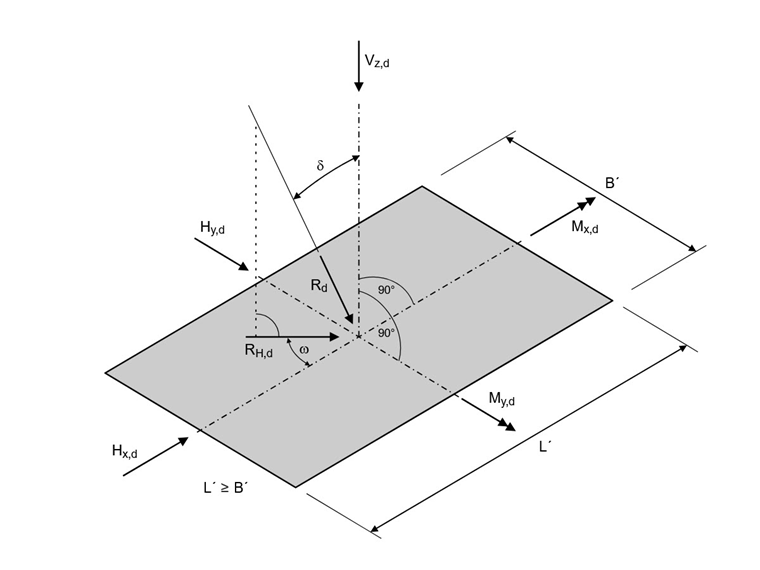
In the bearing resistance design according to EN 1997-1 [1], a comparison is made between the actions perpendicular to the foundation base and the design values of the resistances. A computational method according to [1] 6.5.2.2 is used. Annex D of the standard provides an informative example for the analytical determination of the bearing resistance.
Determination of the bearing resistance for drained conditions
The characteristic value of the bearing resistance can be determined according to [1] Annex D, Equation (D.2) for drained conditions as:
|
σc |
Stress due to cohesion |
|
σq |
Stress due to foundation depth |
|
σγ |
Stress due to foundation width |
Bearing capacity factors (Nc, Nq, Nγ): These factors are calculated considering the soil conditions and the angle of friction.
Shape factors (sc, sq, sγ): These consider the geometry of the foundation, such as rectangular or square base areas.
Base inclination factors (bc, bq, bγ): The base inclination factors consider the inclination of the foundation base α and are generally calculated for the bearing resistance design.
Slope coefficients (ic, iq, iγ): These consider the influences of inclined loads.
Determination of the bearing resistance for undrained conditions
In the case of undrained conditions, the following formula is used:
Verification
The design value of the bearing action is compared with the design value of the bearing resistance:
IBC 2021 / ACI 318-19 (ASD): Soil pressure
Purpose of the verification
The soil pressure verification checks whether the contact stresses transferred from the foundation to the subsoil do not exceed the allowable soil pressure. The stress distribution under the foundation is assumed to be linear in the case of combined stresses from axial force and bending moment.
Stress distribution
The soil contact stresses are determined from the axial force and the bending moment at the foundation base:
|
Pz |
Total vertical load on the foundation [kip] |
|
A |
Foundation area [ft²] |
|
M |
Bending moment at the foundation base [kipft] |
|
S |
Section modulus of the foundation area [ft³] |
Verification
The resulting soil contact stresses must not exceed the allowable soil pressure. The allowable soil pressure σa can be defined in the geotechnical design configuration of the Concrete Foundations add-on.
Utilization ratio
Software configuration
The allowable soil pressure σa is defined in the geotechnical design configuration of the Concrete Foundations add-on. All vertical loads acting on the foundation are adopted from the defined load cases.