The verification of the foundation rotation according to DIN EN 1997-1 [1] A 6.6.5 checks whether a gaping joint occurs beyond the center of gravity of the base area due to permanent actions and the most unfavorable load combination. This ensures that the eccentricity of the soil pressure resultant does not exceed the permissible limit values.
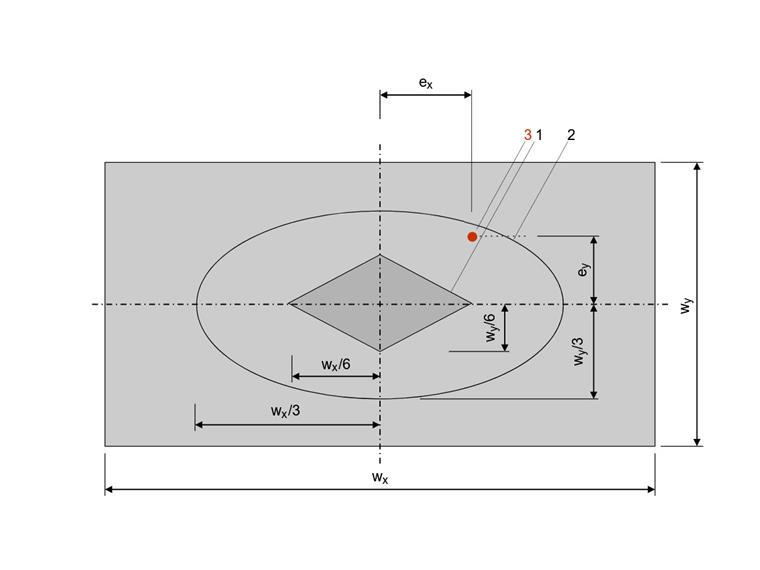
Mark 1 : The limitation of the 1st core width is represented by a rhombus.
Mark 2 : The limitation of the 2nd core width is represented by an ellipse.
Mark 3 : The application point of the resultant is the point at which the entire resulting load acts on the foundation base.
Permanent actions
For foundations on non-cohesive and cohesive soils, no gaping joint may occur in the foundation base due to characteristic permanent actions. This is ensured by the soil pressure resultant lying within the 1st core width. The 1st core width limits the permissible biaxial eccentricity within a rhombus-shaped area.
The condition to be checked is:
Derivation of the condition
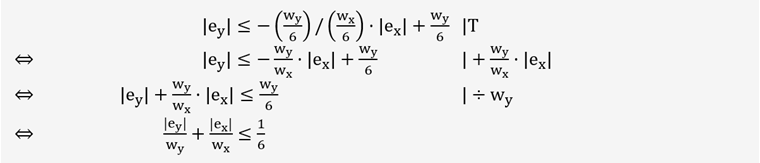
The condition is derived from the following inequality resulting from a linear equation:
The absolute values are necessary for this inequality to apply to all quadrants and to completely cover the rhombus-shaped limitation.
The individual steps of the derivation can be seen in the following illustration:
Most unfavorable combination of permanent and variable actions
The eccentricity of the soil pressure resultant under permanent and variable, characteristic actions may be at most so large that the foundation base remains under compression up to its center of gravity. This means that the 2nd core width must be maintained. It is limited by an ellipse.
The condition to be checked is:
Derivation of the condition
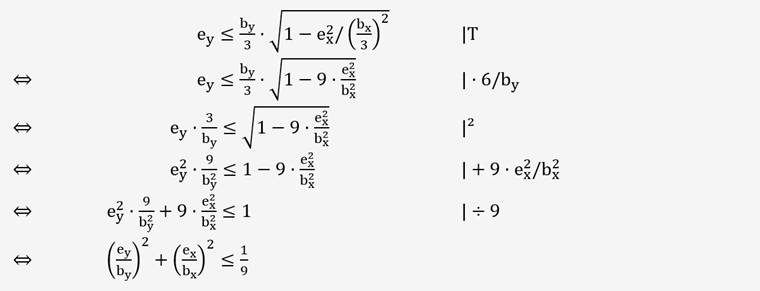
The condition is derived from the following inequality:
This is the ellipse equation with center (0|0) and the diameters 2 ⋅ wy / 3 and
2 ⋅wx / 3.
The individual steps of the derivation can be seen in the following illustration: