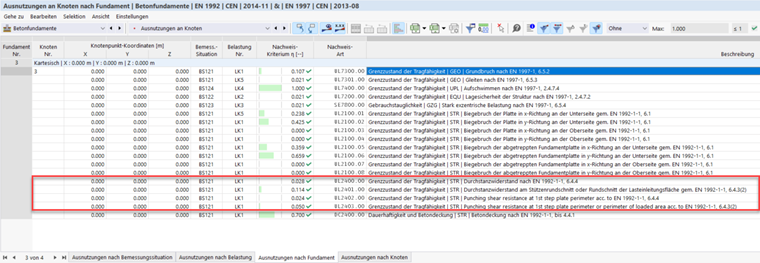
The category Punching manages the parameters relevant for punching shear design.
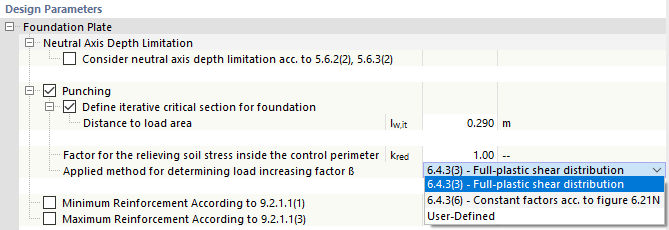
The basic control perimeter is determined by an iterative calculation. If you select the 'Define iterative control perimeter for foundation' check box, you can manually specify the distance to the loaded area lw,it.
kred is a factor for considering the relieving soil pressures within the punching cone. This factor determines what percentage of the soil pressure in the punching cone is included as relieving in the calculation of the resulting shear force. A value of kred = 1.00 means that the soil pressures within the punching cone are fully considered and thus have a maximum relieving effect. A value less than 1.00 reduces the considered soil pressure accordingly, which leads to a higher resulting shear force.
The parameter β can be determined according to various methods. Three options are available for selection in the list. The load increase factor can thus be determined assuming a fully plastic shear stress distribution according to EN 1992-1-1 [1] 6.4.3(3) or from constant factors according to 6.4.3(6). Additionally, there is the option to enter the value user-defined.
Stepped foundations | Punching shear design
For a stepped foundation, two separate punching shear designs are performed: one at the first step and one at the foundation slab.
Design on the foundation slab The first punching shear design concerns the foundation slab. The loaded area is the column cross-section. The basic control perimeter is therefore constructed at a defined distance from the column edge and only encloses the area immediately around the column.
Design on the first step The second design concerns the first step. The column initially transfers its load into the first step, before this transfers the load over an area to the foundation slab. The governing loaded area is therefore not the column cross-section, but the base area of the first step.