


A plate is a flat, planar component that only transfers forces in the direction of its plane. Thus, a plate structure represents a surface structure that mainly consists of plates.
Features
The characteristics of a plate lie in its shape and the possible forces to be transferred. The shape is planar, while mainly axial forces are transferred in the direction of the surface plane; shear forces and bending moments are not taken into account.
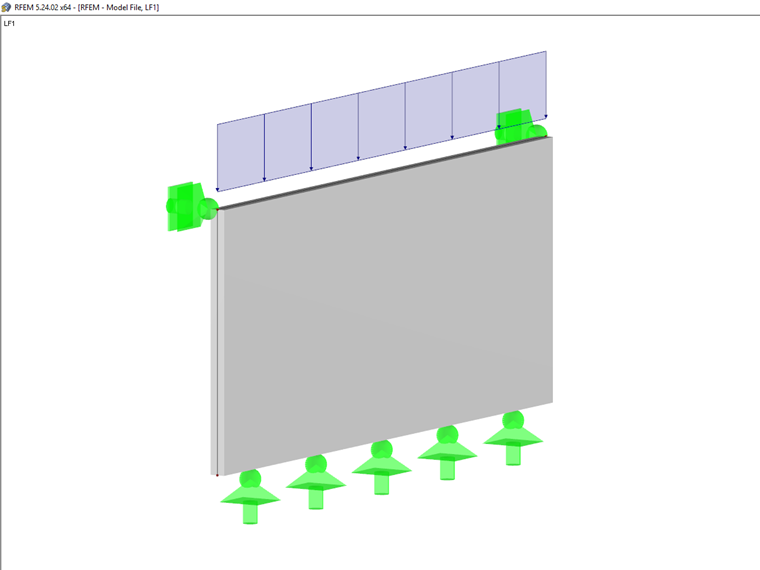
Examples include wall slabs, which transfer vertical and horizontal forces in their plane (Image 01), and ceiling slabs, with a corresponding transfer of horizontal forces in the ceiling plane.
Application
Plates are used in residential buildings and building structures in general, usually in the form of walls.
Wall slabs serve to transfer all vertical loads as axial forces into the ground; they also provide a horizontal stiffening of the overall structure. Therefore, most buildings are structurally designed in such a way that the shear walls provide stability of the structure against all horizontal loads, such as wind or earthquake.
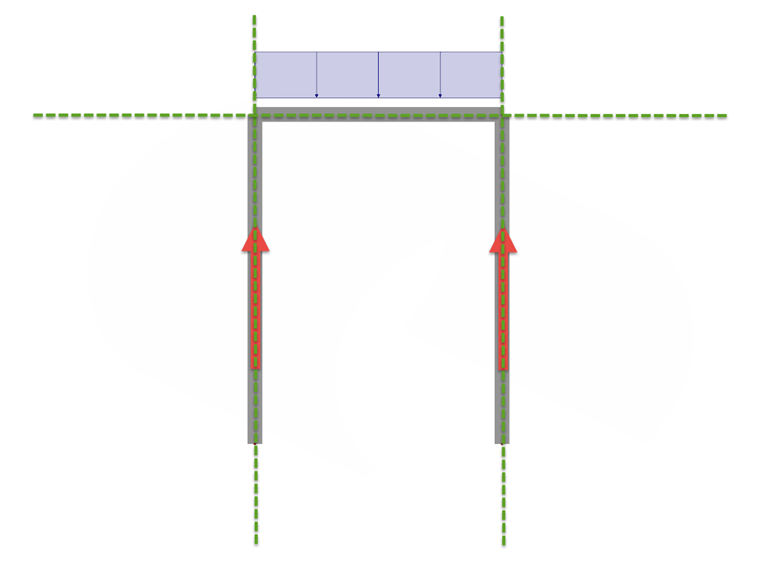
Since (wall) plates only absorb forces in their plane, the lines of action of all walls in the floor plan of the model must intersect in at least two points for the structure to be stable. A simple example is a garage consisting of three walls. The ground plan has a U shape. The lines of action of the wall slabs (the horizontal forces that can be absorbed by the walls) intersect at two points. Image 02 shows a horizontal loading in the direction of the two parallel walls. In this case, the system acts as a single-span beam, with the transverse wall not absorbing any forces in the other direction.
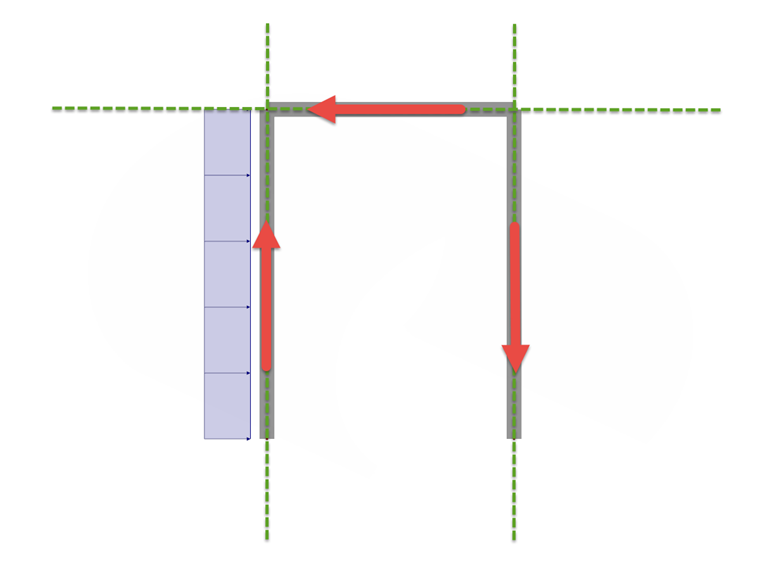
In Image 03, the external load acts in the direction of the single transverse wall, causing it to absorb the entire load. The resulting rotation of the structural system must be compensated by the other two walls.
Slabs act primarily as plates. However, a plate effect must also be planned here to transfer or couple the horizontal external loads.
Plates in RFEM and RSTAB
In RFEM, walls and ceiling slabs can be displayed as surfaces or, alternatively, modeled by using a rigid link.
The structural frame & truss analysis software RSTAB provides powerful tools to model plates.

 Knowledge Base