


Reinforcement Areas
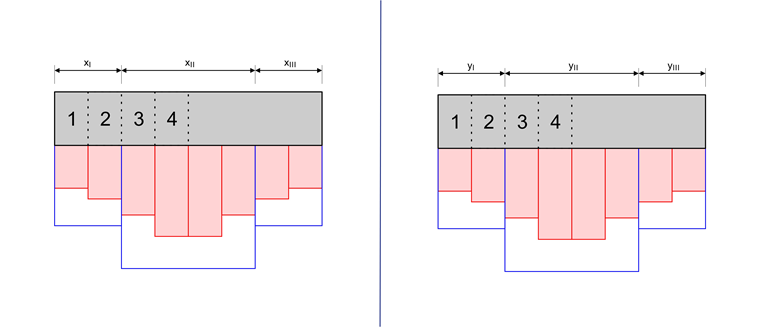
Three areas with different requirements for the required reinforcement section per meter are defined. They are called reinforcement areas. The middle reinforcement area, which is assigned a width of 50 percent of the foundation side length perpendicular to the reinforcement currently being considered in the program design, is designated “II” (Roman numeral two). The remaining two reinforcement areas are the so-called edge reinforcement areas. They are designated “I” and “III” and have a width of 25 percent of the respective foundation side length.
Design Strips
The foundation is divided into eight strips for each direction. The required steel cross-section per meter of each individual strip is shown below the plate. Each of these strips receives a different component of the design moment for which the design is carried out. The size of the components is determined using the distribution numbers α1-4 according to the guideline Heft 240, DAfStb [1], Table 2.9 for plate strips No. 1 through 4.
The required steel cross-section for the individual reinforcement areas is now determined. For the middle reinforcement area, this is always the required steel cross-section of the fourth plate strip. The largest steel cross-section to be covered for the edge strips depends on their width.
There is only one reinforcement area for the upper plate reinforcement. Curtailment would not make sense here, because the required steel cross-section is the same in all plate strips.
Distribution Numbers
The distribution numbers are obtained using the following quotients Q:
|
cx |
Column width in the x-direction |
|
cy |
Column width in the y-direction |
|
wx |
Foundation width in the x-direction |
|
wy |
Foundation width in the y-direction |
|
atx |
Top column allowance in the x-direction |
|
ttx |
Upper bucket wall thickness in the x-direction |
|
aty |
Top column allowance in the x-direction |
|
tty |
Top bucket wall thickness in the y-direction |
|
wx |
Foundation width in the x-direction |
|
wy |
Foundation width in the y-direction |
These quotients can be used to determine the distribution factor for the respective strip in accordance with the following table according to DAfStb [1]:
| Q = 0.1 | Q = 0.2 | Q = 0.3 | |
|---|---|---|---|
| α1 | 0.07 | 0.08 | 0.09 |
| α2 | 0.10 | 0.10 | 0.11 |
| α3 | 0.14 | 0.14 | 0.14 |
| α4 | 0.19 | 0.18 | 0.16 |
| Sum | 0.50 | 0.50 | 0.50 |
If the calculated quotient is less than 0.1, the values of α are determined from the column for a quotient of 0.1. If the calculated quotient is greater than 0.3, the foundation is compact, meaning that a staggered distribution of the design moment is not necessary. The distribution factor α is then the same for all strips and amounts to 0.125. If the calculated quotient lies between the values of two columns, linear interpolation is used.
The component design moment for a plate strip is then the design moment Mbelow (see the chapter Determination of Design Moments )) multiplied by α.