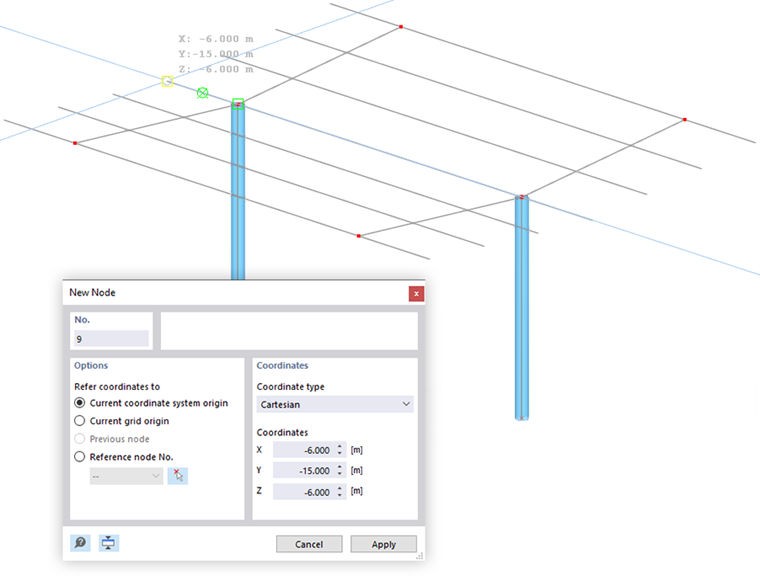
You can use a DXF file as a background layer for entering objects. Compared to the DXF import, where the entire model is converted into nodes and lines and then imported, background layers represent a kind of transparent sheet for specific modeling.
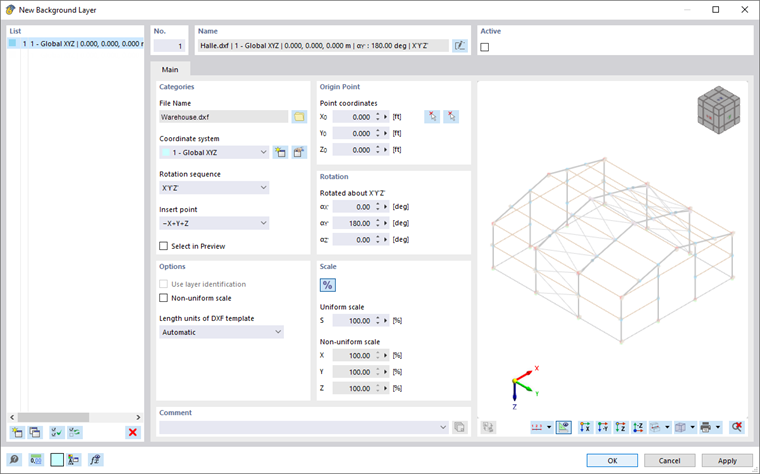
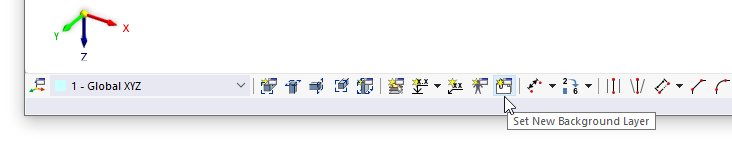
You can also define a new background layer using the
 button available in the CAD toolbar.
To use a background layer, set it to Active. Furthermore, the object snap with the "Background Layers" option need to be activated (see the chapter Object Snaps). You can also do it by quick control using the
 button in the
CAD Toolbar
.
button in the
CAD Toolbar
.
Categories
The background layer has to be in .dxf format. Set the "File Name" by selecting the file in the Windows dialog box using the
 button.
Define the coordinate system to which the background layer refers. You can select a user-defined coordinate system from the list or create a new one using the
 button.
The "Rotation sequence" describes the order of angles by which a rotation of axes can be performed.
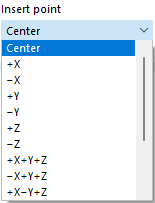
The "Insert point" determines the location that is placed on the "envelope" of the background layer at the Origin Point. Various options are available for selection in the list:
If you tick the "Select in Preview" check box, you can define the insert point graphically: In the "Origin Point" section, click the right
 button, and then define the insert point in the preview window.
Origin Point
The insert point of the background layer is placed in the model at the "Origin Point". Enter the coordinates of the point, or define it graphically using the
button on the left in the work window, or using the
button on the right in the preview area.
Options
If you want to use a "Non-uniform scale" for scaling the layer in the spatial directions, activate the check box. Thus, the corresponding input fields in the "Scale" section become accessible.
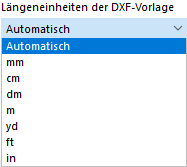
If the "Length units of DXF template" are not to be automatically adopted from the DXF file, you can select the appropriate unit from the list.
Scale
In this dialog box section, you can scale the size of the background layer; for example, to compensate for inconsistencies in units. The normal case is a "Uniform scale" Δ with regular scaling in all directions. For a non-uniform scale, activate the corresponding check box in the "Options" section of the dialog box.
Use the
 button to switch between relative and absolute inputs.
Using Background Layer
If the background layer is set as Active, it is highlighted in gray. Now, you can place nodes and members at the intersection points of layer lines, provided that the object snap for background layers is activated.