


The Connect Skewed Members function in the Tools → Modify Members menu allow you to create connections between members that are spatially separated. You can also use the
 or
or
 button in the CAD toolbar (see the image Modeling Tools). This allows you to link objects in the structural model that have no geometric connection after the import of a CAD file (for example, rafters on the purlins of a roof truss). The location of the objects then does not need to be adjusted.
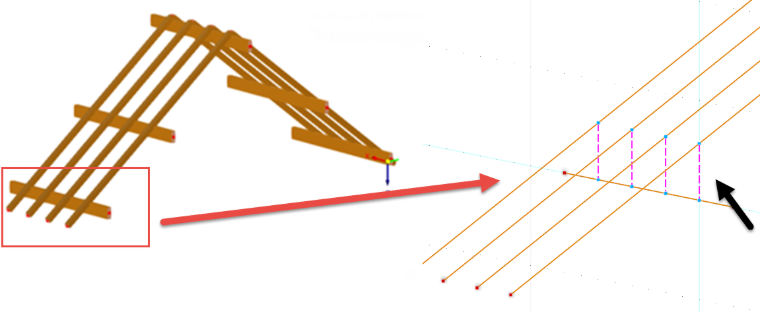
You do not need to select the members before activating the function.
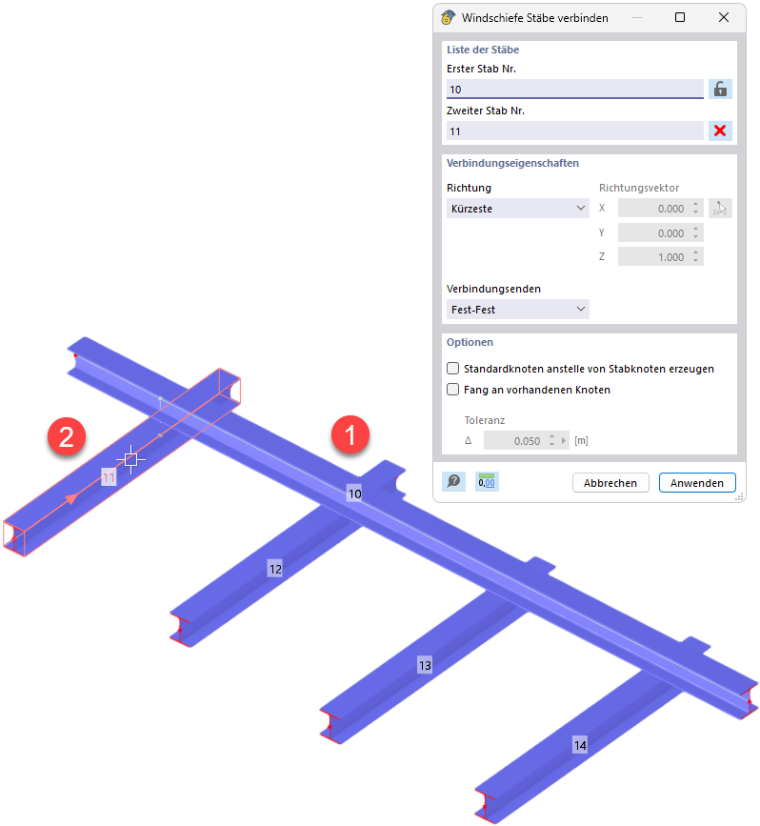
Select the members successively in the work window by clicking them with the mouse. You can also enter the object numbers. When you move the mouse pointer over the second member, you will see the coupling in the preview. Clicking the member creates the coupling.
Connecting Multiple Objects
If you want to connect multiple members to a member, select the first object and then click the
 button: The object will be locked. You can now click successively on all the lines or members that you want to connect to the object. In the image Connecting Skew Members, these would be Members 11 through 14, each of which can be connected to the member above it (Member 10) using couplings.
Connection Properties
Select from the list the direction in which the coupling should be established:
- Shortest: The program creates a perpendicular line between the centers of the two members.
- Parallel to global X/Y/Z: The coupling is made in the direction of an axis of the XYZ coordinate system.
- User-defined: Specify the direction vector or define it graphically using the
 button.
Using the options in the Connection Ends list, you can control how the members are connected:
- Fixed-Fixed
- Fixed-Hinged
- Hinged-Hinged
Options
When creating couplings on the original objects, nodes of the Node on Member type are created by default, so that the members remain undivided. If you want the original objects to be split, activate the Create standard nodes instead of member nodes check box.
The Snap to existing nodes option allows for the coupling to be placed on nodes that already exist on the members.