EN 1998
Ductile reinforced concrete walls are a key structural element in seismic design, as they significantly contribute to the absorption of horizontal forces and energy dissipation. Their structural behavior in the event of an earthquake is significantly influenced by nonlinear dynamic effects, overstrength, and the formation of plastic zones.
Eurocode 8 accounts for these uncertainties by requiring the determination of internal forces based on envelopes and the application of magnification factors, especially for shear forces, for the design.
Standard Principles and Structural Behavior
Determination of Design Bending Moments
The nonlinear behavior of an uncoupled reinforced concrete wall is determined by a single plastic hinge at the base. It is necessary to design this wall section for the bending moment resulting from the analysis of the seismic design situation.
To avoid elongation above the plastic hinge at the base, EC 8 [1] requires the design bending moment diagram based on an envelope derived from the bending moment diagram obtained from the analysis and shifted vertically. This procedure is referred to as tension shift (TS) and is displayed in the following image.
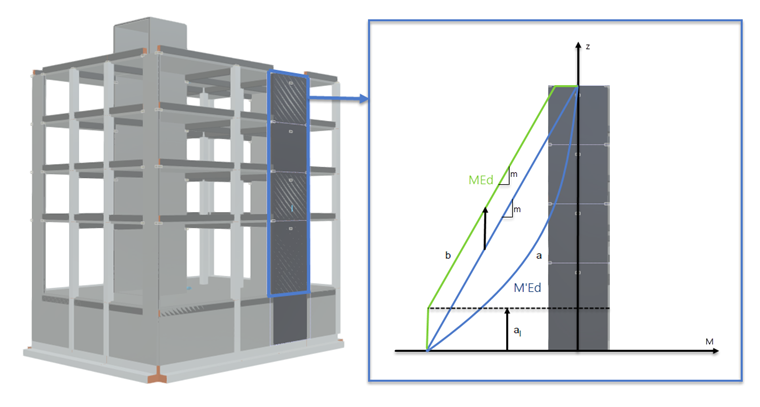
According to EC 8 [1], the envelope may be assumed to be linear, provided that the structure does not have any significant discontinuities in mass, stiffness, or load-bearing capacity over its height. The tension shift (al) should correspond to the member inclination (θ) assumed for the ultimate limit state design (ULS) according to EC 2 [2]. The offset measure is determined as follows (EC 2 [2], (9.2)).
Determination of Design Shear Forces
The bending moment value at the wall base and the isolated cantilever consideration are not sufficient to reliably determine the maximum seismic shear forces at different wall heights. This limitation results from the dynamic nature of the forces transmitted to the wall by the stories, which fluctuate in the event of an earthquake [4].
- To solve this problem, the following basic assumption is made:
If the capacity moment MRd exceeds the bending moment at the wall base, based on the elastic analysis for the design seismic load MEd, then the seismic shear forces at any wall height exceed those calculated from the same elastic analysis in proportion to the ratio MRd/
- MEd.
- This results in the following measure:
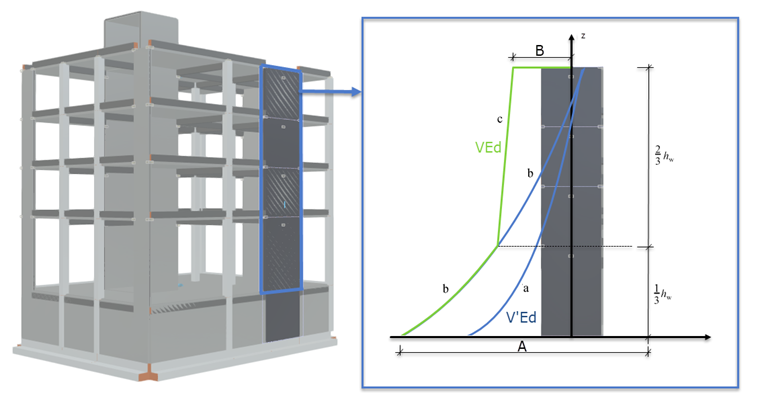
The shear forces (V'Ed) derived from the design seismic analysis are adjusted using a capacity design magnification factor (ε). This factor depends directly on the ratio MRd/M'Ed and scales the shear force accordingly, as proposed by Fardis et al. [3].
In addition, EC 8 [1] requires that the potential increase in shear forces at the base of a primary seismic wall in structures of medium ductility class (DCM) must also be taken into account. The design shear forces (V Ed) are set 50% higher than the shear forces (V'Ed) obtained from the analysis, as displayed in the following equation. For this specific ductility class, a reinforcement factor ε = 1.5 is therefore assumed.
The magnification factor can be described by the following formula (EC 8 [1], (5.25) and 5.4.2.4(7)).
|
q |
Behavior factor used in design |
|
MEd |
Design bending moment at the wall base |
|
MRd |
Design capacity moment (absorbable) moment at the wall base |
|
|
Overstrength factor; if no more precise information is available, |
|
T1 |
Basic period of vibration of the building in the direction of the transverse forces VEd |
|
TC |
Basic period of the constant spectral acceleration range of the spectrum (EC8, 3.2.2) |
|
Se(T) |
Ordinate of the elastic response spectrum (EC 8, 3.2.2) |
The following image illustrates the initially calculated shear force distribution (a), the distribution increased by the magnification factor (b), and the enveloping design shear force distribution (c).