In EN 1992-1-1, Section 6.1, or DIN 1045-1, Section 10.2, the design principles for the ultimate limit state design are presented. These regulations apply to bending with or without an axial force and to the axial force alone.
The calculated limit of failure occurs when the limit strains are reached. Depending on where these limit strains occur, the failure can be triggered by the concrete or the reinforcing steel.
The following image illustrates the allowable strain distributions under bending with and without longitudinal force according to EN 1992-1-1, Section 6.1.
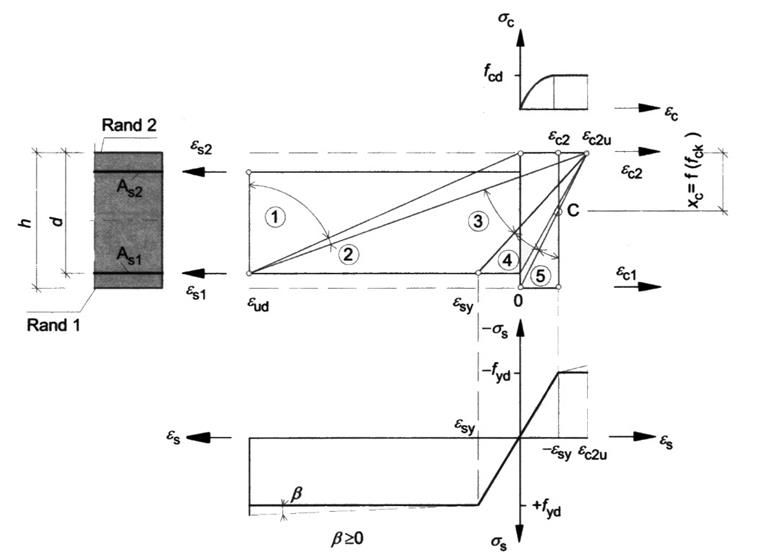
The areas of strain distribution shown in the image have the following meanings according to [1]:
Area 1
This area occurs with a central tensile force or with a tensile force with slight eccentricity. Only strains occur across the entire cross-section. The statically effective cross-section consists only of the two reinforcement layers As1 and As2. The reinforcement fails because the limit strain εud is reached.
Area 2
Area 2 occurs under pure bending and under bending with longitudinal force (compression and tensile force). The neutral axis line lies within the cross-section. The flexural reinforcement is fully utilized, that is, the steel fails as the strain limit is reached. The concrete cross-section is usually not fully utilized: The strains do not reach the limit strain εc2u.
Area 3
This area only occurs under pure bending and under bending with longitudinal force (compression). The load-bearing capacity of the steel is greater than that of the concrete. The concrete fails, because its limit strain εc2u is reached.
As in Area 1 and Area 2, the failure of the concrete is indicated by cracks, because the steel exceeds its yield strength (failure with prior warning).
Area 4
Area 4 occurs under bending with a longitudinal compressive force. It represents the transition from a cross-section subjected primarily to bending to a cross-section subjected to compression.
The concrete fails before reaching the yield strength in the steel, as the possible strains are very small. This area results in a heavily reinforced cross-section. It is therefore avoided by inserting compression reinforcement.
Small steel strains in the tension zone lead to failure without prior warning (the flexural reinforcement does not yield).
Area 5
This area occurs in the case of a compressive force with a small eccentricity (for example, column) or in the case of a centric compressive force. Only strain occurs across the entire cross-section.
The strain at the less compressed edge is between 0 > εc1 > εc2. All strain distributions intersect at Point C.