


Introduction
Reinforced concrete is a heterogeneous composite material. Its behavior is mainly influenced by the following four components.
- Nonlinear σ-ε relation
- Compressive failure
- Crack development under tension
- Strength increase for constricted concrete
Concrete in Compression Area
Material Behavior
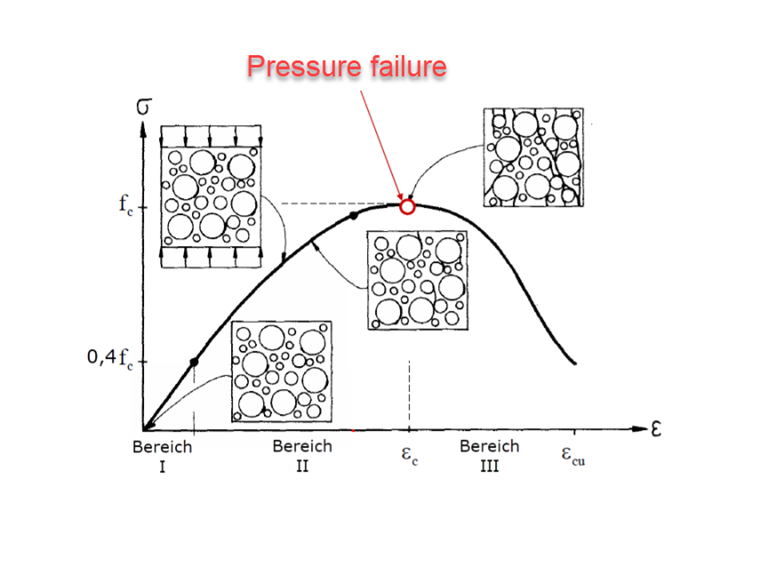
Under short-term uniaxial compressive stress, concrete shows the stress-strain behavior displayed in the following image. This can be roughly divided into three ranges.
Range I
In the range up to approximately σc ≤ 0.4·fc, concrete shows almost linear elastic behavior.
Range II
As the load increases, microcracks form, leading to a decrease in stiffness and a disproportionate increase in strain until the compressive strength fc is reached.
Both the decrease in stiffness and the achievable strength are highly dependent on the rate of loading. The fatigue strength is reduced compared to the short-term strength.
Range III
In deformation-controlled tests, the stresses in the subsequent range decrease with increasing strain as the concrete structure progressively deteriorates. The curve in the descending range is the result of local damage or loosening of the concrete body.
In load-controlled tests, the third range would not show; instead, brittle fracture failure would occur.
Material Model
To describe the material behavior in the compression area under uniaxial loading, the following function was incorporated in EN 1992-1-1 in accordance with (3.14).
|
η |
=εc/εc1 |
|
εc1 |
Compressive strain for maximum value of concrete compressive stress |
|
k |
1.05 |
The resulting curve shape is shown schematically in the following image.
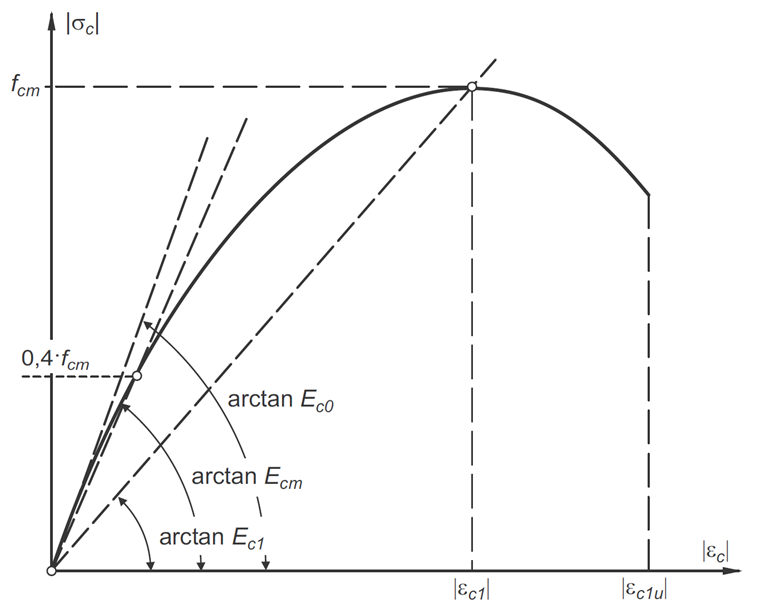
According to EC 2, 3.1.5(2), other idealized stress-strain diagrams may be used if they adequately reflect the behavior of the concrete under analysis.
Assumptions for SLS
The stress-strain diagram according to EC 2, (3.14) for concrete is calculated for the serviceability limit state design using the average strengths of the materials.
Assumptions for ULS
The stress-strain diagram according to EC 2, (3.14) for concrete may be used for the ultimate limit state design. In the equation and in the k-value, fcm is replaced by the design value of the concrete compressive strength fcd and Ecm is replaced by Ecd = Ecm / γCE (5.20).