


Specify in the Navigator which stresses are to be displayed on the surfaces. The table lists the stresses of each surface according to the specifications set in the Result Table Manager .
.png)
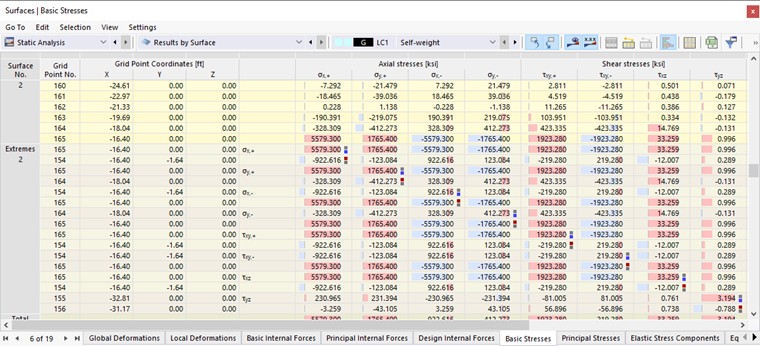
The surface stresses are divided into the following categories:
- Basic stresses: Stresses in the direction of the surface axes
- Principal stresses: Stresses in the direction of the principal axes
- Equivalent stresses: Stresses according to different equivalent stress hypotheses
Basic Stresses
The basic stresses refer to the directions of the local surface axes. For curved surfaces, they refer to the local axes of the individual finite elements (see image Displaying FE Axis Systems ).
The basic stresses are shown in the image Surface Internal Forces and Surface Stresses . They have the following meanings:
Principal Stresses
While the basic stresses refer to the xyz-coordinate system of a surface, the principal stresses represent the extreme values of the stresses in a surface element. The principal axes 1 (maximum value) and 2 (minimum value) are arranged orthogonally. You can display the principal axis directions α graphically as trajectories (compare image Displaying Trajectories of Principal Axes ).
The principal stresses are determined from the basic stresses as follows:
Other Stresses / Elastic Stress Components
This category contains the stress components due to the bending moments and membrane forces. They refer to the directions of the local surface axes. For curved surfaces, they refer to the axes of the finite elements.
The bending and membrane stresses have the following meanings:
Equivalent Stresses
The basic stresses are combined according to four [https://en.wikipedia.org/wiki/Yield_(engineering) equivalent stress hypotheses] for the plane-stress state.
Von Mises
The hypothesis according to von Mises is also known as the "distortion energy hypothesis". It is based on the assumption that the material fails when the distortion energy exceeds a certain limit. The distortion energy represents the energy that causes a distortion or deformation of the body. This approach represents the best-known and most frequently used equivalent stress hypothesis. It is suitable for all materials that are not brittle. Therefore, an important field of application is steel construction. The hypothesis according to von Mises is not suitable for hydrostatic stress states with equal principal stresses in all directions, since the equivalent stress is zero in this case.
The equivalent stresses according to von Mises for the plane-stress state have the following meanings:
Tresca
The hypothesis according to Tresca is also known as the "shear stress hypothesis". It is assumed that failure is caused by the maximum shear stress. As this hypothesis is suitable for brittle materials, it is often used in mechanical engineering.
The equivalent stresses according to Tresca are determined as follows:
Rankine
The equivalent stress hypothesis according to Rankine is also known as the "normal stress hypothesis". It is assumed that the largest principal stress leads to failure.
The equivalent stresses according to Rankine are determined as follows:
Bach
The equivalent stress hypothesis according to Bach is also known as the "principal strain hypothesis". It is assumed that failure occurs in the direction of the greatest strain. This approach is similar to the stress determination according to Rankine. However, instead of the principal stress, the principal strain is used here.
The equivalent stresses according to Bach are determined as follows: